Take a made up example: $420 for Christmas gifts and 14 names on the list. Split evenly, that’s $30 a person, and not one roll of tape or book of stamps is paid for yet.
Real lists don’t split evenly, so they get priced one name at a time. Spending less can feel unkind, while spending more turns into January’s problem. Neither feeling measures how much you love anyone.
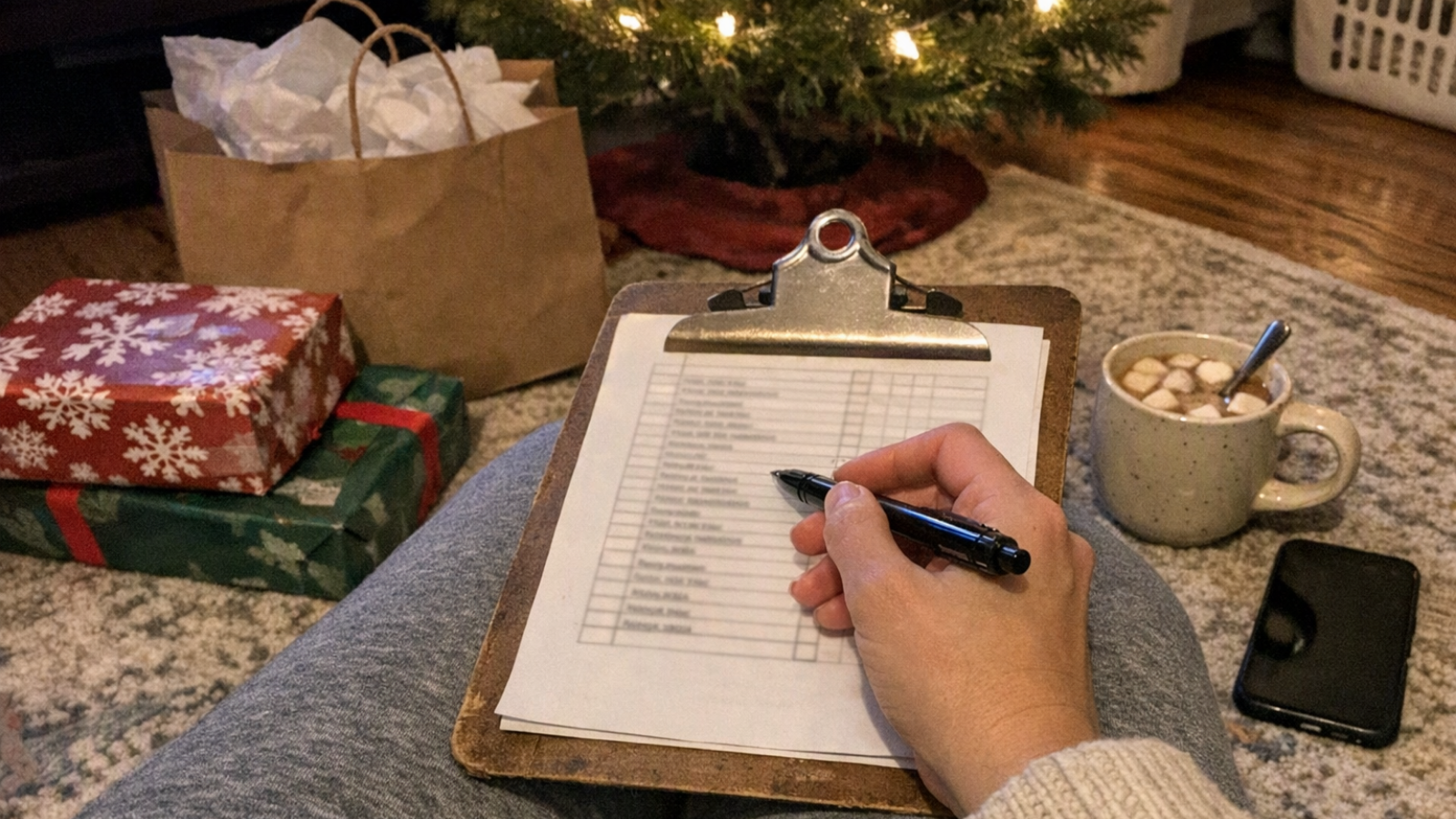
The fix isn’t caring less. It’s working from the top down: one gift total, a few simple tiers and a Spent column you fill in as you go, all on one free printable.
Pick Your Gift Total First, Then Fit the Names Inside It

Someone in the family group chat asks what everyone’s doing for gifts this year, and you start counting names in your head before you’ve even answered.
Before the names, settle one number: your gift total. It’s the most you’ll spend on every gift this Christmas, all added together.
Going name by name feels reasonable each time. A little here and a little there each look small, so the real total only shows up at the register or on the statement.
That doesn’t mean your number has to be tiny. It means you pick it on purpose, instead of finding it out in January.
There’s no right amount to spend on Christmas gifts, and nobody else’s number knows your rent. So here’s a method instead of a rule:
- Start with the money. Count what’s already set aside for Christmas, like a sinking fund or a cash envelope, plus what you’ll save from the paydays before you shop.
- Pay the bills first. Rent, utilities, groceries and minimum card payments come out before any gift money does.
- Keep the rest of Christmas in view. Food, travel and decorations need money too. Christmas on a budget shows how to split one Christmas number into six buckets, and its Gifts bucket is your gift total.
If you still need to save the money, the Christmas savings challenge has free charts that build $210 to $550 before Christmas.
One honest check: if the total only works with a card covering part of it, it isn’t your total yet. Lower it until saved money can pay all of it.
The free gift list puts a Gift budget line at the very top of the page for exactly this reason.
That one number is your answer to how much to spend. Everything after this just divides it.
Put Every Name on the List Before Anyone Gets a Number
It’s mid December when you remember the bus driver. Then the swim coach. Then the cousin who’s coming to dinner this year after all.
Names that show up late are the ones that stretch a budget, because by then the money has already been handed out.
So a Christmas shopping list that keeps the budget starts with every name, and no numbers yet. The back of an envelope works fine for a first pass.
These are the names that often get missed:
- Teachers, classroom aides and coaches
- The office swap or a Secret Santa draw
- A host gift for the home where you’ll spend Christmas Day
- Neighbors, and the friend who drops off cookies every year
- Someone new this year, like a baby or a new partner in the family
Writing a name down isn’t a promise to buy something big. Some names will end up with a card and a batch of cookies, and that’s a real gift.
If the adult side of the list runs long, a name draw can shrink it. Each adult buys for one name instead of everyone.
A long list with small numbers is calmer than a short list that keeps growing.
Give Stocking Stuffers and Other Extras Their Own Lines
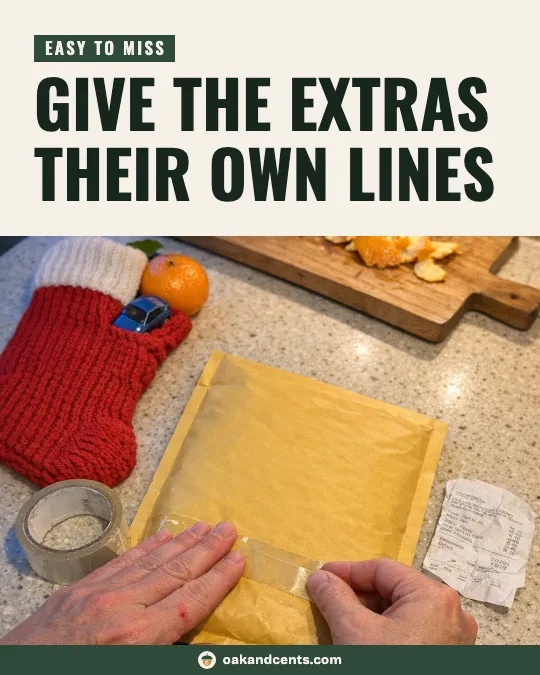
It’s the night before Christmas Eve, and the tape runs out halfway through the last box. Earlier that week, mailing a gift to your aunt cost more than you expected.
Each extra is small, so none of them feels like spending. Together, they can take a real bite out of the gift money.
That’s why extras come off the top, before any name gets a number.
They hide because they’re bought in passing: at the register, at the post office, with the groceries. They rarely get written down anywhere.
Here are 5 extras to give a line of their own:
- Stocking stuffers, with one amount for each stocking
- Wrapping paper, tape, gift bags and tags
- Postage and boxes for anything you mail
- Batteries for toys and gadgets
- School extras, like a class party or a group gift for the teacher
Stockings fill up fast with small things grabbed one at a time. Pick an amount for each stocking and keep everything for it in one bag in the closet.
When the amount is spent, the stocking is done, even if it looks a little roomy.
Note: If you already use the six buckets from Christmas on a budget, wrapping and postage have a bucket of their own. Leave them off the gift list so they aren’t counted twice.
On the free gift list, the last few rows work well for extras.
Small costs need a line too. Otherwise they quietly borrow from the gifts.
Sort the Names Into Tiers Instead of Pricing Each One
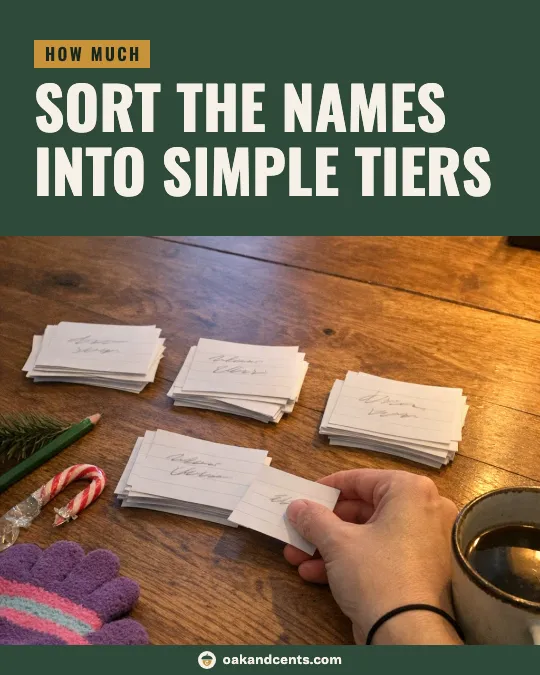
Pricing names one by one can turn into a long talk with yourself. If your brother gets one amount, does your sister need the same? What about her kids?
Tiers settle that once. A tier is just a group of names that all get the same amount.
That doesn’t mean ranking the people you love. It means deciding four amounts instead of fourteen.
Here’s how to set them up:
- Make 3 or 4 tiers, like closest, family, friends and small thanks.
- Put each name in one tier.
- Give each tier one amount per person.
- Multiply, add the extras and compare the sum with your gift total.
If the sum comes out higher, lower one tier a little, move a name down a tier or make one tier homemade. Repeat until the two numbers match.
Here’s the $420 example sorted into tiers. Every number is made up, just to show the math.
| Tier | Who’s in it (example) | Each | Total |
|---|---|---|---|
| Closest | 2 kids and a partner | $60 | $180 |
| Family | 2 parents, a sister and a brother | $20 | $80 |
| Friends | A best friend, the office swap and a cousin from the name draw | $15 | $45 |
| Small thanks | 2 teachers, a coach and a neighbor | $10 | $40 |
| Extras | 2 stockings at $20, wrapping $15, postage $20 | $75 | |
| Total | 14 names plus extras | $420 |
Notice what changed from the even $30 split. The kids get more, the small thanks get less and the extras finally have a home.
Watch the tiers with the most names. In the example, $5 more for each Family name adds $20 to the total, not $5.
A tier isn’t a measure of love. It’s what this year’s money can do, and next year’s list can look different.
Decide once per tier, and you won’t have to decide again at every shelf.
Fill In the Spent Column the Day You Buy
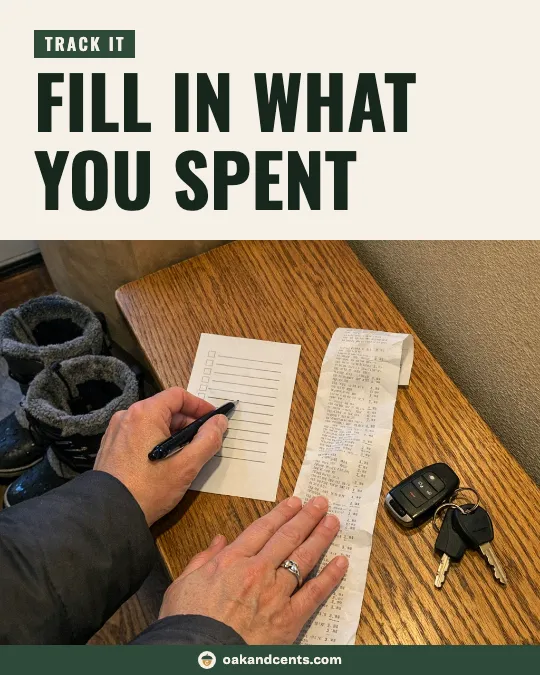
The receipt goes in the bag, the bag goes in the closet, and by mid December nobody remembers what anything cost.
Your list only protects the budget if it shows what you really spent, not just what you planned.
So when you get home, write the price in the Spent column and tick Bought. Tick Wrapped later, once it’s ready to go under the tree.
You don’t need to add everything up every night. Every few purchases, total the Budget and Spent columns for the rows you’ve ticked.
Here’s how that looks with made up numbers. The first four gifts had budgets of $60, $60, $60 and $20, which comes to $200.
You spent $56, $61, $58 and $18, which comes to $193. You’re $7 under so far, and that $7 is a small cushion for later.
If two of you shop, keep one list, on the fridge or in a shared note. Two separate lists are how a gift gets bought twice.
Say this: “Before either of us buys anything, can we agree on one gift total and keep every name on the same list?”
Keep the receipts together in one envelope until after Christmas, in case something needs to go back.
A minute with a pen tonight saves a surprise on the January statement.
If One Gift Goes Over, Borrow From the List, Not a Card
You find the gift your sister would love, and it’s $9 more than her line on the list.
That moment can feel like the whole plan just fell apart. It hasn’t. Every list is built on guesses, and prices don’t always cooperate.
The fix lives in the rows you haven’t bought yet, so look there first. In order:
- Use what you’re under. In the example, the $7 cushion covers most of it, and $2 from the stocking line covers the rest.
- Lower a tier a little. Taking $2 from each of the 4 Small thanks names frees $8.
- Make one gift homemade. The low cost Christmas gifts list has ideas that still feel thoughtful.
- Pick a different gift. Sometimes the second idea is the one that fits.
What doesn’t belong on that list is a credit card, a store card or buy now, pay later. Those move the extra to January instead of fixing it. Buy now, pay later is still borrowing, just in smaller pieces.
If your Spent total has already passed the gift total, the same fix works on a bigger scale. Go through the rows you haven’t bought and lower them until the two totals meet.
Your plan in one line: one gift total, a few tiers, a number by every name and Spent filled in the day you buy.
One row over is a small fix. Putting it on a card turns it into a bigger one.
If Your Gift Total Comes Out Smaller Than You Hoped
Some years the math leaves very little for gifts. If that’s where you are this year, it’s okay. The list just starts smaller.
This method fits best when some money comes in after the bills, even a little.
Hold off on gifts, or keep them very small, if rent, utilities or a card payment is past due, or if a debt has gone to collections. The same goes if a card is already paying for groceries.
Small can still feel warm.
The free list has a box of low cost ideas, like baked treats, a framed photo or a family recipe card. A coupon for time together, a favorite snack box or a handwritten letter works too.
If bills are already piling up, a nonprofit credit counselor can help you decide what gets paid first. The National Foundation for Credit Counseling lists member agencies across the country.
A short list that’s fully paid for is still a generous Christmas.
Start Tonight With One Number at the Top of the Page
The made up $420 list from the start fit on one page once it had tiers and extras. Yours can too.
Tonight, print the free Christmas gift list. Write the year and your gift total at the top, then every name you can think of. Leave the numbers for tomorrow.
If you’re paying down a card this season too, the free debt tracker keeps that progress in view while you shop.
One number at the top, every name below it. That’s the whole first step.