Saving for Christmas usually means waiting to see what’s left in December. It sounds sensible. But by mid December, the cookie exchange, the teacher gifts and the drive to see family have often found that money first.
It’s a real tug of war. You want the season to feel generous, and you don’t want January’s card statement to undo this year’s progress. Feeling both just means you care about both.
The fix isn’t a bigger December. It’s a little money every week, a bit more each time, on a chart you color in. Here are three free ones, for $210, $275 and $550, and a calm way to pick yours.
Three Charts, Three Sizes, One Simple Rule
Each week asks for a little more than the week before. That’s the whole rule.
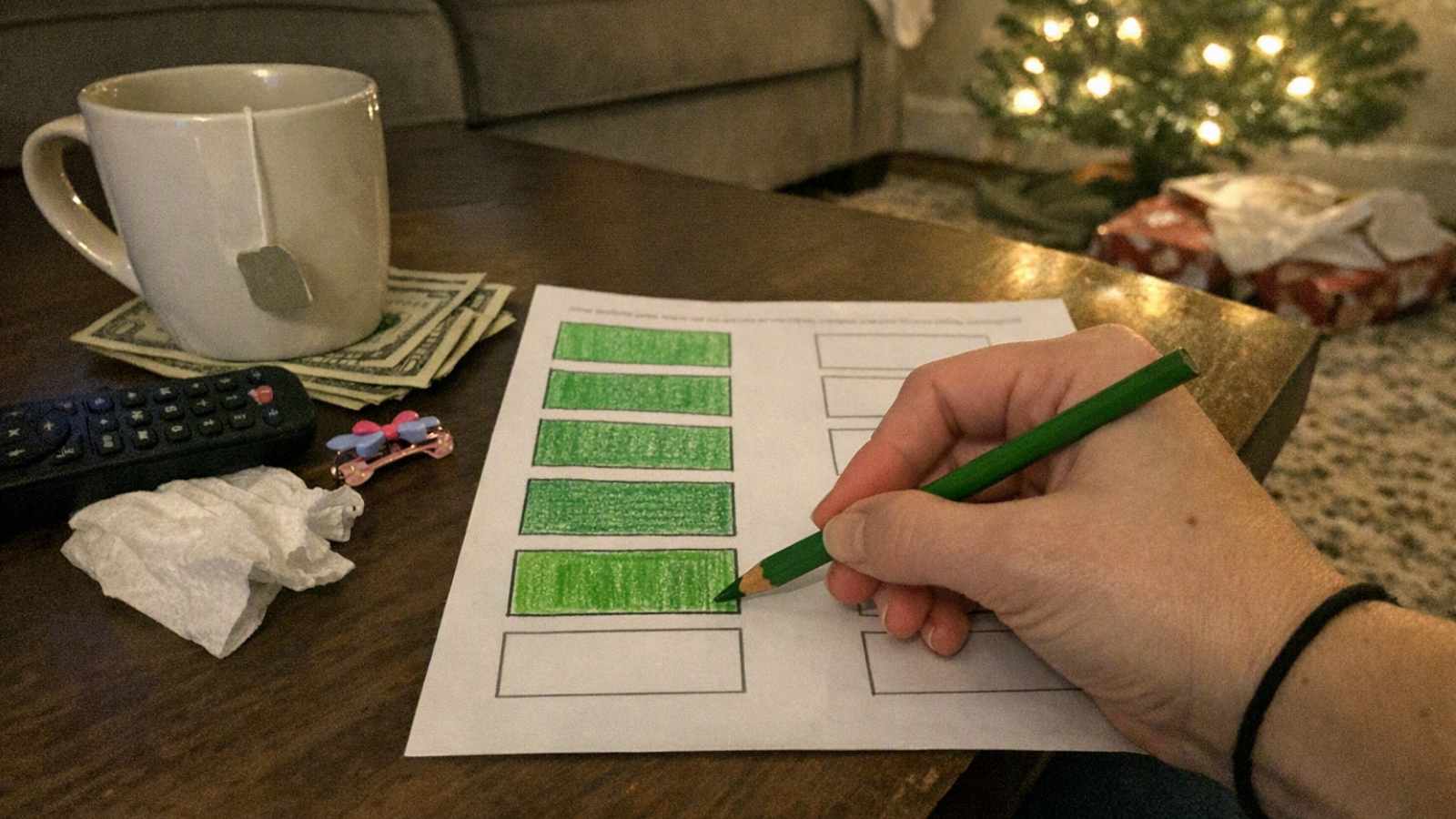
A Christmas savings challenge is a one page chart with a box for every week until Christmas. You save that week’s amount, write the date and color the box.
The small number in each box is your total so far, so you always know where you stand.
You don’t need a binder, an app or a jar full of coins. One printed page and a pencil cover it.
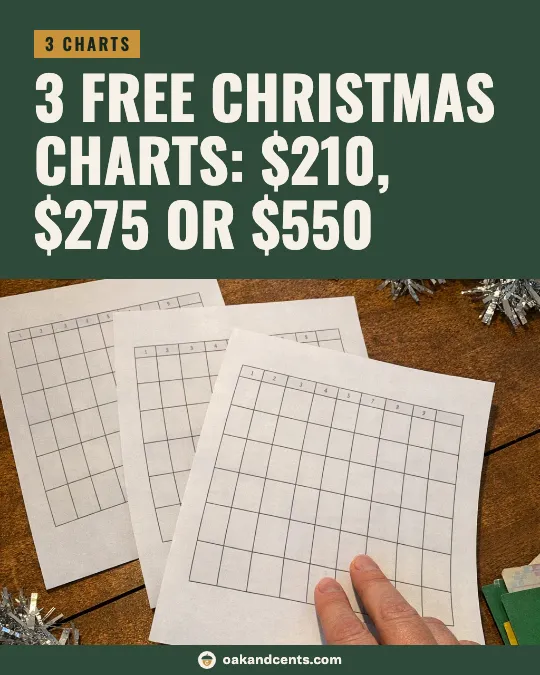
Here are the three free charts, side by side:
| Chart | Weeks | Smallest to biggest week | Total | Start by |
|---|---|---|---|---|
| Christmas Savings Challenge | 10 | $5 to $50 | $275 | Mid October |
| Christmas Savings Challenge (double) | 10 | $10 to $100 | $550 | Mid October |
| 6 Week Christmas Challenge | 6 | $10 to $60 | $210 | Early November |
The first chart grows by $5 a week. The other two grow by $10 a week. So week 1 always feels easy, and the biggest box always comes last.
That last stretch is the part to watch. On the $275 chart, weeks 8, 9 and 10 add up to $135, almost half the total, and they arrive just as December gets busy.
A plan on paper is one less thing to carry around in your head.
Choose by the Biggest Week, Not the Total

The total is what catches your eye. The biggest week is what decides if you finish.
Here’s why. Start in mid October, and week 10 lands in mid December, right when the extra costs of the season tend to pile up.
That doesn’t mean picking the smallest chart out of worry. It means checking one number before week 1.
Look at the last box on each chart: $50, $100 or $60. Then ask one question. After rent, bills, groceries and minimum payments, could you set that amount aside in the middle of December?
If $50 feels doable, the $275 chart fits. If $100 does, the $550 chart could work. If it doesn’t, the $550 chart itself points you back to the $275 one, which halves every amount.
Then count the weeks left before you want to shop:
- 10 weeks or more: either 10 week chart fits.
- 6 to 9 weeks: the 6 week chart, with a spare week or two for a slow one.
- Fewer than 6 weeks: start the 6 week chart anyway. Its first four boxes add up to $100.
Try this: Circle the biggest box on each chart, then look at your December calendar. Pick the chart whose biggest box still lets you breathe that week.
A chart you finish will do more for December than a bigger one you stop at week 8.
Paid Every Two Weeks? Save Two Boxes Each Payday
The charts count in weeks. Your paycheck might not.
When pay lands every other Friday, saving every single week can feel like one more thing to remember. Pairing the boxes fixes that.
That doesn’t mean changing the chart. You just color two boxes on each payday.
Here’s the $275 chart in payday pairs:
- Payday 1: weeks 1 and 2, $15
- Payday 2: weeks 3 and 4, $35
- Payday 3: weeks 5 and 6, $55
- Payday 4: weeks 7 and 8, $75
- Payday 5: weeks 9 and 10, $95
Together, that’s $275 over five paydays. On the $550 chart, the pairs are $30, $70, $110, $150 and $190. On the 6 week chart, they’re $30, $70 and $110.
Paid weekly? One box per payday. Paid once a month? Add up the boxes between this payday and the next, and move that amount in one go.
Pay that comes from tips or shifts can fill a box whenever a good week lands.
If you’d rather save the same amount every payday all year, the biweekly savings challenge works that way.
The chart doesn’t mind which day the money moves. It only asks that each box gets filled.
Give the Christmas Money a Home of Its Own

Where the money sits matters almost as much as how much you save.
Money left in checking blends in with everything else. By December, the Christmas money and the gas money look exactly the same, and one ordinary Tuesday can spend both.
That doesn’t mean you need a special account with a fancy name. Two plain homes work well.
The first is a separate savings account. Some banks let you give it a nickname, like Christmas. Moving each box’s amount there takes about a minute, and the money stays out of sight until you need it.
The second is cash envelopes, if you like holding the money in your hand. One envelope marked Christmas is enough. Our guide to cash stuffing for beginners shows how to keep the envelopes simple.
Some banks and credit unions also offer a Christmas club account, a savings account meant for holiday money. The rules differ from place to place, so ask before you open one.
Say this: “I’d like a separate savings account for Christmas money. Do you have a Christmas club account? Are there any fees, or rules about when I can take the money out?”
Savings at an FDIC insured bank or a federally insured credit union is protected up to $250,000 per depositor (the FDIC and the NCUA explain the details). An envelope in a drawer is only as safe as the drawer.
Money with its own home tends to still be there in December.
Missed a Week? Catch Up Without Starting Over
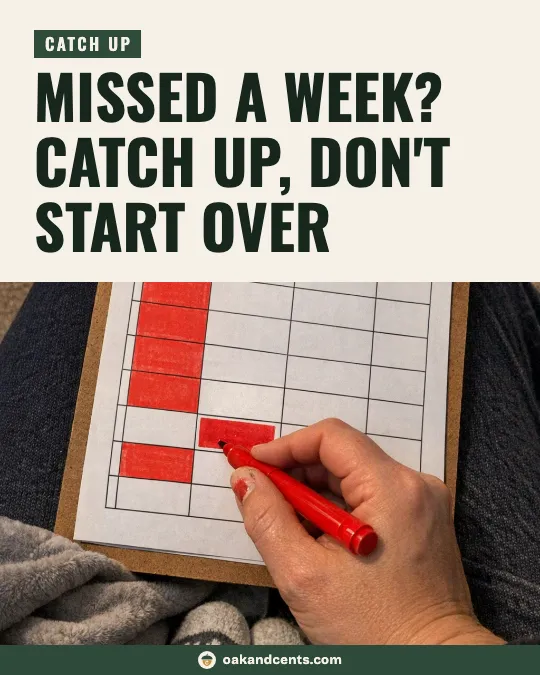
The car needs a new tire, a birthday party pops up, and week 4’s box sits empty. In a busy season, that can happen to anyone.
The tempting move is to decide the whole challenge is ruined and quietly slide the chart into a drawer.
One empty box is a pause, not the end. You have four ways back in, and none of them means starting over.
Here’s how they work, with made up examples. Options 1, 2 and 4 assume you missed week 4’s $20 on the $275 chart:
- Double up next week. Save weeks 4 and 5 together: $20 plus $25 is $45.
- Spread it out. Add $5 to each of weeks 5, 6, 7 and 8. The $20 comes back in four small steps.
- Step down a size. This one is for the $550 chart. If week 6’s $60 feels heavy, finish with the last five boxes of the $275 chart: $30, $35, $40, $45 and $50. You’ll end with $350 instead of $550, so keep your own running total from there.
- Let one box go. Skip week 4, keep going, and finish with $255 instead of $275.
Pick the one that feels lightest this week. Every one of them still ends with money saved for Christmas.
The only move to skip is putting a gift on a card “until the chart catches up.” That’s how a savings plan turns into a January bill.
A chart with one blank box still beats no chart at all.
Treat the Chart as Your Christmas Sinking Fund
A Christmas savings challenge is really a sinking fund with the weekly amounts already printed.
Christmas is a bill with a due date that never moves: December 25, every year. A sinking fund is a pot you fill ahead of a cost like that, so it’s paid for before it arrives.
The chart adds the one thing a plain savings pot leaves out: an amount for every week.
That doesn’t mean the money has to sit untouched until Christmas Eve. It means you only spend what the colored boxes already cover.
On the $275 chart, once week 6 is done, you have $105 to work with, not $275. That one habit keeps an early sale from borrowing against week 10.
When the last box is colored, the total becomes your Christmas number. Our guide to Christmas on a budget shows how to split one number so the gifts don’t swallow the food and wrapping money.
For the gifts, a Christmas gift list with an amount next to every name keeps the total honest. And these low cost Christmas gifts can stretch a smaller fund further.
Your plan in one line: one chart, one home for the money, one box a week and no shopping past the last colored box.
The chart fills the fund, the fund pays for Christmas, and the card stays out of it.
If Bills Are Already Tight, Let Christmas Be Smaller
In some seasons, even $5 a week is spoken for before it arrives. When that happens, the bills simply go first.
The charts work best with a regular paycheck, even a modest one, and a little breathing room once the bills are paid. They also suit anyone who enjoys watching progress on paper.
Hold off on the chart if rent or a utility bill is past due, or if a debt is with a collection agency. The same goes if a card is paying for the groceries. Those need the money first.
If you’re paying down a card, keep every minimum payment going. A small fund can keep holiday costs off that card, which protects the progress you’ve already made.
When it’s hard to tell what to pay first, a nonprofit credit counselor can look at the whole picture with you. The National Foundation for Credit Counseling is one place to start looking.
Four boxes on the 6 week chart make $100. A $100 Christmas paid in full can feel lighter in January than a bigger one on a card.
Write Your Start Date at the Top Tonight
December doesn’t have to be the month you find out what’s left. You can decide tonight what the weeks before it will set aside.
Print the chart that fits, write what you’re saving for and today’s date at the top, and save week 1’s amount: $5 or $10. Then color the box.
Paying down a card too? Put the free debt tracker next to the chart on the fridge. You’ll watch one number go up while the other comes down.
Once Christmas is paid for, our savings challenge ideas have more free charts for whatever comes next.
One colored box is a small thing. A full chart is Christmas, already paid for.