The car registration notice and the back to school list both seem to arrive out of nowhere. But they show up around the same time every year. They just don’t show up every month, so a monthly budget tends to forget them.
When one lands, it can feel like two bad choices: put it on a card, or squeeze it out of the grocery money. The trouble isn’t you. Your budget simply had no spot for it.
A sinking fund is that spot: a small amount set aside each payday for one cost you can see coming. The 5 examples below come with the math worked out, so you can pick one and start it this payday.
Sinking Funds Are Savings for Bills You Already Know About
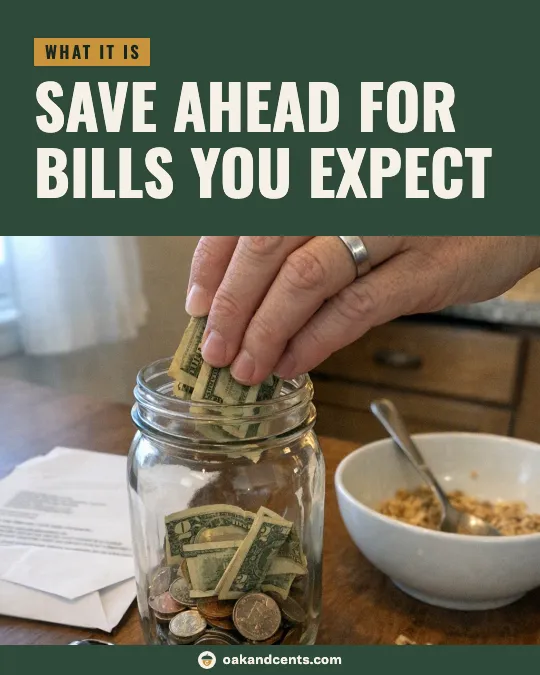
The car will need new tires sometime this year. Your daughter’s birthday is in March. The dog’s yearly checkup is on the fridge calendar.
None of these are emergencies. You know they’re coming, even if you don’t know the exact day.
That’s what a sinking fund is for. It’s money you set aside a little at a time for one cost you know is coming, so it doesn’t land on a credit card.
The name sounds technical, but the idea is old. Some families keep a coffee can for Christmas. Others keep an envelope marked “car.” Both are sinking funds.
Each fund has three parts: what it’s for, how much you’ll need and when you’ll need it.
That doesn’t mean you need a fund for every little thing. Most households do fine with a handful.
Why it matters: A big yearly bill is really a small monthly bill that nobody split up for you. A sinking fund does the splitting.
When the money is already there, the bill is just a bill. It stops being a crisis.
A Sinking Fund Isn’t the Same as an Emergency Fund
It’s easy to mix the two up, because both are savings you leave alone. They just do different jobs.
An emergency fund is for what you can’t plan: a job loss, a hospital stay, a month with a much smaller paycheck. You hope you never need it.
A sinking fund is for what you can plan. You fully expect to spend it, and that’s the point.
Here’s a simple way to tell them apart. If you could write the cost on a calendar, it belongs in a sinking fund. If you’d only find out about it the day it happens, it’s an emergency.
New tires are a sinking fund. A flat tire on the way to work is an emergency.
Keeping them separate protects both. When the emergency fund pays for Christmas, it isn’t there in March when the water heater quits.
If you don’t have any emergency savings yet, many people build a small cushion first. Our guide to a starter emergency fund walks through that first goal.
After that, how much an emergency fund should be covers the bigger number.
One fund plans for the calendar. The other protects you from what the calendar can’t see.
5 Sinking Fund Examples Worth Starting With

Most of the costs that knock a budget sideways fall into a few groups. Here are five that show up in a lot of homes.
- Car repairs and registration. Oil changes, tires, wiper blades and the yearly registration. Cars rarely give much notice before they need something.
- Gifts and holidays. Birthdays, Christmas, the teacher gift and the office swap. If you’re planning December now, our guide to Christmas on a budget splits this fund into six buckets.
- Back to school. Supplies, shoes that suddenly don’t fit, school photos and field trip money.
- Medical and dental. Copays, prescriptions, new glasses and the part of a dentist visit insurance doesn’t cover.
- Yearly bills and renewals. Car insurance paid every six months, a warehouse club membership, a yearly subscription or the pet’s checkup.
Here’s what those five could look like with made up numbers, just to show the math. Your amounts will be different.
| Fund | Example goal | Needed in | Each month |
|---|---|---|---|
| Car repairs and registration | $600 | 12 months | $50 |
| Gifts and holidays | $480 | 12 months | $40 |
| Back to school | $300 | 10 months | $30 |
| Medical and dental | $360 | 12 months | $30 |
| Yearly bills and renewals | $240 | 6 months | $40 |
| Total | $1,980 | $190 |
That’s $190 a month in this example, or $95 from each paycheck if you’re paid twice a month.
If $190 feels like a lot right now, that’s normal. You don’t have to start all five. Pick the one that stung the most last year and start there.
Five funds on paper is a wish list. One fund you actually fill is a plan.
Divide the Cost by the Months You Have Left
This is the whole method, and it’s simpler than it sounds.
Take what the cost will be and divide it by the months until you need it. That’s your monthly amount.
Say the car registration is about $180 and it’s due in six months. That’s $30 a month. If you’re paid every other week, about $15 a payday gets you there with a little to spare.
Not sure what something costs? Look at last year’s receipt or bank statement, then round up a little. Prices tend to creep.
Each fund also needs a “needed by” date. Without one, the goal floats, and the fund slowly turns into general savings.
Starting late is fine too. If school starts in two months and you’ll need $300, the honest number is $150 a month. If that won’t fit, save what you can, trim the list a little and start earlier next year.
Round numbers help here. $30 is easier to remember on payday than $28.47.
The math is one division. The real work is just doing it every payday.
Keep Sinking Fund Money Apart From Your Checking
Money sitting in everyday checking has a way of turning into groceries and gas. That’s not a willpower problem. A number in the same account simply looks like spending money.
Keeping it somewhere else fixes most of that.
You have a few simple choices:
- One separate savings account. All your funds live in one account, and you track each fund on paper.
- Savings buckets inside one account. Some banks and credit unions let you split one savings account into named pots.
- Cash envelopes. One envelope per fund, filled on payday. If that sounds like you, our guide to cash stuffing for beginners shows how to start.
Any of them works. The best one is the one you’ll keep using.
If the money sits in a bank or credit union, check that the account has FDIC insurance or NCUA insurance. Both protect your savings up to set limits if the bank or credit union fails.
Cash at home doesn’t have that protection, so keep envelope amounts modest and store them somewhere safe.
Give the account a plain nickname, like “Car and school,” so it’s easy to leave alone.
Out of sight but still close by. That’s the spot you want.
Fill Your Funds on Payday, Not at the End of the Month
Saving whatever is left at the end of the month sounds sensible. By then, though, there often isn’t anything left.
That isn’t about discipline. Whatever goes first gets first pick of the paycheck, and groceries and gas are always ready to go first.
So let the funds go first. The day your pay lands, send each fund its share before the week’s spending starts.
An automatic transfer for the day after payday does this without you having to remember. If you budget by paycheck, it’s simply one more line after the bills.
If you share money with a partner, choose the funds together. It’s much easier to leave a fund alone when you both agreed on it.
Say this: “Could we set aside $40 each payday for the car and school costs? I’d love for the next repair to come out of savings instead of going on the card.”
Some months, the full amount won’t fit. Send a smaller amount and keep the habit going. $10 into a fund still counts.
Your plan in one line: one cost you can see coming, divided by the months left, moved to its own spot every payday.
Funds you fill first get filled. Funds you fill with whatever is left usually stay empty.
Track Every Fund on One Page
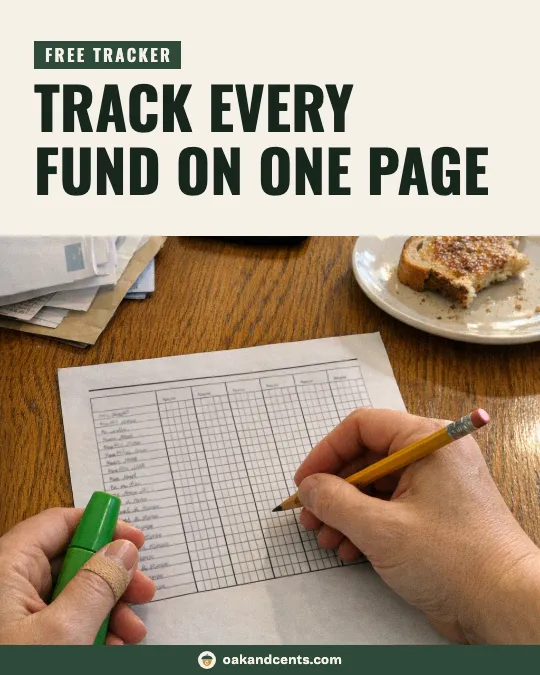
A sinking fund is easier to keep when you can watch it grow.
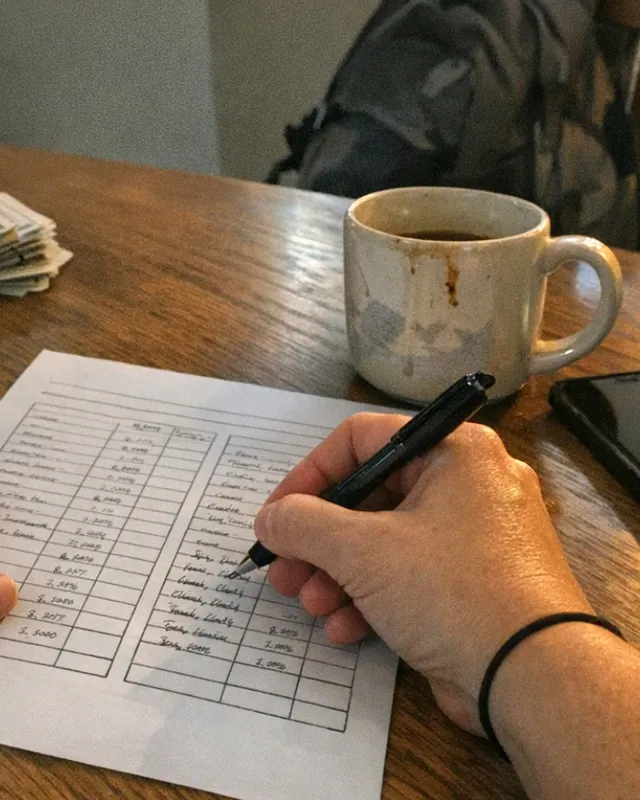
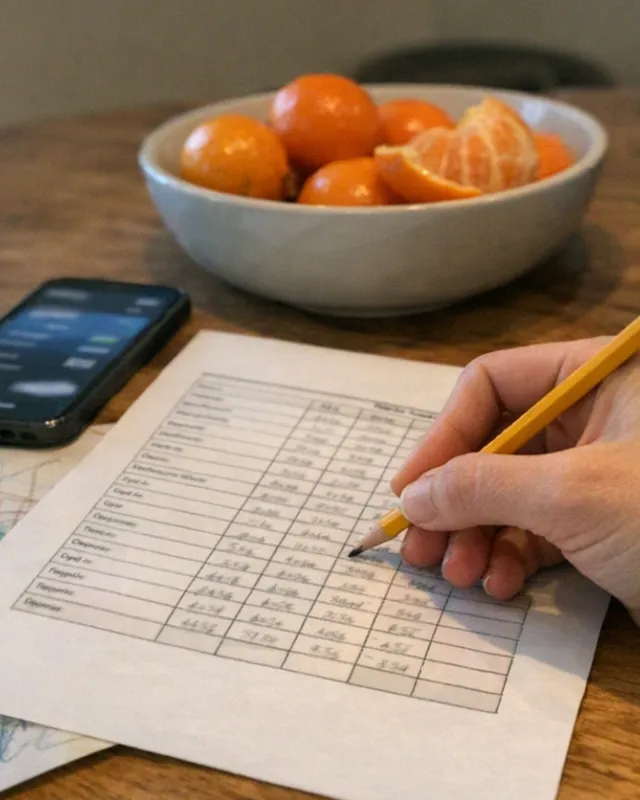
The free Sinking Funds Tracker on this page has six fund columns. At the top of each, you write the fund’s name, the goal, when you need it and the monthly amount.
Below that, there’s a box for every month from January to December. After you add to a fund, you write the new balance in that month’s box.
Once a month, a few numbers, about five minutes.
The page also helps when a fund comes up short. Say the car needs $400 and the car fund holds $300.
Borrow the last $100 from another fund instead of a card, then top that fund back up over the next few paydays.
Spending a fund isn’t a setback. When the money goes out for the thing it was saved for, the fund did its job.
Around month three, the habit can start to feel boring. That’s a good sign. Take a minute to look down a column and notice how far it has come.
Prefer a computer? The Savings section of our free monthly budget spreadsheet already has lines for a Christmas fund and a car repairs fund, plus blank lines for your own.
A page you fill in once a month is easier to keep than a system you have to think about every day.
If Bills Are Behind, Sinking Funds Can Come a Little Later
Sinking funds fit well when there’s a little left after rent, utilities, food and the minimum on every debt. Even $20 a payday is enough to start one.
Think twice if a bill is already past due, a debt has gone to collections or a card is covering groceries most months. Right now, that money has a more urgent job.
That doesn’t mean sinking funds are off the table. It means they come a little later.
If you have no emergency savings at all, a small starter cushion often comes first. Our emergency fund calculator shows what that first goal could look like with your own bills.
When everything feels urgent at once, a nonprofit credit counselor can help you sort out which bills can’t wait. Start with the National Foundation for Credit Counseling to find one.
Starting later isn’t falling short. It’s starting at the right time for you.
Start Your First Fund This Payday
That car registration or school supply list doesn’t have to catch you off guard again. Next year, it can arrive as just another bill.
Before your next payday, pick one cost you know is coming. Write down what it will cost and when you’ll need it, then divide by the months you have left.
On payday, move that amount first and write it on the free tracker.
If you’re also paying down a card, keep your free debt tracker close by. Every bill a sinking fund covers is one that stays off the card.
One cost, one amount, one payday. That’s all it takes to begin.