Most Christmas plans start with a list of names. It feels like the loving place to begin. It’s also how the total creeps up one gift at a time, until January’s statement lands on the counter.
It can feel like two bad choices: hold back and worry about letting people down, or say yes to everything and undo months of progress on your card. Neither says anything about how much you care.
Christmas on a budget isn’t about skipping Christmas. It’s one number, chosen in October and paid with money you set aside before December. By the end, you’ll have your number, six buckets and a plan for tonight.
Set One Christmas Number Before You Write a Single Name
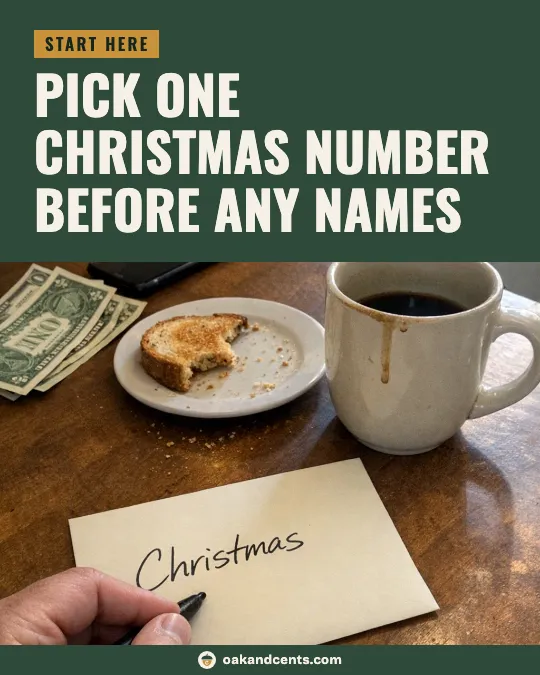
It’s Sunday night, the kids are finally asleep, and you open the notes app to start the gift list. Before the first name, write something else: one number.
That number is your whole Christmas. Gifts, the big meal, the tree, gas for the drive, wrapping paper, all of it.
Starting with names works backwards.
Every gift seems fair on its own, so you only meet the real total at the register, or later on the statement.
Starting with the number flips that. The money comes first, and the list fits inside it.
That doesn’t mean your number has to be tiny. It just has to be one you can pay without new card debt.
It comes from two places: anything already tucked away for Christmas, plus what you’ll set aside from your paychecks before December.
Some people call this a sinking fund: a savings pot you fill a little at a time for a cost you know is coming. Christmas is the easiest one to see coming.
Try this: Write your number on a plain envelope, or name a separate savings account “Christmas,” before you open a single shopping app.
Leave out money you’re only hoping for, like a bonus nobody has promised. If it shows up, it can go toward your card.
A smaller number you can keep will feel better in January than a bigger one you can’t.
Count Your Paydays Between Now and Christmas
December has a way of stacking everything into two weeks: the school party, the gift swap, the grocery run for the big dinner and the usual bills.
That squeeze is a timing problem, not a you problem.
Christmas costs bunch up, while your pay arrives in steady pieces. When the two don’t line up, the gap tends to land on a card.
Starting in October gives your paychecks time to catch up.
You don’t need a big pile of money, just a small, steady amount from each payday left.
Here’s an example with made up numbers.
Say you’re paid every other Friday, starting this week. That’s six paydays before Christmas: two each in October, November and December.
Set aside $100 each payday, and you’ll have $600 by the week before Christmas. December arrives with the money already waiting, and that feels very different from hoping it works out.
For your own amount, divide your number by the paydays you have left. If $100 feels like a stretch, try $50. That still adds up to $300, and $300 paid in full is a real Christmas.
If you already budget by paycheck, this is just one more line after the bills.
When the math feels tight, the number gets smaller. The rent doesn’t.
Split Your Number Into 6 Buckets Before You Shop
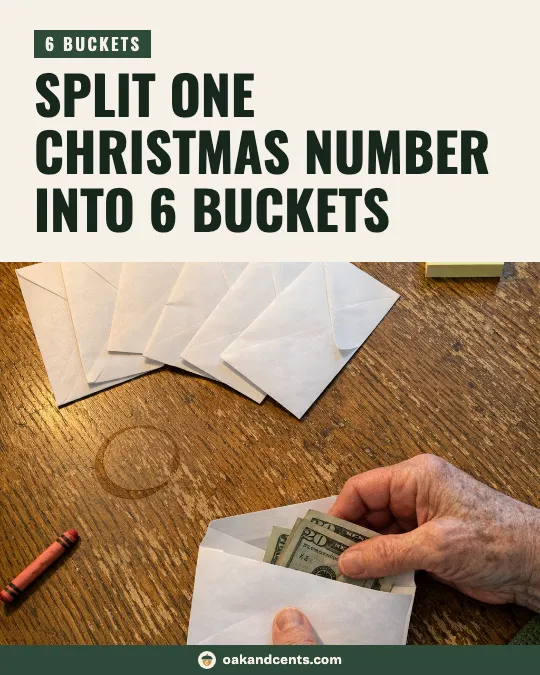
Gifts get all the attention. But December also brings tape, a ham or a turkey, stamps and gas for the drive.
Without a spot of their own, those little costs come out of the gift money, or they go on a card.
That’s what the six buckets are for.
Each part of Christmas gets its share before you buy anything.
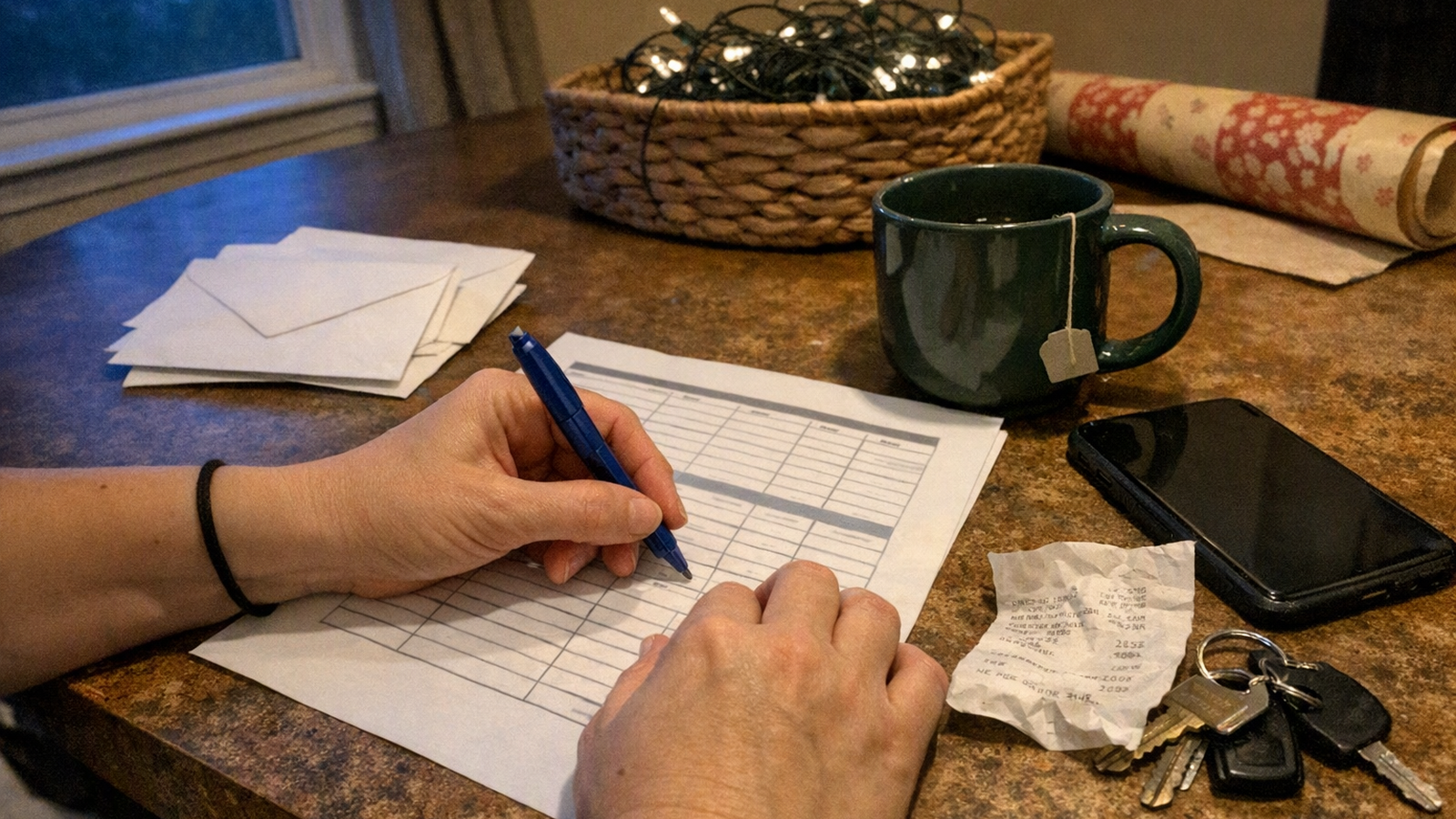
You don’t need a spreadsheet. The free planner on this page has all six buckets ready, with room for what you planned, what you spent and what’s left.
Here’s the $600 example again, split six ways. The amounts are made up, just to show how it works.
| Bucket | Example | What it covers |
|---|---|---|
| Gifts | $330 | Presents for family, friends, teachers and the office swap |
| Food and hosting | $120 | The big meal, baking and the dish you bring to someone else’s table |
| Decor and cards | $45 | A tree or greenery, a few lights and holiday cards |
| Travel | $45 | Gas or a ticket to see family |
| Wrapping and postage | $30 | Paper, tape, gift bags and shipping |
| Buffer | $30 | Surprises, like a forgotten name or a school party |
| Total | $600 |
Your split will look different, and that’s the point. If you’re driving to family this year, Travel gets more and Gifts get a little less.
The total stays the same.
If one bucket runs short, borrow from another bucket, not from your card. Keep the buffer for real surprises, not for one more gift.
Gifts are only one part of Christmas. Seeing all six keeps the total honest.
Give Every Name a Budget Instead of a Wish List
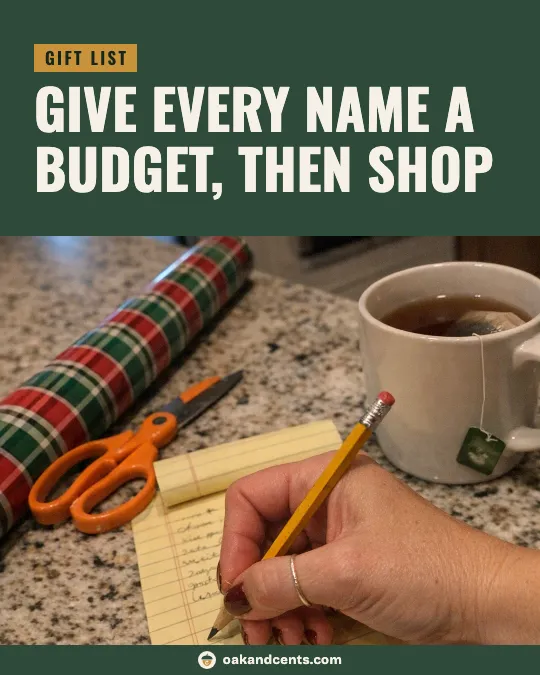
The kids’ wish lists come home from school, the ads follow you around your phone, and suddenly every gift feels like a must.
A dollar amount next to each name keeps the list from growing on its own.
A wish list starts with the gift and hunts for the money. A budget starts with the money and then finds the gift.
A smaller amount doesn’t mean a careless gift. Often it means more thought went into it.
Here’s one way to split the $330 Gifts bucket in our example:
- Two kids: $60 each
- Your partner: $50
- Two parents: $35 each
- Sibling name draw: $25
- Office gift swap: $20
- Homemade cookies for teachers and neighbors: $45
That adds up to $330. When the Gifts bucket is empty, the list is done.
For the adults, a name draw turns a long list into a short one: each person buys for one name instead of everyone. If you suggest it, keep it short and warm.
Say this: “Money’s a little tighter for us this year, so we’re keeping adult gifts to about $25. Would a name draw work for everyone?”
Watch the little extras at the register, too. Five of them at $8 each come to $40, more than the whole buffer.
A list with prices is a plan. A list without them is a wish.
Shop Only With Money You’ve Already Saved
You spot the exact toy your youngest asked for, on sale, a week before payday. It’s so tempting to grab it now and sort out the money later.
That’s how a careful plan still ends up on a card.
The fix is simple: shop in the order your savings fill up.
You don’t have to finish everything by Thanksgiving. The food gets bought the last week anyway.
In our example, October’s $200 pays for the kids’ gifts and the wrapping. By the end of November, the rest of the gifts are paid for too. What’s left covers decorations, travel, food and the buffer in December.
Keep the money where it won’t get spent by accident: a separate savings account, or labeled envelopes if you like cash stuffing.
Before each shopping trip, ask three quick things: which bucket is this from, what’s left in it, and is that money already saved?
If the last answer is no, it waits for the next payday.
Be careful with buy now, pay later at checkout. It splits a price into smaller payments, but it’s still a loan with its own due dates.
Every payday you tick off as saved is a real step forward. Let yourself notice it.
Money first, shopping second. That order does most of the work.
Make It Work on Your Kind of Paycheck
Maybe your pay lands every Friday. Maybe it comes once a month, or it depends on tips and how many shifts you picked up.
The six buckets stay the same either way. Only the way you fill them changes. Here’s the same $600 example on different paychecks, still with made up numbers:
- Paid weekly: about $55 a week for the 11 Fridays left before Christmas.
- Paid twice a month: $120 from each of the five paydays before mid December.
- Paid once a month: count only the paychecks that come before you shop. Two paychecks means $300 each, or a smaller number.
- Tips or gig work: save the same share of every deposit, like 10 cents of every dollar. Slow weeks won’t break the plan.
- A bonus or extra shifts: decide where it goes before it lands, like half to Christmas and half to your card.
Need a little more room? Seasonal jobs or a no spend November can help, as long as the extra goes straight into the buckets.
A plan that fits your paycheck beats a bigger one that doesn’t.
Skip the 5 Little Mistakes That Put Christmas on a Card
You’re tired, the line is long, and the cashier asks if you’d like to save today with a store card. Saying yes in that moment is easy, and that’s exactly when the offer comes.
Christmas usually slides onto a card in small moments like that, not one big decision.
You don’t need iron willpower, just a swap ready before you’re in line.
Here are five common mistakes, with a swap for each:
- Opening a store card for the checkout discount. Instead, pay from your Gifts bucket and let the discount go.
- Splitting a gift into buy now, pay later payments. Instead, wait until the bucket covers the full price.
- Buying gifts whenever an idea pops up. Instead, write the name and the budget first, then shop.
- Putting “just this one thing” on your everyday card. Instead, pay with cash or debit from your Christmas money.
- Trying to match what others spend. Instead, suggest a name draw or a $25 limit for the adults.
Your plan in one line: one Christmas number, six buckets, a little from every payday and one free tradition.
There’s one more reason to keep Christmas off a card you’re paying down. Most cards only skip interest on new purchases when last month’s bill was paid in full and on time (the CFPB explains how that works).
If it wasn’t, a new $50 gift often starts costing interest right away.
Each swap is small. Together, they keep January’s statement looking like November’s.
Use What You Already Have Before You Buy Anything
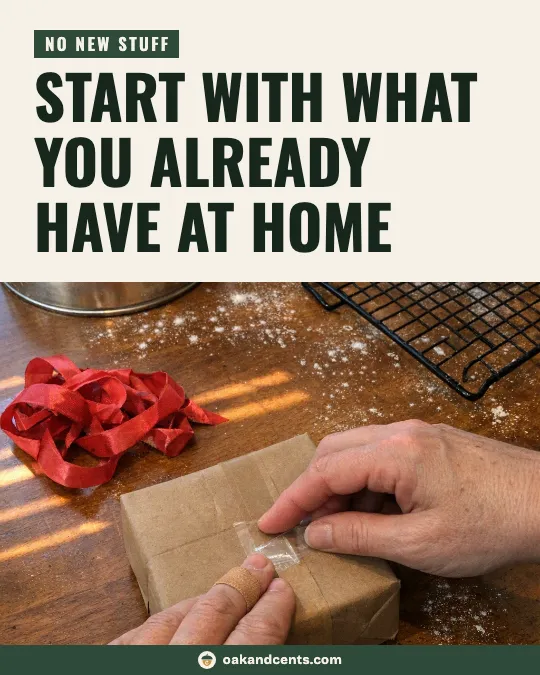
There’s probably a drawer in your kitchen with half a roll of wrapping paper, a few gift bags and a tangle of last year’s ribbon.
That’s a good place to start.
You can begin tonight without buying a planner, an app or a single new supply. Six envelopes or one sheet of paper can hold the buckets.
That doesn’t mean Christmas has to look bare. It means starting with what’s already here.
A gift card hiding in your wallet can join the Gifts bucket once you’ve checked what’s left on it.
Some parts of the season cost little or nothing. Put one or two on the calendar now: a drive to see the lights, a movie night with cocoa or a cookie baking afternoon.
Years from now, an evening like that may be the part someone brings up first.
If you’re paying down a card, keep your free debt tracker next to the planner. Watching that number drop all through December is its own small gift.
The season doesn’t need new stuff to feel full. It needs a few evenings you planned on purpose.
If Money Is Already Stretched, Start Smaller
Some years, even $50 a payday just isn’t there. If that’s you this year, you haven’t done anything wrong. The plan just starts somewhere else.
This plan fits well when you have a paycheck coming in, even a small one, with a little left after the bills.
Think twice if rent, utilities or a card payment is past due, or if a debt has gone to collections. The same goes if a card is already covering groceries. Those come first.
In those cases, a smaller Christmas is a kind choice for your family.
A nonprofit credit counselor can help you sort out what to pay first. You can find one through the National Foundation for Credit Counseling.
A smaller Christmas this year is still Christmas.
Start With One Number Tonight
Go back to that gift list you were about to start. Before the first name, write a single number at the top.
Then divide it by your paydays left and fill in the six buckets.
The free Christmas planner on this page has room for all of it, plus a gift list with a budget for every name.
If a card balance does creep up this season, the plan isn’t over. The debt payoff calculator can show how small extra payments bring it back down.
The number comes first. The names can wait until tomorrow.