Keep an eye on your balance, the usual advice goes. It sounds sensible. On a big debt, it can also be the most discouraging number in the house.
You send a payment, open the app a few days later, and the balance has barely moved. You want to keep going, but you’d also like some sign that it’s working. Needing that sign isn’t a weakness.
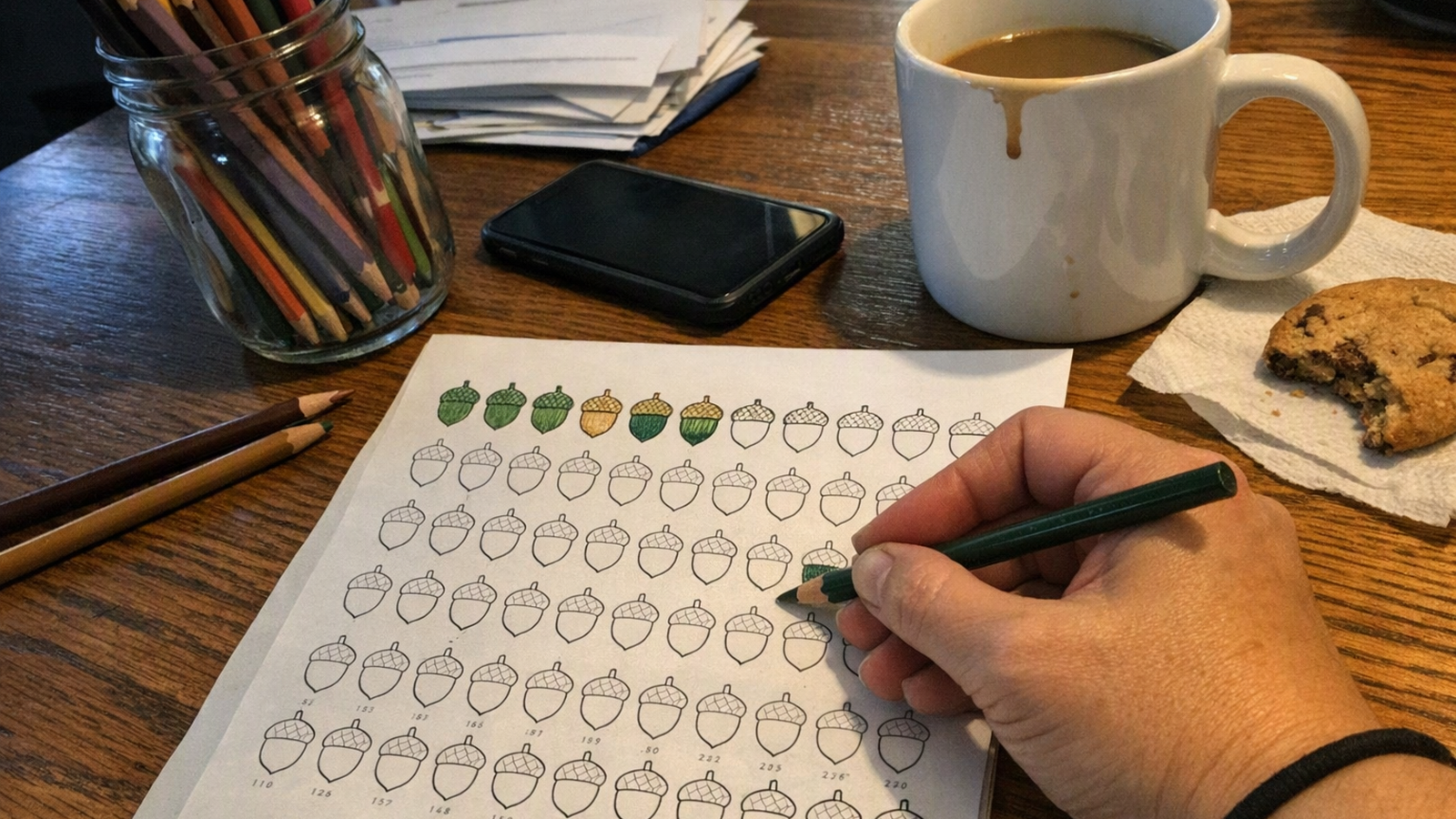
A debt payoff coloring chart gives you one. Each acorn is 1% of your goal, and you color one every time the amount you owe drops that much.
Here’s which page to print, how to fill it in and what to do on halfway day.
Why Coloring Works When the Balance Barely Moves
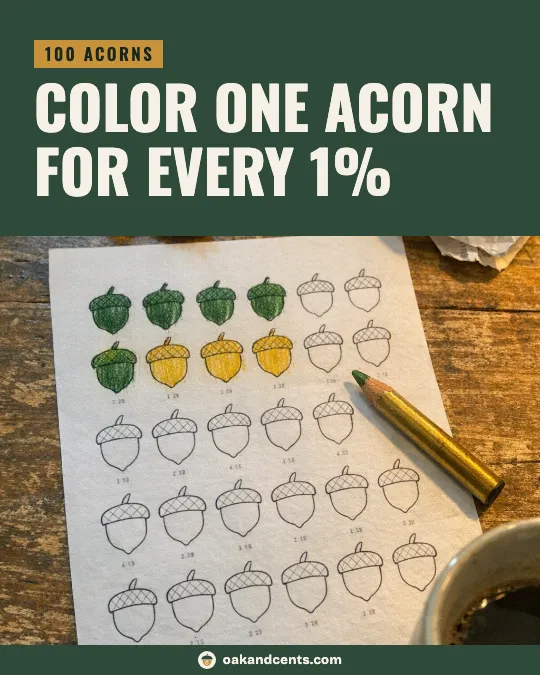
A balance of $10,000 that drops to $9,700 still looks like $10,000. Your eyes skip right past the change.
Three colored acorns don’t look like nothing. They look like a start.
That’s the whole idea behind a coloring chart. It turns a slow number into something you can see filling up.
It doesn’t mean the math matters less. It means you get to feel the math working.
Our free Debt Payoff Coloring Chart has 100 acorn outlines in a 10 by 10 grid. Each acorn stands for 1% of your goal. You start at the top left and work across.
Under every acorn is a small number: your total paid off so far when you reach that acorn.
Down the right side, each row is labeled from 10% to 100%. The 50% row says “halfway,” and the last row marks the finish.
At the top, there are lines for what you’re paying off and your start date. At the bottom, there are lines for the day you reach halfway, the day you finish and a reward.
The acorns are a small nod to our name. Oak trees start that way too.
A number can feel stuck. A row of colored acorns can’t.
Pick the Page That Fits Your Debt
You print the whole set, but you only need one page per goal.
The chart comes as four pages. Three of them have the math already filled in, and one is blank for your own number.
Here’s what’s printed on each page:
| Page | Goal | Each acorn | 25% | Halfway | 75% |
|---|---|---|---|---|---|
| 1 | $5,000 | $50 | $1,250 | $2,500 | $3,750 |
| 2 | $10,000 | $100 | $2,500 | $5,000 | $7,500 |
| 3 | $20,000 | $200 | $5,000 | $10,000 | $15,000 |
| 4 | Your goal | Your goal divided by 100 | You fill in | You fill in | You fill in |
If you owe right around $5,000, $10,000 or $20,000, one of the first three pages is ready to go.
If your number is somewhere in between, the blank page is the better fit. It keeps the chart honest, so the last acorn lands on the day your balance actually hits zero.
The blank page swaps the dollar amounts for the numbers 1 to 100. Each number is the percent you’ve paid off by that acorn.
Pick the page that matches your real number, not the one that looks nicest.
Use the Blank Page for Your Exact Number
Say your card shows $3,400 this month. That’s not on any printed page, and that’s fine.
The blank page asks for one bit of math, and you only do it once.
Divide your goal by 100. That’s what each acorn is worth.
With a made up $3,400 card, each acorn is $34. Write $34 on the “Each acorn” line at the top.
Then fill in the three milestone lines:
- 25% of $3,400 is $850
- Halfway is $1,700
- 75% is $2,550
That’s it. You don’t need to label all 100 acorns. The printed numbers 1 to 100 already tell you the percent.
If the division gives you cents, like $72.50 for a $7,250 goal, write it down as is. A calculator on your phone is plenty.
Five minutes of setup, then months of coloring.
Color by What You Owe, Not What You Sent
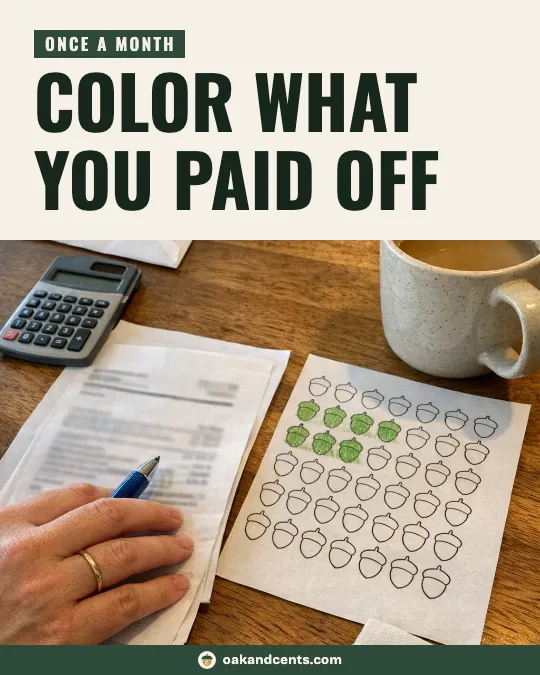
It’s tempting to color an acorn every time you make a payment. But on most cards, part of each payment goes to interest first.
So when you send $150, the amount you owe drops by less than $150.
That’s why the chart counts what you’ve paid off, not what you’ve paid. The page says it plainly: color one acorn each time your balance drops by one acorn’s worth.
That doesn’t mean you need to track interest yourself. One quick subtraction once a month does it.
Here’s how, with made up numbers on the $5,000 page:
- Write down the balance you started with: $5,000.
- Look up what you owe today, say $4,380.
- Subtract. You’ve paid off $620 so far.
- Color every acorn up to the one marked $600. That’s 12 acorns.
The extra $20 isn’t lost. It counts toward acorn 13 next month.
This way, interest is already counted for you, and the chart always matches your statement.
Honest acorns are worth more than fast ones.
Make the Halfway Acorn a Real Event
It’s easy to color the 50th acorn and move straight on, eyes already on the 50 still blank.
Halfway is worth stopping for. It’s the point where you’ve paid off as much as you still owe.
The chart gives it its own line: “Halfway on.” Write the date the day you color it.
That doesn’t mean a big, costly celebration. Rewards that suit a debt chart are small and cheap, so they don’t undo the progress.
A few ideas: a homemade pizza night, a library haul and a long bath, a picnic at the park or a new box of colored pencils for the second half.
Write your reward on the “Reward” line at the bottom before you color the first acorn. Having it on paper makes it feel promised.
You can do the same at 25% and 75%. Those amounts sit in the box at the top of every page.
Say this: “We just colored the halfway acorn on the card chart. Can we do pizza and a movie at home on Friday to mark it?”
Small celebrations along the way make the long middle feel shorter.
Put the Chart Where Your Family Can Cheer You On
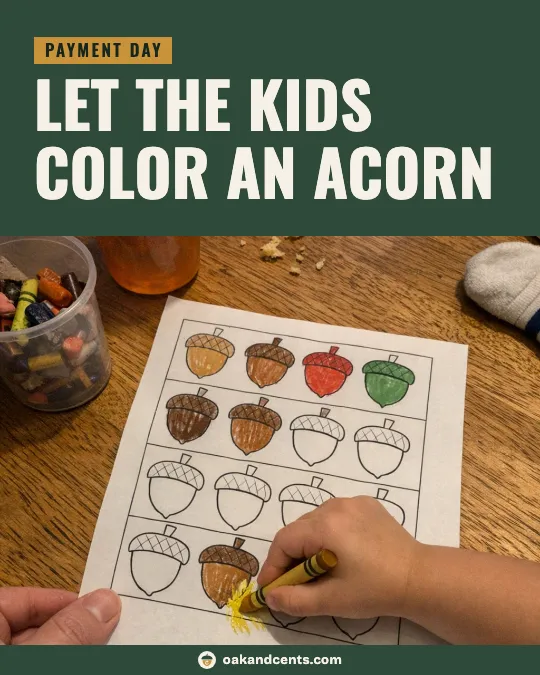
A chart in a folder gets colored in a burst, then forgotten. A chart on the fridge gets noticed.
If you have kids, this can be a fun job for them. Let them color the acorn on payment day, while you read out the new balance.
You don’t have to share the dollar amounts if that feels too personal. The acorns tell the story without them.
Pick a spot you see every day: the fridge, the inside of a pantry door or the front of your bill folder.
You can start with what’s already in the house. Crayons, colored pencils, a highlighter from the junk drawer. Nothing to buy.
Some people like a new color for each month, so the chart doubles as a timeline. Others use one color until halfway, then switch.
If you also like seeing the numbers, our free debt tracker by email is a one page printable where you color in every payment.
A chart your family can see turns a private chore into a shared win.
Pair It With a Plan So the Acorns Keep Coming
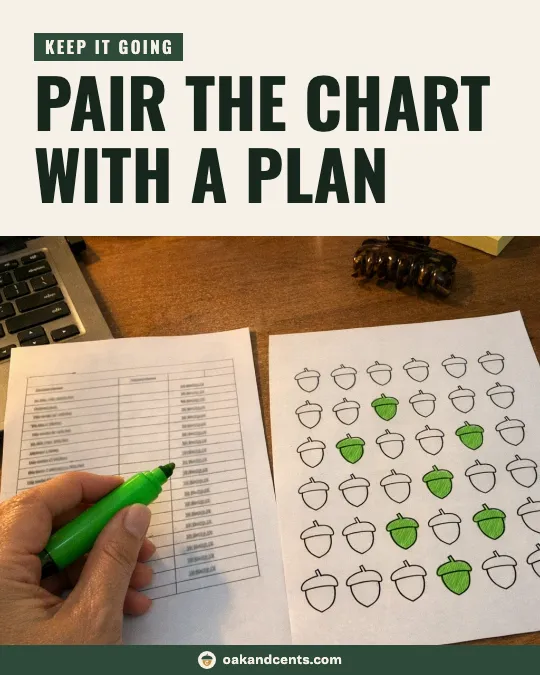
A coloring chart shows progress. It doesn’t decide where your money goes.
That part comes from a payoff order. Without one, the acorns tend to arrive slowly and unevenly.
Start with the debt payoff worksheet. It lists every debt on one page and ranks them two ways, so you know which one is #1.
Then choose how to use the charts:
- One chart for your total: good for seeing the big picture, like $10,000 across every card and loan.
- One chart per debt: each one fills faster. This suits the debt snowball method, where the smallest debt goes first.
Your plan in one line: one payoff order, all extra money to debt #1, and one acorn colored every time the amount you owe drops.
Want to know roughly when you’ll color the last acorn? The free debt payoff calculator can show a payoff month with your own numbers.
If you’d rather see percentages on a screen, the free debt payoff tracker spreadsheet works out how much of each debt you’ve paid off. It’s an Excel file that also opens in Google Sheets.
The plan moves the money. The chart keeps you going.
When Rent Comes First, the Acorns Can Wait
Some months, there’s nothing to color. If the minimums are all you can manage, you haven’t done anything wrong.
A coloring chart fits well when you can pay every minimum and have a little extra, even $25, to push one debt down.
Think twice about starting with a chart if a payment is past due or a debt has gone to collections. The same goes if your minimums add up to more than you can pay.
In those cases, rent, utilities and food come first.
A nonprofit credit counselor can help you put those bills in order. Try the National Foundation for Credit Counseling to find one.
If money is tight every month, getting out of debt with no money left over has small steps that come before the chart.
The acorns will still be there when you’re ready for them.
Color Your First Acorn This Week
Open the app one more time and find that balance that barely seemed to move. This time, write it at the top of a chart as your starting number.
Then pick your page, fill in the date and choose a small reward.
When the amount you owe drops by one acorn’s worth, color it in. It might take one payment. It might take two.
Either way, that first colored acorn is real progress, and you’ll be able to see it every time you open the fridge.
One acorn at a time.