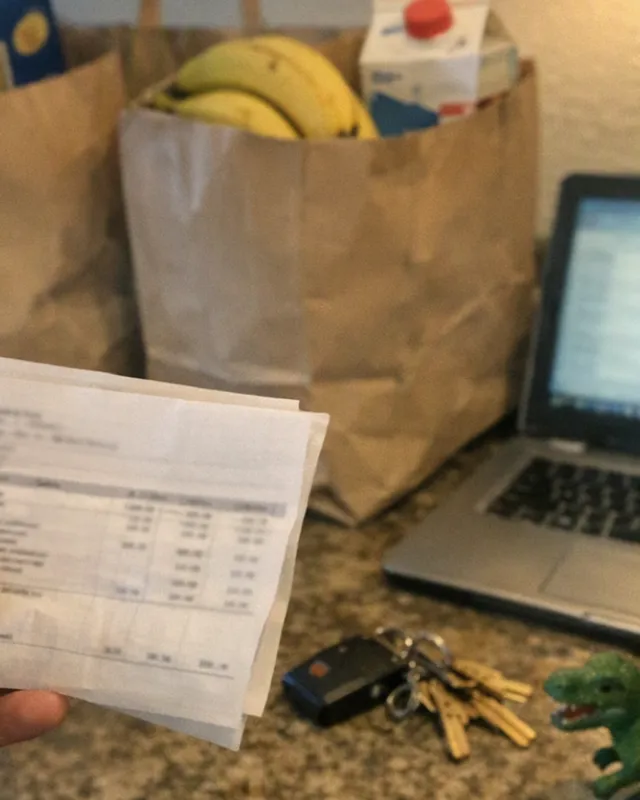

The statements are scattered. One sits in your inbox, one is in the kitchen drawer, and one is still sealed on the counter where you dropped the mail.
Every time you try to think about your debt, you have to go hunting for it first. So you either avoid the whole thing, or you face it all at once and feel worse.
Both are what anyone does when the paperwork lives in three different places.
A debt payoff worksheet ends the hunting. It puts every debt on one page and ranks them in the order you’ll pay them.
One evening with it can turn three scattered statements into a filled in sheet, a debt #1 and a plan for your extra money.
Put Every Debt on One Page Before You Decide Anything

It’s the week before rent. You open your banking app to check that the card payment went through, and then you remember the store card. And the medical bill from spring.
Debt is easier to steer when you can see all of it at once.
Scattered across apps and envelopes, each debt feels like its own little emergency. On one page, they turn into a list.
That doesn’t mean you have to fix anything tonight. It only means writing it down.
The free Debt Payoff Worksheet on this page is one printable sheet. At the top, there’s a line for the date and a box for the extra you can pay each month.
Below that is a table with 10 numbered rows. Each row has room for the debt’s name, the balance (what you owe today), the interest rate, the minimum payment and the due date.
Two columns of small circles on the right let you rank each debt two ways. A totals line adds up your balances and your minimum payments.
A short “How to rank” box at the bottom explains both orders, so you don’t have to remember them.
Ten rows is plenty for most households. If you have more, the Debt List page in our free budget sheets has 12 rows and a column for extra payments.
A debt you can see is a debt you can plan for.
Gather Four Numbers From Each Statement
A statement has a lot going on: tiny print, rewards charts, offers you never asked for. You can skip almost all of it.
You only need four numbers for each debt:
- The balance: what you owe today. The app is often more current than the paper statement.
- The interest rate (APR): APR is the yearly interest rate on the debt (the CFPB explains APR here). The worksheet asks for the yearly rate, not a monthly one.
- The minimum payment: the smallest amount due this month.
- The due date: just the day of the month, like the 14th.
You don’t need every number down to the penny. Close enough is fine for ranking, and you’ll update the page later anyway.
If a number is missing, a two minute call usually fills the gap.
Say this: “Hi, I’m putting together a list of my debts. Could you tell me my current balance, my interest rate and my minimum payment?”
Not sure you’ve found everything? You can check your credit reports for free.
The three nationwide credit bureaus let you check each report once a week at AnnualCreditReport.com (the FTC explains how). An old store card or a loan you’d forgotten will often show up there.
Four numbers per debt. That’s the whole homework.
See How the Rows Fill In With a Made Up Example
Here’s a made up household with four debts, written the way they’d go on the worksheet. The numbers are only an example, and due dates are left out to keep the table small.
| Debt | Balance | APR | Minimum | Snowball order | Avalanche order |
|---|---|---|---|---|---|
| Medical bill | $350 | 0% | $40 | 1 | 4 |
| Store card | $450 | 26% | $25 | 2 | 1 |
| Visa | $2,200 | 22% | $60 | 3 | 2 |
| Car loan | $7,000 | 7% | $210 | 4 | 3 |
| Totals | $10,000 | $335 |
The totals line tells this household two things. They owe $10,000 in all, and $335 a month keeps every debt current.
That second number matters most. It’s the amount that has to go out every month, no matter which order they pick.
Seeing a total like $10,000 in your own handwriting can sting. It can also be a relief. The number stops growing in your head and sits on a page, where you can work with it.
You don’t have to feel ready to write it. You just have to write it.
The total is where you start. It isn’t a verdict on you.
Rank Your Debts Two Ways, Then Choose One

Without a ranking, most of us pay whichever bill feels loudest that week. The one with the scary letter. The one that just texted a reminder.
A ranking decides once, so you don’t have to decide every payday.
The worksheet gives you two ways to rank:
- Snowball order: write 1 next to the smallest balance, 2 next to the next smallest, and so on. Small debts disappear sooner, so you see progress fast.
- Avalanche order: write 1 next to the highest interest rate. If two rates match, rank the smaller balance first. It usually costs the least interest overall.
In the made up household, snowball puts the $350 medical bill first. Avalanche puts the 26% store card first.
You don’t need to know which one is right for you before you start. Rank both, then go with the one that sounds easier to keep up.
If you’re torn, debt snowball vs avalanche walks through both side by side, and the debt snowball method shows the first order step by step.
Then tick the box for the order you’ll use and write your #1 debt on the “Debt #1” line. That small line turns a list into a plan.
Try not to switch orders every month. Changing targets spreads the extra money thin again.
An order you’ll still follow in month 6 beats a smarter one you drop in month 2.
Give Your Extra Money One Job
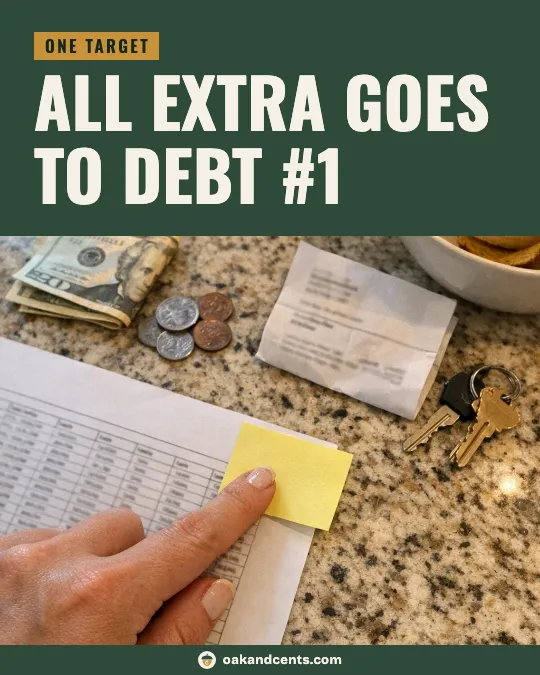
Payday lands, the bills go out, and there’s $50 left. It’s tempting to send a little to each card so nothing feels left out.
The feeling is kind. The math is slow. Spread thin, the extra barely moves any single debt.
The “Either way” box on the worksheet has the rule that makes both orders work: pay every minimum on time, put all extra money on debt #1, and when it’s paid off, add its payment to #2.
That doesn’t mean your extra has to be big. $25 counts. $50 counts.
Here’s the made up household again. They have $50 extra a month and pick the snowball order, so their #1 is the $350 medical bill.
With its own $40 minimum, the medical bill now gets $90 a month. It has no interest, so it’s paid off in month 4: three payments of $90, then a last one of $80.
Then that $90 moves to the store card, on top of its $25 minimum. Now the store card gets $115 a month, and the next debt falls faster.
Write your own amount in the “Extra each month” box at the top. To see how long your whole list might take in both orders, try the free debt payoff calculator.
If you’d rather type than write, the free debt snowball spreadsheet sorts your debts and builds the month by month plan for you. There’s an avalanche version too. Both are Excel files that also open in Google Sheets.
Your plan in one line: every minimum on time, all extra to debt #1, and its payment rolls to #2 when it’s gone.
Spread out, extra money feels busy. Pointed at one debt, it finishes something.
Keep the Page Where You’ll Actually See It
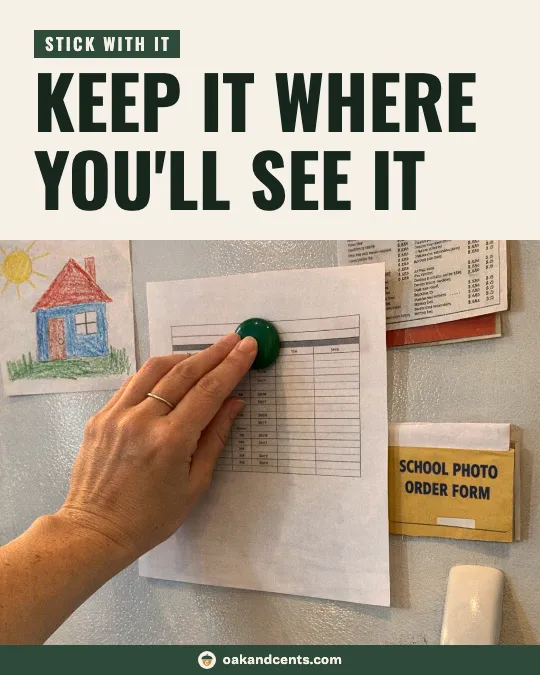
A worksheet in a drawer is usually forgotten by the second week. One on the fridge gets looked at every time you reach for the milk.
Seeing the plan often makes it easier to keep.
Pick a spot you pass every day: the fridge, the inside of a cabinet door or the front of a binder.
You don’t need to update it every week. Once a month is enough, maybe the day after payday. Write the new date at the top, update the balances and cross out any row that hit zero.
Try this: Put a note in your phone for the day after your next payday that just says “update the debt page.” Five minutes, once a month.
Month 3 can be a tricky one. The excitement has faded, and the big balances still look big. That’s normal, and it’s exactly when a crossed out row helps.
If you like something to color, the debt payoff coloring chart gives you 100 acorns per goal, one for every 1% you pay off. You can also get our free debt tracker by email and color in every payment.
You can start with a pencil, a magnet and the free page. Nothing to buy.
Progress you can see is progress you’ll keep.
When a Worksheet Isn’t the Whole Answer
Some months, there’s nothing left after the minimums. If that’s where you are, you haven’t done anything wrong. The list is still worth making.
This worksheet fits well when you can pay every minimum and have even a small amount left over.
Think twice about the ranking part if a payment is past due or a debt has gone to collections. The same goes if the minimums add up to more than you can pay.
Then the first job is different: rent, utilities, food and the most urgent bills.
In that case, a nonprofit credit counselor can look at the whole picture with you. Search for one through the National Foundation for Credit Counseling, and bring your filled in worksheet so every number is already on one page.
If you’re unsure which bill comes first when money is short, which debt to pay off first walks through it calmly.
A list is still useful when the plan has to wait.
Fill In Row One Tonight
Start with the envelope still sealed on the counter. Open it, find the four numbers and write them on row one.
That’s enough for tonight. Tomorrow, add the next one.
Once every row is full, rank them, tick snowball or avalanche and write your debt #1 on the line at the bottom.
When you’re ready to turn it into a full plan, this debt payoff plan picks up right where the worksheet ends.
One row tonight. The whole page by the weekend.