

A $640 store card can be gone by month 4 with $185 a month. The number is made up, but it shows how the debt snowball method starts: with one small debt you can finish.
When you owe on five things at once, it’s hard to know where the extra should go. Spread it thin and nothing moves. Hold it back and the worry stays. That stuck feeling comes from five bills pulling at once, not from anything you’re doing.
The snowball isn’t about a bigger paycheck. It’s one list, one order and one simple move: when a debt is gone, its payment moves to the next. You can have your list in order, with the first target circled, before the weekend.
What the Debt Snowball Method Really Does
Think about the statements, apps and envelopes that each tell you a different amount you owe. That scattered feeling is the first thing the snowball fixes.
The debt snowball method is a simple order for paying off debt. You list every debt from the smallest amount owed to the largest.
You pay the minimum on all of them. Every extra dollar goes to the smallest one.
When the smallest debt is paid off, its payment doesn’t drift back into everyday spending. It rolls onto the next debt, so that payment grows, like a snowball rolling downhill.
So the whole method comes down to three rules: pay every minimum, send all the extra to the smallest debt, and roll each paid off payment onto the next one.
The Consumer Financial Protection Bureau lists it as one of two common ways to pay down debt. The other one pays the highest interest rate first (CFPB).
The snowball’s strength is the early win. One debt disappears in months instead of years, and there’s one less due date to remember.
That doesn’t mean it’s the only right way. It can cost a little more interest than paying the highest rate first. In the example below, that difference is about $300 over the whole plan.
What it gives you in return is a clear next step every single month.
The math matters. So does a plan you’ll still be following next spring.
Step 1: Write Every Debt on One Page
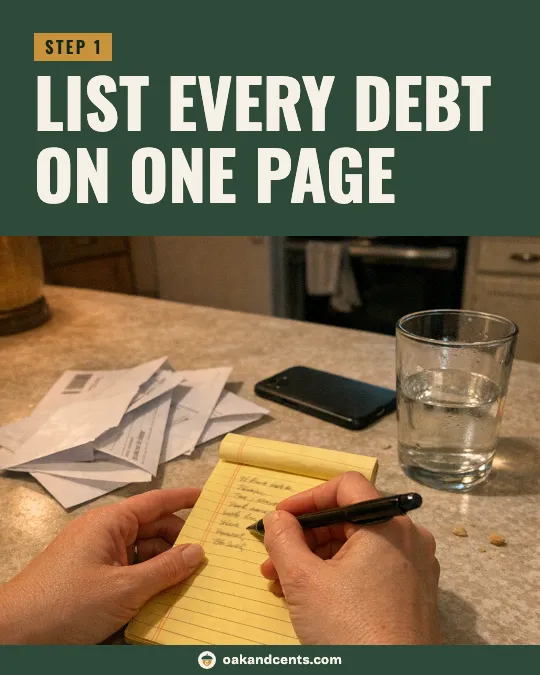
Maybe there’s a statement on the counter you haven’t opened yet. That’s a very normal place to start.
Grab one sheet of paper. For each debt, write four things: its name, the amount you owe today, the minimum payment and the due date.
Add the interest rate too. The snowball doesn’t use it to set the order, but it’s good to know what each debt costs you.
You’ll find all of it on your latest statement or in the lender’s app. Include the small ones, like a medical bill or a store card you rarely use.
The free Debt Payoff Worksheet on this page has ten rows ready for exactly this, plus a column to number your snowball order.
Seeing the total can sting. It’s the same number it was yesterday, though. The only difference is that now it’s written down where you can work with it.
You don’t need to fix anything tonight. Just get every debt onto the page.
You can’t roll a snowball you can’t see.
Step 2: Line Them Up From Smallest to Largest
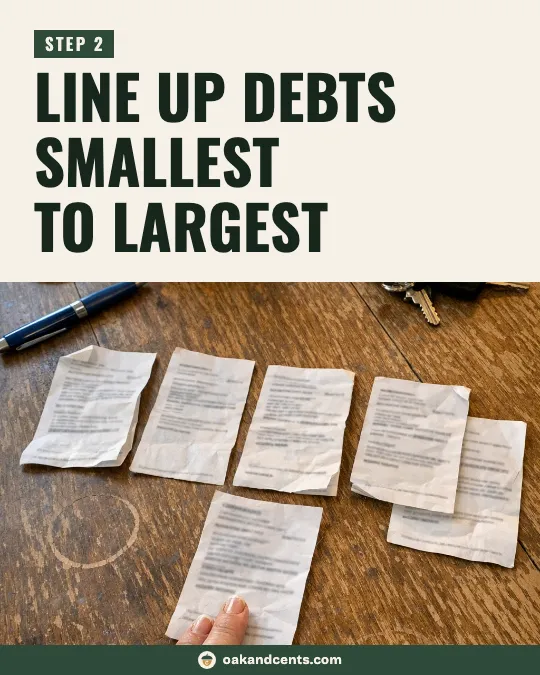
Now put your list in order by the amount you owe, with the smallest at the top.
Here’s a made up example with five debts:
- Store card: $640
- Medical bill: $1,150
- Visa: $2,900
- Mastercard: $4,750
- Car loan: $8,200
That’s $17,640 in all, and the minimum payments add up to $535 a month.
Notice what decides the order. The Visa has the highest interest rate, at about 27%, and the medical bill has no interest at all. In the snowball, only the amount owed counts.
If ignoring the interest rate feels odd, that’s a fair reaction. The trade is a little more interest in exchange for a much sooner first win.
If two debts are close in size, put the one with the higher interest rate first.
Write the numbers 1 to 5 next to your debts, and that’s your order for the whole plan.
The order is the plan. Once it’s written down, you don’t have to decide again every payday.
Step 3: Pick One Extra Amount You Can Send Every Month
The last few days before payday, there’s often a little money left that slips into takeout or one more grocery run.
That small amount is where the snowball gets its speed. Minimum payments keep debts shrinking, but slowly. The extra is what pushes the first debt over the finish line.
That doesn’t mean finding $500. It means one amount you can send every month without it bouncing back onto a card.
In our example, the extra is $150 a month. With it, the store card is gone in month 4.
With only $50 extra, the same store card is paid off in month 9. Slower, yes, but the snowball still rolls the same way.
The extra can come from a few places at once: a bill you lower, a subscription you cancel, a few hours of side income. The list of ways to lower monthly bills is a good place to look first.
If you’re not sure what’s left after the bills, making a budget while you’re in debt helps you find your number.
Keep a small cushion too, so a flat tire doesn’t go straight onto a card. A starter emergency fund protects the snowball from surprises.
A small extra you keep sending beats a big one you can only manage once.
Step 4: Pay Every Minimum, Then Send the Extra to the Smallest
Every debt gets its minimum payment, on time, every month. Only the smallest debt gets more.
This step keeps the rest of your list safe while you focus. Missing minimum payments for several months can hurt your credit score, and you’ll still owe the debt (FTC).
Here’s how it looks in the example. The store card gets its $35 minimum plus the $150 extra, so $185 a month.
The other four get just their minimums: $50, $85, $120 and $245. That’s $685 going out each month in total.
You don’t have to do anything fancy to keep track. One payday, one round of payments, one bigger payment to the target debt.
Why it matters: Putting every minimum on autopay protects you on the busy weeks. Then the extra can be one payment you send by hand on payday, and you get to watch it go.
If a due date lands right before payday every month, you can ask the lender about moving it. That one call can make the whole plan feel calmer.
Minimums keep you safe. The extra moves you forward.
Step 5: Roll Each Paid Off Payment Onto the Next Debt
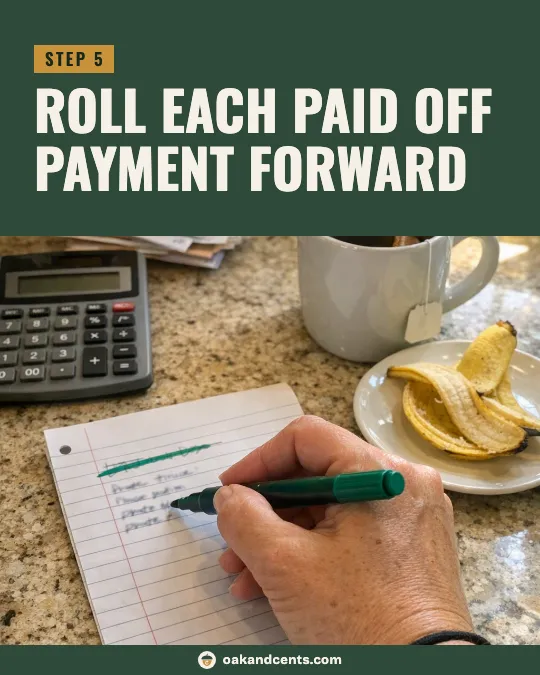
This is the step that turns a list into a snowball.
When the store card is paid off, its $185 doesn’t go back into the budget. It joins the medical bill’s $50 minimum, so the medical bill now gets $235 a month.
Each time a debt is finished, its payment rolls forward and the next payment grows. Here’s the same made up example, with $685 a month the whole way through:
| Target debt | Payment while it’s the target | Paid off in |
|---|---|---|
| Store card ($640) | $185 | Month 4 |
| Medical bill ($1,150) | $235 | Month 8 |
| Visa ($2,900) | $320 | Month 18 |
| Mastercard ($4,750) | $440 | Month 28 |
| Car loan ($8,200) | $685 | Month 32 |
You never pay more than $685 in a month. The money just keeps moving to the next debt.
In this example, everything is paid off in 32 months, about 2 years and 8 months, with about $3,660 in interest along the way.
The free debt snowball spreadsheet comes filled in with these same five example debts. Type in your own, and it shows your plan month by month and the month each debt reaches $0.
It opens in Excel, or in Google Sheets once you upload it to Google Drive.
Your plan in one line: one list, smallest first, every minimum on time, all the extra on one debt, and each paid off payment rolled to the next.
The hard part is the moment a debt is gone. That $185 suddenly looks like free money. It isn’t. It’s the snowball.
The payment you just freed up is already the right size for the next debt.
Keep Going When the Middle Feels Slow
It’s month 12. The first two debts are long gone, and the Visa in our example still has about $1,600 left on it.
This is the part of the snowball that tests people. The middle debts are bigger, so the wins come further apart.
In the example, ten months pass between paying off the medical bill and paying off the Visa. That gap is the math, not a sign the plan stopped working.
It helps to watch the total, not just the next debt. By month 12, about a third of the $17,640 is already paid off.
That doesn’t mean you need a fancy app to see it. Paper works well, because you can see it on the fridge.
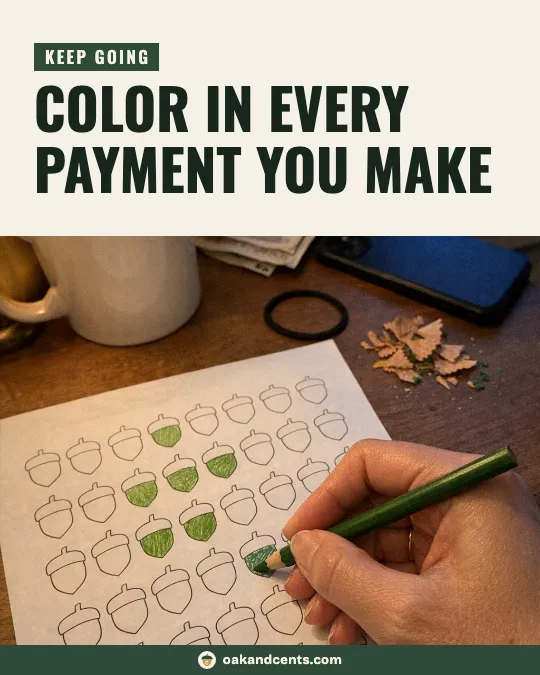
The free coloring chart on this page has 100 acorns to color in. Its last page is blank, so you can write in your own total and let each acorn stand for 1% of it.
If you’d like one page that holds the whole list, the free debt tracker lets you list your debts in snowball order and color in every payment.
When a debt reaches $0, mark it in a way you’ll notice: a thick line through it, a sticker, a favorite dinner at home.
Slow isn’t stuck. Every payment still counts, even in the months you can’t feel it.
If a Large Debt Carries the Highest Rate, Compare First
The snowball fits well when you have several debts, you can pay every minimum, and a quick win would help you keep going.
It may not be the best fit if one of your largest debts also has a much higher interest rate than the rest. Paying that one first could save you real money.
In our example, paying the highest interest rate first saves about $300 and finishes one month sooner. The snowball gets its first win in month 4 instead of month 15.
The debt snowball vs avalanche guide walks through both, and the free debt avalanche spreadsheet runs the same math highest rate first.
Think twice about starting any payoff method if you can’t cover all your minimums, a bill is past due or a debt has gone to collections. Those come first.
Calling the lender yourself is free. You don’t need to pay a company to talk to your credit card company for you (FTC).
Say this: “I want to keep paying, but I can’t cover the full minimum right now. What payment plans or hardship options do you offer?”
If those calls feel like too much to handle alone, the National Foundation for Credit Counseling can match you with a nonprofit credit counselor.
Starting later, with a steadier footing, is still starting.
Your First Snowball Step This Week
Somewhere on your own list is a debt like that $640 store card: small, a little annoying, and closer to $0 than you think.
Tonight, write every debt on one page. Then number them from smallest to largest and circle number 1.
This week, set your minimums on autopay and pick your extra amount. On payday, send it to the circled debt.
Want to see your own timeline first? The debt payoff calculator shows your debt free date and total interest for the snowball and the avalanche side by side.
The worksheet, the spreadsheet and the calculator are all free to use, with no sign up.
One small debt first. The rest follow in order.