

It’s Sunday night. The car loan letter is on the counter under a permission slip, and the card app just sent a reminder you already knew was coming.
Part of you wants to finally sit down and make a plan. Another part wants to close the app and deal with it next month. Both make sense when money feels heavy. They’re just a tired mind trying to protect your Sunday night.
A debt payoff plan isn’t a thick binder or a fancy spreadsheet. It’s one page and six simple steps. By tonight, you’ll know what you owe, what you can pay each month and which debt gets the extra first.
Step 1: Gather Every Statement and Write Down What You Owe
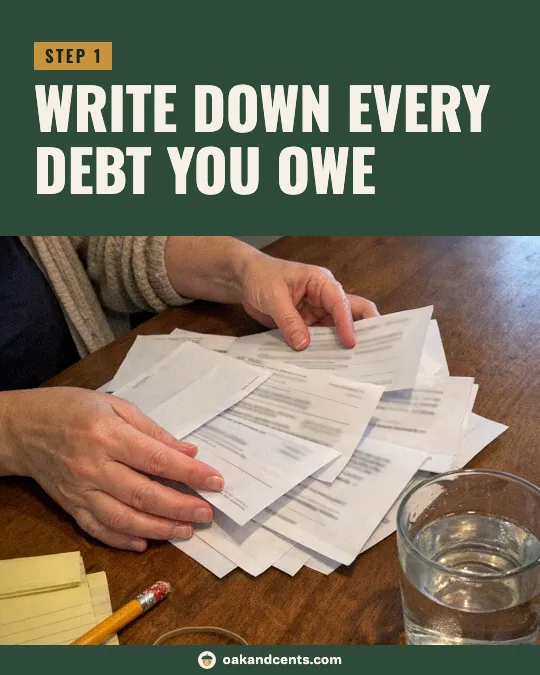
A plan starts with a full list, including the debts you’d rather not look at.
It’s easy to keep one or two debts in your head and forget the medical bill in the kitchen drawer. When something’s missing, the plan has a quiet leak from day one.
That doesn’t mean sorting out years of paperwork tonight. It means one line per debt.
For each one, write down the name, what you owe, the interest rate, the minimum payment and the due date. Most of it is on the latest statement or in the lender’s app.
If the rate is listed as APR, that’s the yearly interest rate. If a debt has no interest, write 0%.
Here’s a made up household we’ll follow through every step:
- A medical bill with $450 left, no interest, $40 minimum
- A store card with $1,200 at 25% interest, $40 minimum
- A Visa with $3,800 at 21% interest, $95 minimum
- A personal loan with $5,000 at 12% interest, $165 minimum
Together, that’s $10,450.
The free debt payoff worksheet has 10 numbered rows and a totals line, so nothing slips through.
Include anything past due or in collections, too. Those might need a different first step, which we’ll get to near the end.
You can’t plan around a debt you haven’t written down.
Step 2: Find One Monthly Number You Can Pay Every Time
Your whole plan runs on one number: the total you’ll send to debt each month.
It’s every minimum added together, plus whatever extra you can manage on top.
In our example, the minimums are $40, $40, $95 and $165. That adds up to $340. The household finds $120 extra, so its monthly number is $460.
A number you can repeat matters more than a big one. A plan built for a good month tends to break the first time the car needs a repair.
That doesn’t mean you need $120 extra. If your extra is $20 right now, that’s your number. You can raise it when a bill drops or your pay goes up.
Not sure where the extra could come from? Our guide on how to make a budget when you’re in debt walks through it. These 10 realistic ways to pay off debt fast have more ideas.
Note: If a minimum payment is smaller than the interest charged each month, that debt grows even when you pay on time. The debt payoff calculator warns you when that happens. It’s a good reason to call that lender.
Write your monthly number at the top of your page and circle it.
It doesn’t need to be impressive. It needs to be repeatable.
Step 3: Put Your Debts in Order, Smallest First or Highest Rate First
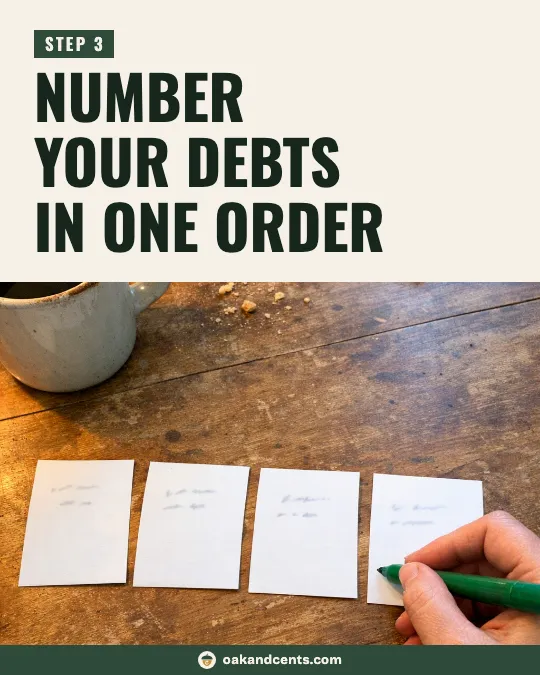
Your extra money goes to one debt at a time, so your list needs an order.
There are two common ways to choose it. Smallest first is called the debt snowball: the smallest amount you owe gets the extra. Highest rate first is the debt avalanche: the debt with the highest interest rate gets it.
Number your debts 1, 2, 3 and 4 in the order you pick.
In our made up example, smallest first goes medical bill, store card, Visa, personal loan. Highest rate first goes store card, Visa, personal loan, then the medical bill last, since it has no interest.
With $460 a month, both orders finish in month 28. Highest rate first saves about $56 in interest. Smallest first pays off its first debt in month 3, instead of month 9.
So you’re choosing between a little less interest and an earlier win. Both are good reasons.
You don’t have to find the right answer. You just have to pick one and keep it. Our guide to debt snowball vs avalanche can help if you’re torn.
If a bill is already past due, the order changes. Our guide on which debt to pay off first explains why.
A quick win or a little less interest. Either way, the debt goes away.
Step 4: Make Every Minimum Automatic, Then Send the Extra to Debt Number 1
A missed minimum can bring a late fee and undo a month of progress, so protect the minimums first.
Set each one on autopay from your bank or the lender’s site, for the minimum amount. If your checking account runs close to zero, calendar reminders on payday work too.
That doesn’t mean everything has to run on its own. The extra is a payment you make on purpose, once a month or once a payday.
In our example, smallest first means the medical bill is debt number 1. It gets its $40 minimum plus the $120 extra, so $160 goes there each month. Everything else gets its minimum, right on time.
If a due date lands in the wrong week, it may help to ask about moving it.
Say this: “Hi, I get paid on the 15th and the 30th. Is it possible to move my due date so it falls a few days after payday?”
Some lenders can, some can’t, and asking costs nothing.
Before you turn on any autopay, check that the date leaves enough in your account for rent and groceries.
Minimums on autopilot. Extra on purpose.
Step 5: When a Debt Hits $0, Move Its Payment Down the List
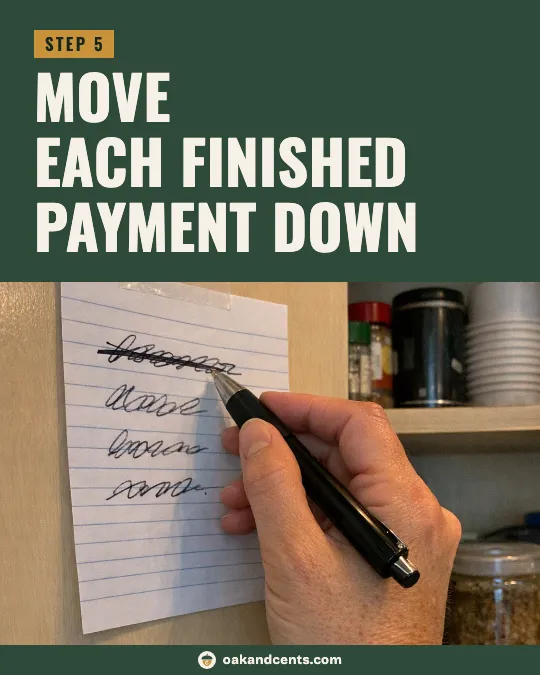
Paying off a debt doesn’t free up money to spend. It frees up money to aim at the next one.
This is the step that makes the plan speed up on its own.
Here’s how it plays out in our made up example, paying smallest first:
- The medical bill is gone in month 3. Its $160 moves to the store card, which now gets $200 a month.
- The store card is gone in month 10. Its $200 joins the Visa’s $95 minimum, so the Visa gets $295.
- The Visa is gone in month 23. Now the whole $460 goes to the personal loan.
- The personal loan is gone in month 28.
The monthly number never changed. It was $460 from the first month to the last.
Compare that with paying only each minimum and never moving anything. The Visa alone would take 70 months.
The free debt snowball spreadsheet and debt avalanche spreadsheet move each payment for you and show your debt free month.
Your plan in one line: one list, one monthly number, one order, and every finished payment moved down to the next debt.
When a debt hits $0, mark it. Cross it off, tell someone, have a cheap pizza night. Small celebrations help a long plan feel doable.
The payment keeps working. Only its address changes.
Step 6: Check In Once a Month and Color In Your Progress
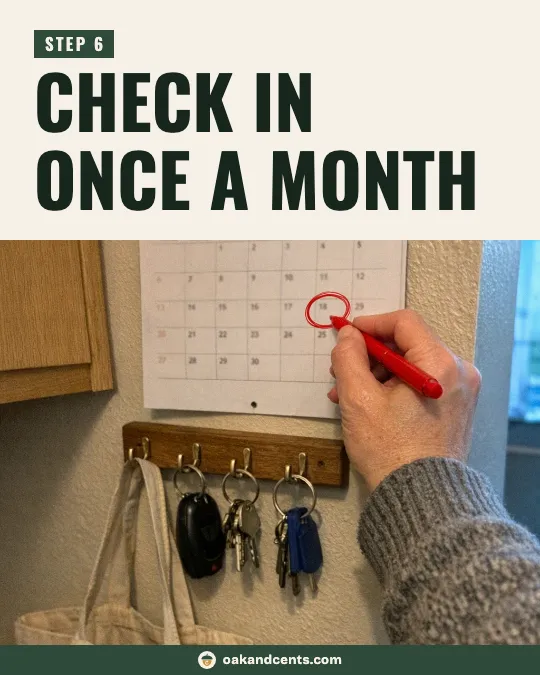
A plan that lives in a drawer slowly stops working.
You don’t need to check your debts every day. Once a month is plenty, maybe the first Sunday after payday.
That check takes about ten minutes. Here’s what to look at:
- Did every minimum go out on time?
- Did the extra reach debt number 1?
- What does each debt show now, and what’s the new total?
- Is anything coming next month, like a birthday or car registration, that needs a little set aside?
Then make the progress visible.
The free debt payoff coloring chart has 100 acorns, each one worth 1% of your goal. If you’d rather use a screen, the debt payoff tracker spreadsheet shows how much of each debt you’ve paid off.
Month three often feels slow. Early on, more of each payment goes to interest, so the totals move less than you’d hope. That’s the math, not a sign the plan is broken.
If a month goes sideways, pay the minimums, skip the extra and pick back up next month. One short month doesn’t erase the ones before it.
Ten minutes a month keeps the plan yours.
Who This Plan Fits, and When to Start Somewhere Else
This six step plan works best once the basics are steady. Here’s an honest look at where it fits.
| Good fit | Think twice |
|---|---|
| You have a regular paycheck, even a small one | Rent, a utility or a car payment is already past due |
| Every minimum fits in your budget each month | The minimums add up to more than you can pay |
| You can repeat some extra, even $20 | A debt collector is calling about a debt |
| You’d like to see a finish month | Your income just dropped and you’re not sure what’s coming |
If you’re in the right column, the plan isn’t off the table. It just starts after a different first step.
The FTC suggests calling the people you owe early, before a debt collector gets involved. Ask about a payment plan you can manage (see the FTC’s advice on getting out of debt).
A nonprofit credit counselor can also spread those statements out with you and help pick a first step. The National Foundation for Credit Counseling is a good place to start looking.
Getting steady is part of the plan, too.
Your Plan for Tonight
That car loan letter is still on the counter, tucked under the permission slip. It doesn’t need fixing tonight. It only needs to become the first line on your page.
Gather the statements and fill in the worksheet. Tomorrow, add up your minimums, choose your extra and number your debts.
Then type everything into the debt payoff calculator to see your own debt free month. If you’d like a printable to color in as you go, the free debt tracker is ready too.
Start the page tonight. The plan will follow.