A $3,000 card at 24% interest, paid at $90 a month, takes 56 months to clear. Send $190 a month instead, and it’s gone in 20, with about $1,350 less interest. The numbers are made up. The math is real.
You want the debt gone fast, but the week still needs groceries, gas and some breathing room. So fast starts to sound like a second job and no comforts at all. None of that means you’ve done something wrong.
Paying off debt fast isn’t about doing everything at once. It’s a handful of small, steady moves that point every extra dollar the same way. Here are 10 realistic ones for almost any paycheck, easiest first.
1. Put Every Debt on One Page Before You Change Anything
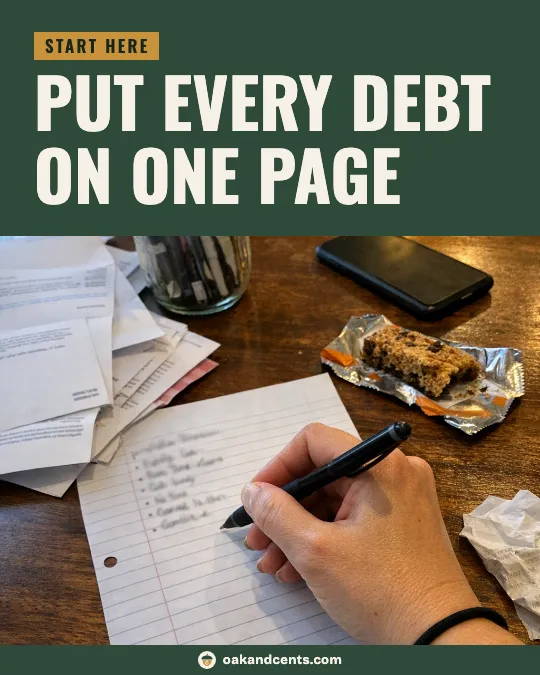
The statements live in different places. One is in an email you keep meaning to open, one is in an app, and one is on the counter under the mail.
Before you pay a single extra dollar, put them all on one page.
It’s normal to dread this part. Seeing the total in one place can make your stomach drop.
But the total is just a number. It doesn’t describe you, and it’s usually less scary on paper than it is in your head.
For each debt, write down four things: what you owe, the interest rate, the minimum payment and the due date. The rate is on your statement, often listed as APR, the yearly interest rate on the card or loan.
The free debt payoff worksheet has room for 10 debts, plus columns to number them later.
Why it matters: You can’t send extra money to the right place until you can see every place it could go.
Tonight, just gather the statements. Writing them down can wait until tomorrow.
Fast starts with clear. One page is enough.
2. Give All Your Extra Money to One Debt at a Time
Most people with a little extra split it evenly, $25 here and $25 there, so no debt feels left out.
It feels fair. It also spreads your extra so thin that nothing finishes.
The worry underneath is real: if a debt only gets its minimum, will it slip? It won’t, as long as that minimum goes out on time every month.
Here’s a made up example. Say you owe on three things: a store card with $800 at 26% interest, a Visa with $2,600 at 22%, and a car loan with $7,500 at 7%. The minimums are $30, $70 and $230.
You find $100 extra a month. Instead of splitting it, all $100 goes to one debt, on top of its minimum. Every other debt gets its minimum, right on time.
If that one debt is the store card, it’s gone in month 7. Paid at just its $30 minimum, the same card would take 41 months.
You’re allowed to leave the other debts on their minimums for a while. You’re not ignoring them. They’re waiting their turn.
Spreading feels fair. Focusing is what finishes.
3. Choose Smallest First or Highest Rate First, Then Stay With It
Once all the extra goes to one debt, the next question is which debt that should be.
There are two common orders, and both work.
- Smallest first (the debt snowball): the extra goes to the smallest amount you owe. You get a finished debt sooner, and that win can keep you going.
- Highest interest rate first (the debt avalanche): the extra goes to the debt with the highest rate. It usually costs less interest overall.
In our made up example, the store card is both the smallest debt and the one with the highest rate, so both orders start in the same place. Often they won’t.
You don’t need to find the one right answer. An order you keep up will do more than a slightly cheaper one you give up in month 3.
The snowball vs avalanche calculator runs both with your own numbers, and our guide to debt snowball vs avalanche helps you choose.
Pick one tonight and write a 1 next to that debt.
The order that works is the one you’re still following in spring.
4. Find a Small Extra Amount You Can Send Every Month

$50 a payday doesn’t sound like much. If you’re paid every other Friday, it adds up to about $108 a month.
Maybe the worry is that there’s no extra at all. For a lot of households, it hides in small leaks: a subscription nobody uses, takeout on the busiest night, the grocery run without a list.
That doesn’t mean giving up every small comfort. It means finding one or two leaks and moving that money on purpose.
Here’s what a little more each month does to that $3,000 card at 24% interest from the start. These are made up numbers, and you can check them in our credit card payoff calculator.
| Paid each month | Paid off in | Interest along the way |
|---|---|---|
| $90 | 56 months | About $1,990 |
| $140 | 29 months | About $960 |
| $190 | 20 months | About $640 |
| $240 | 15 months | About $490 |
Just $50 more a month cuts the time almost in half.
If you plan your money by payday, add the extra as its own line right after the bills. Our guide to budgeting by paycheck shows how.
Pick an amount you could send even in a tight month. You can always raise it later.
A steady $50 does more than a big payment you can only manage once.
5. Ask Your Card Company for a Lower Interest Rate

“They’ll never say yes to someone like me.” That one thought keeps a lot of people from making a five minute phone call.
The FTC suggests asking your credit card company for a lower rate (see its advice on getting out of debt). You can do it yourself, for free. You don’t need to pay anyone to call for you.
The worst answer is no, and a no costs you nothing.
If they do say yes, it adds up. If the rate on that made up $3,000 card dropped from 24% to 18%, the same $190 a month would save about $190 in interest and finish a month sooner.
Keep it short and friendly.
Say this: “Hi, I’ve been a customer for a while and I’m working on paying this card down. Is there any way to lower my interest rate?”
If they say no, ask when you could ask again, and put that date on your calendar. Write down who you spoke with and what they said.
Our full script for asking for a lower credit card interest rate has more help for the call.
One short call might do more than a month of cutting back.
6. Trim One Monthly Bill and Send the Difference to Your Debt
A lower rate makes each dollar go further. Trimming a bill gives you more dollars to send.
Think about the phone plan, the streaming services or the car insurance that renewed without anyone checking. Bills that stay the same are easy to forget, because they leave so quietly.
You don’t need to cancel everything you enjoy. Pick one bill this month: ask about a cheaper plan, compare one insurance quote, or pause a subscription nobody opens.
Say you cut $30 from your phone bill. That’s $360 a year, and if it goes straight to your target debt, it works for you every single month.
The part people miss is moving it on purpose. Money you save but don’t send tends to disappear into ordinary spending.
Our list of ways to lower monthly bills has more ideas to try.
Tonight, circle the one bill you’ll call about this week.
Saved money only helps when it has somewhere to go.
7. Give Tax Refunds and Bonuses a Job Before They Arrive
The refund lands, or a bonus shows up on a pay stub, and suddenly there’s breathing room. A few weeks later, it’s hard to say where it went.
That isn’t carelessness. Money without a plan gets pulled toward whatever feels most urgent that week.
The fix is to decide the split before the money arrives.
Here’s one made up example for a $1,000 tax refund: $700 to your target debt, $200 to your cushion, and $100 for something your family will enjoy.
Keeping a little for fun isn’t a setback. It’s what makes the plan feel livable.
The same split works for overtime or birthday money. For more coming in, our list of side hustles to pay off debt has ideas with honest pay.
Write your split on a sticky note and put it where you’ll see it when money comes in.
A plan made in advance beats a decision made on payday.
8. Roll Each Finished Payment Into the Next Debt
Then comes the day your first debt hits $0. It’s a lovely feeling, and it’s also the moment your plan speeds up.
Don’t let that payment drift back into everyday spending. Send it to the next debt on your list.
In our made up example, the store card is paid off in month 7. Its $130, the $30 minimum plus the $100 extra, now joins the Visa’s $70 minimum. So the Visa gets $200 a month.
You’re still paying the same $430 a month in total. Nothing new comes out of your budget.
Keep rolling, and the Visa is gone in month 21 and the car loan in month 29.
Paying only the minimums on each, with no rolling, the last debt would take until month 63. If the card minimums shrink as you pay, it takes even longer.
Celebrate each payoff in a small way. Then let the payment keep its job.
The free debt snowball spreadsheet does this rolling for you and shows the month you’ll be debt free.
Your plan in one line: one page of debts, one target, one steady extra amount, and every finished payment rolled forward.
Each finished debt makes the next one shrink faster.
9. Keep a Small Cushion So Surprises Stay Off the Card
The car needs new tires in the same month the school trip money is due. With no cushion, the card is the only place it can go.
That isn’t a lack of willpower. It’s what happens when every dollar is spoken for and life sends a bill anyway.
A small cushion protects the progress you’ve already made.
That doesn’t mean saving a full emergency fund before you pay extra on anything. A starter cushion is enough for now.
Setting aside $25 a week gives you $500 in 20 weeks.
For costs you can see coming, like car registration, a sinking fund works the same way. A little goes in at a time, so the bill doesn’t land on a card.
Our guide to a starter emergency fund walks through a first goal, and the emergency fund calculator can help you pick your own number.
If you do have to use the card, the plan isn’t over. Pay the minimum, refill the cushion, and pick back up.
Paying off debt fast isn’t only about sending more. It’s also about adding less.
10. Let Slow Months Count by Tracking Progress You Can See
Month three can feel like nothing is happening. The amount you owe moved, but not by much, and the finish line looks just as far away.
This is the point where a lot of plans quietly stop. Not because the plan failed, but because the progress was hard to see.
Part of that is how interest works. Early on, a bigger slice of each payment goes to interest. As the amount you owe shrinks, so does the interest, and more of every payment knocks down the debt itself.
So the slow start is built into the math. It isn’t a sign you’re doing it wrong.
A month where you paid every minimum on time and sent a little extra is a good month, even if nothing hit $0.
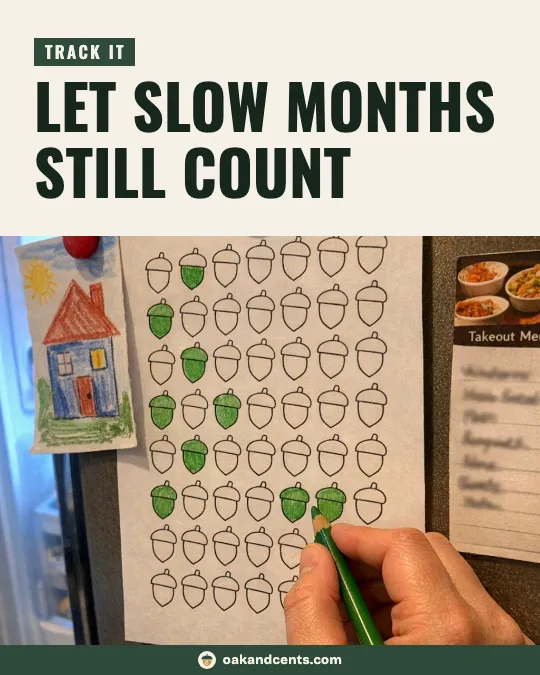
The trick is to make progress something you can see. Color in a chart, cross off a row, or watch a bar fill up.
The free debt payoff coloring chart has 100 acorns to color, each one worth 1% of your goal. There are pages for $5,000, $10,000 and $20,000, plus a blank one for your own number.
Prefer a screen? The debt payoff tracker spreadsheet shows how much of each debt you’ve paid off. Or get the free debt tracker by email.
Some months will be smaller. A car repair, a sick week or a short paycheck can eat the extra.
On those months, pay the minimums and color in what you did pay. A smaller month is still a month on the plan.
Tonight, color in or cross off anything you’ve already paid this month, so your chart starts with progress already on it.
Fast is lovely. Steady is what gets you there.
If a Bill Is Past Due, Put Speed on Hold
Sometimes even the minimums don’t fit, or a bill is already past due. If that’s where you are, nothing here is a test you failed. The order just changes.
Keep a roof, the lights and food first. Then call the people you owe before a payment is missed. The FTC suggests calling early, before a debt collector is involved, to ask about a payment plan you can manage.
Our guide on which debt to pay off first shows how to sort out what comes first.
For a second set of eyes on every bill, reach out to the National Foundation for Credit Counseling and ask about a nonprofit credit counselor.
Getting steady comes before getting fast.
Start With One Page Tonight
That $3,000 card at the top of this page didn’t need a second job or a year with no comforts. The jump from 56 months to 20 came from $100 a month and one clear target.
Tonight, gather your statements and put every debt on one page. Tomorrow, pick your target and the order you’ll follow.
When you’re ready, run your own numbers through the debt payoff calculator to see your own debt free month. For a full step by step version, our debt payoff plan guide puts every piece in order.
One page tonight. One target tomorrow.