Take a $600 card at 24% interest. Send it $175 a month and it’s gone by month 4. Send it $75 and it takes until month 9. The numbers are made up, but the gap is real.
The slower plan doesn’t look wrong. You’re paying every bill, sending extra and trying hard. That’s what makes these mistakes easy to miss: most of them look like good habits.
The fix isn’t working harder or cutting more. It’s spotting a few small leaks in a plan that’s mostly working. There are nine to check here, and fixing just one this week is enough.
1. Splitting Your Extra Money Evenly Across Every Card
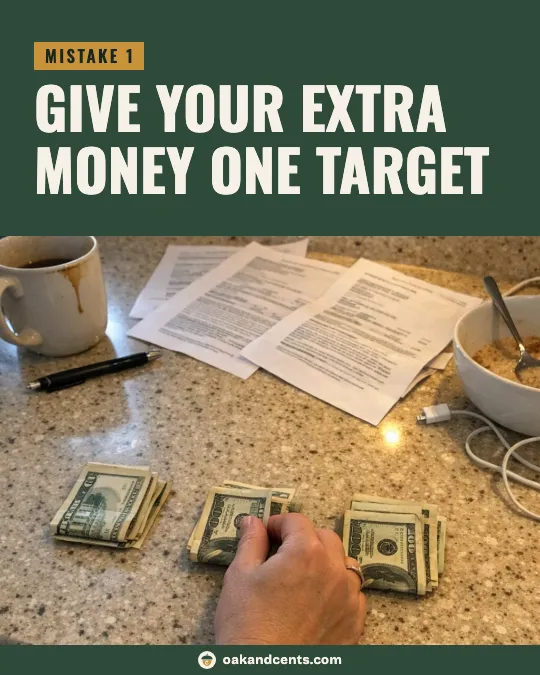
You have $150 left after the minimums, so you send $50 to each of your three cards. It feels fair.
The worry underneath is real: if a card only gets its minimum, it might slip.
But split three ways, the extra is too thin to finish anything soon. Here’s a made up example: three cards at $600, $2,400 and $4,100, all at 24% interest, with minimums of $25, $60 and $105.
| Card | Extra split $50 each | All $150 on the smallest |
|---|---|---|
| $600 card paid off | Month 9 | Month 4 |
| $2,400 card paid off | Month 24 | Month 15 |
| $4,100 card paid off | Month 28 | Month 28 |
With the same interest rate on every card, the finish line and the total interest come out about the same either way. The difference is how long each card hangs around, with its own bill and due date.
Focused, you’re down to two cards by month 4. Split, you’re still juggling three until month 9.
You’re allowed to leave a card on its minimum for a while, as long as that minimum goes out on time.
Tonight, circle one card. Every spare dollar goes there until it’s gone.
Thin payments feel fair. Focused payments finish.
2. Guessing at the Total Instead of Writing It Down
Once the extra has one target, the next question is which one. That’s hard to answer from memory.
Maybe a statement or two is still sitting in its envelope. Opening them can feel like inviting bad news into the room.
The fear makes sense. But a number you avoid stays scary, and a number on paper becomes something you can plan around.
Guessing also leads to small, costly surprises: a forgotten store card, a medical bill you thought was smaller, a minimum that went up.
Take twenty minutes with a cup of tea. For each debt, write the name, the amount you owe, the interest rate, the minimum and the due date. The free Debt Payoff Worksheet on this page has room for ten.
You don’t have to fix anything yet. This step is only about seeing.
If you’d like help choosing an order once it’s all written down, which debt to pay off first walks through it.
A number on paper is easier to face than a number in your head.
3. Letting Due Dates Sneak Up on Busy Weeks
Five debts can mean five different due dates, scattered across a month that already has rent, school forms and a birthday party.
With that many dates, one slipping past on a busy week is easy. That’s a calendar problem, not a caring problem.
It still matters, though. Missing minimum payments for several months can hurt your credit score, and you’d still owe the debt (FTC).
The fix is to take your memory out of it. Put every minimum on autopay from the account your paycheck lands in. Then your only job on payday is the extra.
The free Bill Tracker on this page gives you one page with every due date and a box to tick each month.
If a due date always lands right before payday, you can ask to move it. Lenders don’t always say yes, but asking is free.
Say this: “My paycheck comes in around the 5th. Is it possible to move my due date to the 10th, so the payment lines up with my pay?”
Autopay remembers so you don’t have to.
4. Still Using the Card You’re Paying Down
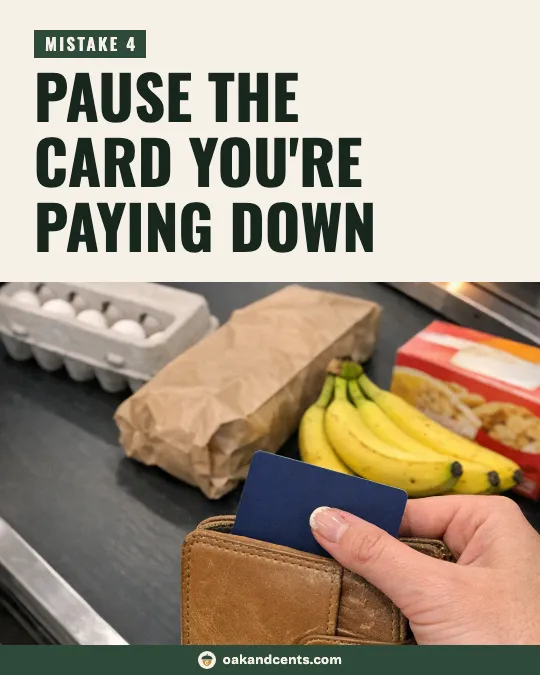
Even with every due date on autopay, there’s one leak autopay can’t fix.
You’re at the grocery store, the total is a little higher than you planned, and the card you’re paying down is right there in your wallet.
One swipe doesn’t feel like a setback. But it quietly undoes part of this month’s extra payment.
There’s an interest cost too. When last month’s bill wasn’t paid in full, new purchases usually start costing interest from the day you make them (CFPB).
That doesn’t mean you have to cut the card up or close it. It means giving it a break while you pay it down.
Try this: Take the card out of your wallet tonight, and remove it from your phone and your favorite shopping apps. Pay with debit or cash for now.
If the card is covering groceries because there’s no money left, that’s a sign the budget needs a look, not a sign you’ve failed. Making a budget while you’re in debt can help you find the gap.
You can’t empty a bucket you’re still filling.
5. Forgetting the Bills That Only Come Once or Twice a Year
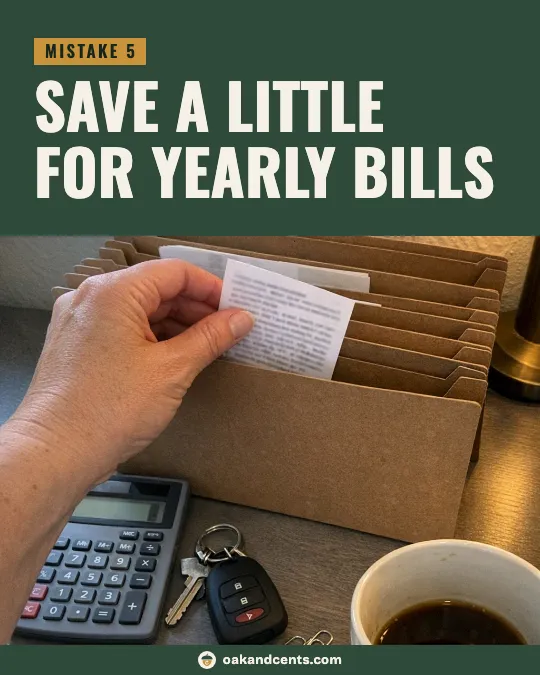
Once the card is out of your wallet, it’s often the rare bills that sneak back onto it.
Car registration. The school supply list. A yearly subscription. Holiday gifts. They aren’t emergencies. They’re just easy to forget because they don’t come every month.
When one lands with no money set aside, it tends to go on the card you’ve been paying down. Then the plan feels like it’s going backwards.
The fix is a sinking fund: a little money set aside each month for a cost you know is coming.
Here’s an example with made up numbers. A $240 car registration due once a year is $20 a month. Put $20 aside each month, and next year’s renewal is already covered.
Start with your two or three biggest yearly bills. You don’t need a fund for everything on day one.
The free Sinking Funds Tracker on this page has six columns for exactly this. If sinking funds are new to you, what sinking funds are explains them in plain words.
A bill you saw coming isn’t a setback. It’s just a bill.
6. Paying Off Debt With No Cushion at All
It’s easy to think every spare dollar should go to the debt. That feels like the fastest way out.
Then a tire goes flat, the repair is $180 and there’s nothing in savings. So it goes on a card, and two months of extra payments disappear in an afternoon.
That isn’t bad luck or poor planning. Surprises are part of a normal year.
A small cushion keeps them away from your cards. It doesn’t need to be big. Even a few hundred dollars covers a lot of ordinary surprises.
That doesn’t mean pausing your debt plan for a year. It means slowing the extra for a few weeks while you build a small starter fund, then speeding back up.
A starter emergency fund walks through saving your first $1,000, one payday at a time.
Keep it somewhere a little out of reach, like a separate savings account, so it waits for real surprises.
A small cushion protects every payment you’ve already made.
7. Switching Methods Every Few Weeks
“Maybe the avalanche would be smarter.” “No, the snowball feels better.” Then back again.
It’s natural to second guess a plan, especially in the slow months. Every new article seems to have a better idea.
But each switch moves the extra to a new target before the old one is finished. Progress gets spread around, and the first payoff keeps sliding further away.
The truth is that both methods work. In our five debt example, the avalanche saves about $300 compared with the snowball, while the snowball clears its first debt 11 months sooner.
The debt snowball vs avalanche guide shows both side by side.
Either one beats switching back and forth.
Pick one, write the order on paper and give it at least three months. The debt payoff calculator can help you choose with your own numbers.
The best method is the one you stop debating.
8. Making the Budget So Tight It Snaps
You cut every bit of fun from the budget to free up more for debt. No takeout, no coffee out, nothing for yourself.
It works for a few weeks. Then a long Friday arrives, and a $60 takeout night happens anyway, with a side of feeling like you failed.
The problem isn’t your willpower. A plan with no room for real life is very hard to keep.
That doesn’t mean spending freely. It means a small, planned fun line, like $20 a week, that you can use without a second thought.
A fun line you planned isn’t a leak. It’s what keeps the plan going in month eight.
The 50/30/20 calculator shows one way to split your paycheck so wants have a home too. And if small purchases keep slipping through, these pauses before you pay can help.
A slightly slower plan you keep beats a strict one you abandon.
9. Treating One Hard Month as the End of the Plan
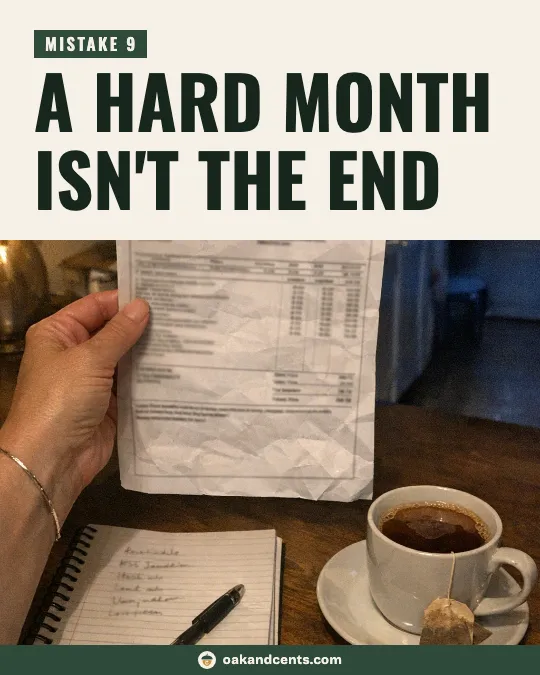
All the fixes above make the plan steadier. None of them make it unbreakable, and that’s okay.
Maybe it’s month 6. The car needs a repair, and this month’s extra goes to the mechanic instead of the card.
The thought comes fast: “I’ve ruined it.” From there, it’s tempting to stop tracking, stop opening the app and let the plan quietly fade.
That’s the mistake that costs the most, and it isn’t the repair. It’s quitting after it.
Here’s what one hard month really does, using a made up household with five debts and $150 extra each month. On the snowball plan, they’re debt free in month 32.
Say they skip the $150 extra in month 6 and pay only the minimums. They’re still debt free in month 32. The cost is about $80 more in interest over the whole plan.
Even skipping the extra three months in a row only moves the finish to month 33, for about $240 more in interest.
One month off the plan isn’t the end of the plan. It’s a bump in it.
What protects you in a hard month is the floor: every minimum, paid on time. Keep that, and you can restart the extra on your very next payday.
It helps to decide your restart date out loud. Write it at the top of your debt list: “Extra starts again on the 15th.”
If the hard month turns into several, and minimums start slipping, that’s the moment to ask for help, not to hide. Call your lenders about a payment plan.
A nonprofit credit counselor can help you decide which bills come first while things are tight. The National Foundation for Credit Counseling can steer you to one.
When it’s time to see your progress again, a coloring chart or the free debt tracker makes the total feel real. Every colored square still counts.
Progress is rarely a straight line. A plan that bends is still a plan.
Try This 3 Minute Check Before Your Next Payday
You don’t have to fix all nine at once. Read these five questions and see which one makes you pause.
- Does all of my extra money go to one debt?
- Do I have every debt, minimum and due date written in one place?
- Are all my minimums on autopay?
- Is the card I’m paying down out of my wallet and apps?
- Do I have money set aside for at least one yearly bill or surprise?
A “no” isn’t a failure. It’s simply the next thing to work on.
Pick One Mistake to Fix This Week
The $600 card from the opening is the whole lesson in small. The only thing that changed between month 9 and month 4 was where the extra went.
Most of these fixes are like that: small, a little boring and quietly powerful.
This week, choose one. Circle one card, set up one autopay, or move one card out of your wallet.
Then run your numbers through the debt payoff calculator to see your own finish line.
One small fix this week is plenty. The plan will do the rest of the work, payday by payday.