Say your household spends about $4,000 a month, made up numbers. The advice you hear most is three to six months of expenses, so the math lands somewhere between $12,000 and $24,000.
That number can feel like a wall. Saving it seems impossible, but skipping it feels risky, so it’s easy to get stuck in between. That in between spot is where plenty of hardworking people end up when the target is this big.
The answer isn’t a bigger paycheck. It’s a more honest number, built from the bills you can’t skip and reached in small stops. Three short steps give you a range that fits your household, a first stop you can reach and a payday plan to get there.
Three to Six Months Is a Rule of Thumb, Not a Rule
An emergency fund is money set aside for the month your pay drops or a big surprise bill lands. A job loss, a hospital bill, a car that won’t start on a workday.
Its only job is to be there, so a hard month doesn’t turn into new debt.
You’ve probably heard “three to six months of expenses.” It’s a common rule of thumb, and a good place to begin. It just leaves out two things that matter.
First, it says “expenses,” which sounds like everything you spend now. In a real emergency, a lot of that spending can pause for a while.
Second, it treats every paycheck the same. A steady paycheck and a month of tips are not the same kind of risk.
That doesn’t mean the rule is wrong. It means your number can be more personal than the rule.
An emergency fund also isn’t for costs you can see coming, like Christmas or the car registration. Those belong in sinking funds, so the emergency money stays put.
The three steps below turn the rule of thumb into your own number.
Step 1: Add Up the Bills You’d Still Pay in a Hard Month
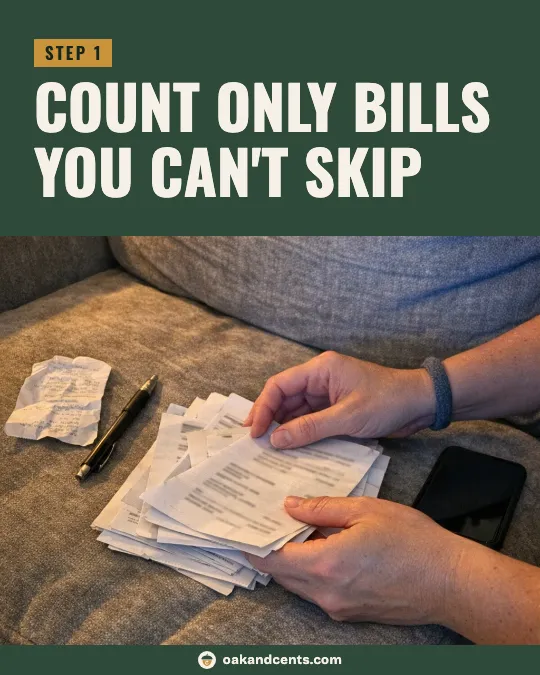
It’s Sunday night and you’re checking what’s due this week. Some bills could wait if money got tight. Others can’t.
Those are the ones your emergency fund needs to cover.
Think about the bills that keep the lights on and get you to work: rent or mortgage, utilities, groceries, gas or a bus pass, insurance, childcare and the minimum payment on every debt.
The rest can usually pause for a few months. Streaming, eating out, gifts and any extra debt payments on top of the minimums.
Here’s the made up household from the intro. It spends $4,000 a month, but the bills it can’t skip look like this:
- Rent: $1,300
- Utilities: $200
- Groceries: $600
- Gas and car costs: $300
- Insurance: $200
- Minimum debt payments: $250
- Other bills that can’t wait: $150
That adds up to $3,000 a month, not $4,000.
Bills that come once or twice a year count too. A $600 car insurance bill every six months is about $100 a month on this list.
Note: Use what a lean month really costs, not a hopeful guess. A grocery number that’s too low makes the goal look smaller than it is.
The emergency fund calculator has this same example filled in, so you can swap in your own numbers line by line.
Your fund doesn’t have to cover your whole life. It has to cover the bills that can’t wait.
Step 2: Choose a Range That Fits How Steady Your Pay Is
Now multiply that monthly number by a range of months. Which range depends mostly on one thing: how steady your pay is.
When the same paycheck lands on time every two weeks, the main worry is a big bill or a job change.
When pay rises and falls with tips, commission or gig work, slow months are part of the pattern, so the cushion has more to do.
The same goes when one income supports the whole family. A gap in that paycheck reaches everyone.
Here’s how the ranges look with the example’s $3,000 of monthly bills. These are the ranges our calculator uses, and they’re a guide, not a rule.
| Your pay | Months of bills | With $3,000 a month |
|---|---|---|
| About the same every month | 3 to 6 | $9,000 to $18,000 |
| Changes month to month | 6 to 9 | $18,000 to $27,000 |
| One income, family counting on it | 6 to 9 | $18,000 to $27,000 |
Other things can nudge you toward the top of your range: an older car, ongoing health costs or a job in a field with layoffs. Two steady incomes may make the low end feel fine.
If the number in your row makes your chest tighten, that’s a normal first reaction. You aren’t meant to save it this year.
Think of the range as the finish line. Step 3 is the first stop.
Step 3: Set a Small Starter Goal You Can Reach First

The car makes a new noise on the drive to school. Even a few hundred dollars set aside can keep that repair off a credit card.
That’s why a starter goal comes first.
A simple way to set it: $1,000 or one month of your bills, whichever is smaller. If your bills come to $800 a month, $800 is your first stop. For the example household, it’s $1,000.
Here’s the math with made up numbers. Say $400 is already saved and $200 a month can go in. That reaches $1,000 in 3 months.
If $200 isn’t there right now, smaller amounts still move. $50 every two weeks is about $108 a month, and in the example it reaches $1,000 in about 6 months.
From there, the next stops are one month of bills ($3,000 in the example), then three months ($9,000). At $200 a month, the climb from $1,000 to $3,000 takes 10 months.
That sounds slow, and it is. But each stop makes the next surprise a little smaller.
Our guide to a starter emergency fund has more ways to find that first $1,000.
Your plan in one line: the bills you can’t skip, times the months that fit your pay, reached one small stop at a time.
Every stop you reach is real money between you and the next hard month.
Emergency Fund or Debt? Many People Do a Little of Both
If you’re paying down a credit card, it can feel wrong to leave money sitting in savings while interest piles up.
It can also feel risky to send every spare dollar to the card with nothing set aside. Then one surprise bill goes right back on it.
That’s why many people paying off debt use an order like this:
- Pay at least the minimum on every debt, every month.
- Build the starter fund.
- Send most extra money to debt, using a plan like the debt snowball or avalanche.
- Come back and finish the full fund once the debts are paid, or sooner if your pay is shaky.
That’s general education, not advice for your situation. The order that fits you depends on your interest rates, your job and your family.
The debt payoff calculator can show how fast extra payments would clear each debt once the starter fund is in place.
If the starter fund gets used along the way, that’s what it’s there for. Refill it first, then go back to the extra debt payments.
A small cushion and a steady payoff plan can work side by side. You don’t have to pick one forever.
Keep It Somewhere Boring and Save It for Real Emergencies

Money in your everyday checking has a way of disappearing on a busy week. A separate savings account keeps it out of sight but still close.
Most people keep their fund at a bank with FDIC insurance or a credit union with NCUA insurance. Both protect your savings up to set limits if the bank or credit union fails.
Keep it out of the stock market too. An investment can be down right when the washing machine floods the laundry room.
Before you use the fund, ask three quick questions. Did I see this coming? Do I truly need it? Can it wait until payday? If it’s unexpected, necessary and urgent, that’s what the fund is for.
If you share money with someone, agree on those rules ahead of time.
Say this: “Can we agree the emergency account is only for things like a job loss, a medical bill or the car breaking down? If it’s anything else, let’s talk about it first.”
And if you do use it, nothing went wrong. Refill it with the same small payday amount and keep going.
Boring is the point. The fund’s whole job is to be there.
Start Even Smaller If Rent or a Bill Is Behind
This three step method fits well when you have a regular paycheck, even a small one, and your bills are being paid on time.
It works with pay that changes too. Base Step 1 on a slow month, use the 6 to 9 month row and let the good months do a little extra.
Think twice if rent or a utility bill is already past due, a debt has gone to collections or a card is covering groceries each month. Those come first, before any savings goal.
In that case, a much smaller cushion is a fine place to start. Even $100 set aside can soften a bad week.
If you’d like someone to look at the whole picture with you, a nonprofit credit counselor can help you decide what to pay first. Counselors in the National Foundation for Credit Counseling network offer that kind of help.
A smaller number that’s honest about your month is better than a big one that keeps you from starting.
Find Your Number Tonight
The wall at the start was $12,000 to $24,000. For the example household, the honest range turned out to be $9,000 to $18,000, and the first stop was just $1,000.
Your numbers will be different, and they’ll be yours.
Tonight, add up the bills you’d still pay in a hard month. Then open the emergency fund calculator, type them in and pick how steady your pay is.
Set one small automatic transfer for the day after payday, and write the first deposit on the free savings tracker when it lands.
The big number can wait. The first stop is close enough to start this week.