The little amber light on the dashboard comes on during the school run, and your stomach drops before you’ve even parked. You already know where the repair is going: on the card.
Paying down debt and saving at the same time can feel like being asked to do two jobs with one paycheck. Of course you feel torn. Both jobs matter.
The answer isn’t a giant savings account. It’s one small, separate cushion, built a little at a time. This guide helps you pick a starter number, a weekly pace that fits your pay and a few places to find the first dollars.
A Starter Emergency Fund Is a Small Cushion, Not the Whole Plan

A starter emergency fund is a small amount of money you keep only for surprises. The tire that goes flat, the urgent care copay, the furnace that clicks and won’t start.
It doesn’t need to cover everything. It just needs to catch the first hit, so the next surprise doesn’t land on a credit card.
That’s why it’s small on purpose.
A full emergency fund usually means a few months of bills, and that can take years to save. A starter fund is the first stop on that road, and you can reach it much sooner.
That doesn’t mean a starter fund is all you’ll ever need. It means you don’t have to wait for the big number to feel a little safer.
Once it’s in place, our guide to how much an emergency fund should be walks through the bigger goal.
A small cushion that’s really there does more for you than a big one that’s still a plan.
Pick Your Number: $1,000 or One Month of Bills
You’ve probably heard $1,000 as the classic starter goal. It’s a nice round number, and it covers a lot of everyday surprises.
There’s one tweak worth making. Use $1,000 or one month of your bills, whichever is smaller.
Your bills here means the ones you’d still pay in a hard month: rent, utilities, groceries, getting to work, insurance and the minimum on every debt.
If those come to $800 a month, $800 is your starter goal. It covers a full month of the basics, and it’s a more honest first stop than a round $1,000.
If they come to $2,500 a month, your starter goal is $1,000.
Not sure what your bills add up to? The emergency fund calculator adds them for you and shows your starter goal right away.
The right first number is one you can actually reach.
Choose a Weekly Amount You Can Keep
When the goal is $1,000, it’s easy to think $20 won’t make a dent. It does, because it keeps coming back every week.
What matters most is an amount you can keep sending, even in a tight week.
Here’s how long $1,000 takes at a few weekly amounts. These are example numbers, starting from zero.
| Save each week | About each month | Reach $1,000 in |
|---|---|---|
| $20 | $87 | 50 weeks |
| $25 | $108 | 40 weeks |
| $50 | $217 | 20 weeks |
| $100 | $433 | 10 weeks |
Paid every two weeks? Double the weekly amount for each payday. $50 a payday is the same as $25 a week.
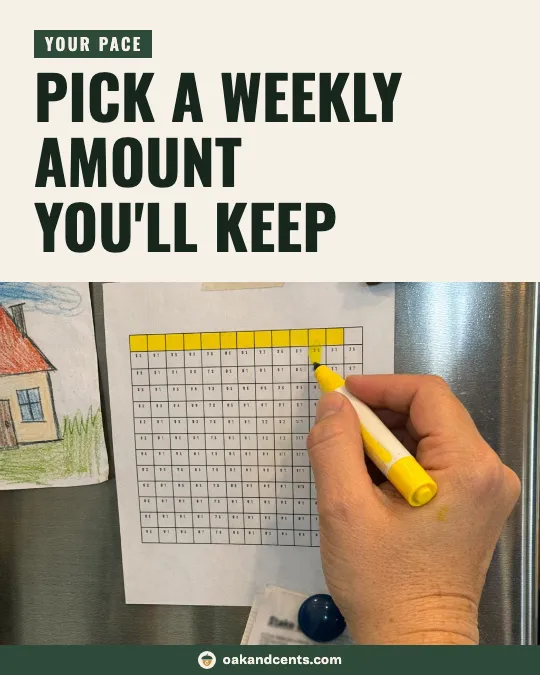
If you like coloring in progress, two free charts on this page can help.
The $1,000 in 100 Days chart has 100 boxes, one for each day you save $10. The Biweekly Payday Challenge has 26 boxes, one for each payday.
At $20 a payday, the biweekly chart adds up to $520 over a year. At $40 a payday, it’s $1,040.
A slow pace isn’t a failure. Some weeks you’ll send more, some weeks less.
The amount you keep sending will get further than the one you stop.
Find the First Dollars Without Cutting Everything
You don’t have to give up every small joy to build this fund. Often, the first few hundred dollars are already sitting around in some form.
Here are six places many households can look:
- Something you no longer use. A stroller, a gaming console or a bike that just gets dusted. One or two sales can give the fund a jump start.
- A refund or rebate. A tax refund, a store return or a deposit you get back. Send part of it straight to the fund before it blends into checking.
- One subscription you forgot about. Cancel the one you don’t miss and move that same amount each month.
- The change jar. Roll the coins in the kitchen jar and deposit them. It’s small, and it counts.
- A few extra hours. Extra shifts, babysitting or a weekend gig. Our list of side hustles to pay off debt has more ideas with honest pay.
- A pause on extra debt payments. Already paying extra on a card? Some people send that extra here for a few months. Every minimum still goes out.
If your bills feel too high to save anything, our guide to lowering your monthly bills is a good place to look first.
You don’t need all six. One or two can get the fund started this month.
Give the Money a Home Where It’s Hard to Spend
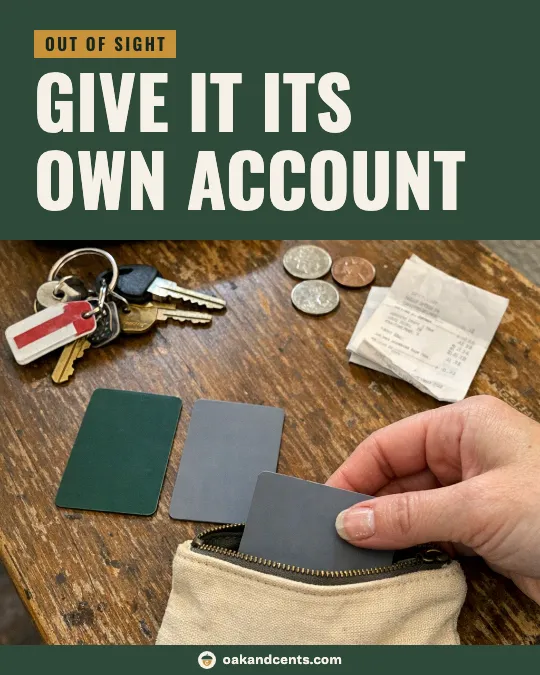
Money in your everyday checking has a way of turning into groceries and takeout. That isn’t a character flaw. It just looks like spending money when it sits next to spending money.
So give it a separate home.
A savings account works well, especially one you don’t see every time you open your banking app. Some people keep it at a different bank so a transfer takes a day, which gives them a moment to pause.
Check that the account has FDIC insurance at a bank or NCUA insurance at a credit union. Both protect your savings up to set limits if the bank or credit union fails.
Then set an automatic transfer for the day after payday. The money moves before the week’s spending starts, and you don’t have to remember.
If you share money with a partner, agree on the plan together so neither of you is surprised by the transfer.
Say this: “Could we keep $1,000 just for emergencies before we put extra on the card? I’d feel calmer if we moved $25 every payday into savings until we get there.”
Try this: Give the account a plain nickname, like “Only for surprises.” It’s easier to leave alone when the name reminds you what it’s for.
Your plan in one line: one small starter number, one separate account and one automatic transfer the day after payday.
Out of sight, but a day away when you need it.
Keep Paying Every Minimum While You Save
It can feel wrong to save while you still owe money. Interest on a card keeps adding up, and every dollar in savings is a dollar not paying it down.
That worry makes sense. But without any cushion, the next surprise usually goes right back on the card, and the progress slips.
That’s why many people paying off debt use a simple order: pay every minimum, build the starter fund, then send extra money to debt.
The minimums are the part that never pauses. Keep them on autopay while the fund grows.
Once the starter fund is full, the extra goes back to your debts. A plan like the debt snowball method gives that extra money one clear target.
This is general education, not advice for your situation. The order that fits you depends on your interest rates, your job and your family.
A small cushion protects the debt plan. It doesn’t compete with it.
Use It, Refill It and Notice Every Milestone
The first time you use the fund, it can feel like going backwards. It isn’t. That’s exactly what it’s for.
Before you dip in, ask three quick questions. Did I see this coming? Do I truly need it? Can it wait until payday?
If it’s a surprise, it’s needed and it can’t wait, use the fund. That’s its job. A broken car you need for work counts. A sale on boots doesn’t.
Costs you can see coming, like back to school or Christmas, belong somewhere else. Our guide to sinking funds shows how to save for those separately.
After you use it, refill it with the same payday amount. Then keep going.
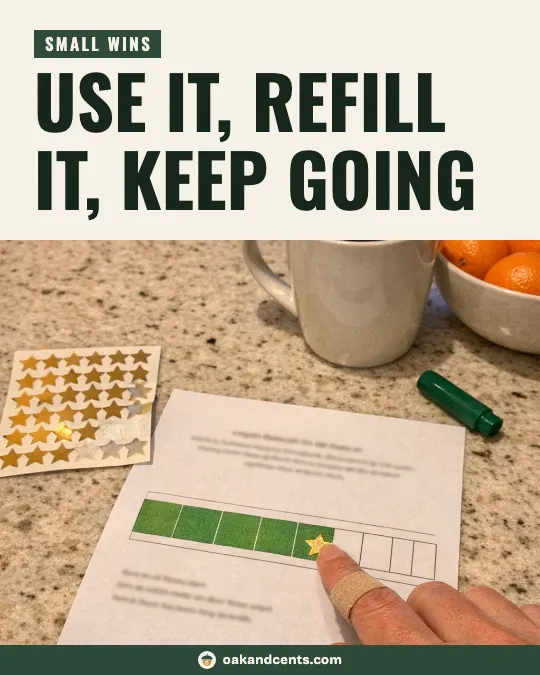
Along the way, notice the stops: $250, $500, $750. Color the boxes on your chart or fill in the progress bar on the free Savings Tracker.
Around month three, the habit can start to feel slow. That’s normal. Look back at the first box you colored and see how far it is from where you are now.
A fund that gets used and refilled is working. A fund that’s never touched is just waiting its turn.
Catching Up on Late Bills Comes Before the Cushion
A starter fund fits well when your bills are being paid on time and there’s even a little left after the basics.
Think twice if rent, utilities or a minimum payment is already past due, or if a debt has gone to collections. In those months, catching up comes first.
That doesn’t mean saving is off the table forever. It means the order changes for a little while.
A nonprofit credit counselor can help you set the order when everything feels due at once. Member agencies of the National Foundation for Credit Counseling are a good first stop.
Starting later is still starting.
Move Your First $10 Tonight
The next time that amber light comes on during the school run, the repair can come out of a fund instead of going on the card.
Tonight, figure out your starter number: $1,000 or one month of bills, whichever is smaller. Then move $10 into a separate savings account and color the first box on the free chart.
Set the automatic transfer for your next payday before you close the app.
If you’re also paying down a card, keep your free debt tracker nearby. Watching both numbers move in the right direction is its own quiet kind of relief.
The first $10 is the hardest one. Every dollar after it has company.