Payday lands on Friday, and by Tuesday the account already looks thinner than it should. The bills are paid and the groceries are put away, but the rest seems to have slipped through your fingers.
A detailed budget with thirty categories sounds exhausting. Having no budget at all feels worse. Wanting something in between is a very reasonable thing to want.
The 50/30/20 rule is that in between. It’s three simple buckets for your pay, and no receipts to sort at midnight. Your own three numbers are a few minutes away, with example paychecks to check them against.
What the 50/30/20 Rule Means in Plain Words

The 50/30/20 rule gives every paycheck three jobs.
- 50% for needs: the things you have to pay to live and work.
- 30% for wants: the things that make life nicer but could pause if they had to.
- 20% for savings and debt: your emergency fund, retirement and anything you pay above the minimum on a debt.
That’s the whole rule. You’ll also see it called a 50/20/30 budget. It’s usually the same idea with the buckets listed in a different order.
Why does it help? Most people find thirty categories hard to keep up with. Three buckets are easy to remember on a busy Tuesday.
That doesn’t mean you have to hit 50, 30 and 20 exactly. It’s a starting split, not a test.
The 20% is the part that moves you forward. Even a smaller number there, kept every month, adds up.
A rough split you keep beats a detailed plan you drop by February.
Use the Pay That Lands, Not the Number Before Taxes
Start with the money that actually shows up in your account. That’s your pay after taxes, health insurance and anything else that comes out first.
The rule is usually based on that number, because it’s the money you can really plan with. If money for retirement comes out of your paycheck before payday, some people count it as part of the 20%.
Next, turn your paycheck into a monthly number, so the three buckets line up with your monthly bills.
Here are two examples with made up numbers:
- Paid every two weeks: you get 26 paychecks a year, so $2,000 each time works out to about $4,333 a month.
- Paid every week: $500 a week is about $2,167 a month.
You don’t need to do that math by hand. The free 50/30/20 calculator turns any paycheck into a monthly number for you.
If two of you share the bills, add both paychecks after taxes and split the total the same way.
If your pay changes from month to month, use a lower month you’ve actually had. When a bigger month comes, the extra can go straight to the 20%.
If you’d rather plan payday by payday, the same split works on each check. The guide to budgeting by paycheck shows how to match bills to paydays.
Plan on the steady number. Give the extra a job when it shows up.
Sort Your Spending Into Needs, Wants and the 20

Sorting is where the rule gets real. Grab last month’s bank statement and a pen, and give each charge one of three labels.
Needs usually include:
- Rent or mortgage
- Utilities and a basic phone plan
- Groceries
- Insurance and medical costs
- Getting to work: gas, transit or a car payment
- Childcare
- The minimum payment on each debt
Wants usually include eating out, streaming, hobbies, trips, new clothes beyond the basics and the nicer version of a need.
The 20 covers your emergency fund, retirement and any extra debt payments.
The gray areas are where people get stuck. A simple test helps: the basic version is a need, and the upgrade is a want.
Groceries are a need. Takeout on a Friday is a want. A phone plan is a need. The newest phone on a payment plan is partly a want.
That doesn’t mean wants are bad. They’re a full 30% of the plan on purpose.
Labels aren’t judgments. They’re just a way to see where the money goes.
Count Minimum Payments as Needs and Extra as the 20
The card statement arrives, and the minimum payment is printed in bold. That minimum belongs in needs, right next to rent.
Missing it can bring late fees and can hurt your credit, so it’s treated like any other bill you have to pay.
Anything you pay above the minimum goes in the 20%.
Here’s an example with made up numbers. A card’s minimum payment is $40, and you send $140. The $40 sits in needs. The other $100 counts toward the 20.
That’s a kinder way to see it. Extra debt payments aren’t spending. They’re progress.
If all of your 20% goes to debt for a while, your savings line may read $0. Many people keep a small starter emergency fund first, so a surprise doesn’t land right back on the card.
If you have more than one debt, the debt snowball method is one simple way to choose where the extra goes first.
Minimums keep you current. The 20 is what moves you forward.
Three Paycheck Examples, Split the 50/30/20 Way
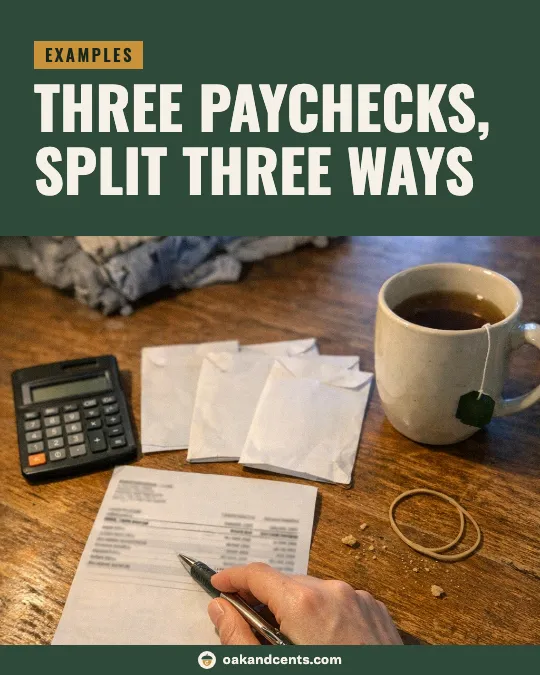
Examples make the rule easier to picture. Here are three monthly paychecks, after taxes, split the classic way. The amounts are made up.
| Monthly pay after taxes | Needs (50%) | Wants (30%) | Savings and debt (20%) |
|---|---|---|---|
| $2,500 | $1,250 | $750 | $500 |
| $3,500 | $1,750 | $1,050 | $700 |
| $4,500 | $2,250 | $1,350 | $900 |
Take the middle row. With $3,500 a month, needs get $1,750, wants get $1,050 and savings and debt get $700.
If rent is $1,100, that leaves $650 in needs for groceries, utilities, gas, insurance and minimum payments. That might fit, or it might be tight. Either way, now you know.
The $700 in the 20 might go $200 to an emergency fund and $500 to extra card payments. It’s your call.
Your own numbers will sit somewhere between these rows, or outside them. The split works the same way.
Try this: Write your monthly pay at the top of a page, then three lines under it: half, 30% and 20%. Tape it inside a cabinet where you’ll see it on payday.
Three numbers on one page can do more than a budget app you never open.
When Needs Take More Than Half, Try a Gentler Split
You add up rent, utilities, groceries and the car, and needs already take 60% of your pay. Your stomach drops a little.
That’s usually about rent and prices, not about you.
The 50/30/20 rule is a starting point, and it bends. When needs run high, two other splits can fit better for now:
- 60/20/20: 60% needs, 20% wants, 20% savings and debt. On $3,500 a month, that’s $2,100, $700 and $700.
- 70/20/10: 70% needs, 20% wants, 10% savings and debt. On $3,500 a month, that’s $2,450, $700 and $350.
That doesn’t mean you’ve given up on saving. A 10% share kept every month still moves you forward.
Check your split again when something changes: a raise, a new lease or a car that’s finally paid off.
If you’re paying off debt, you can also shift part of the wants bucket into the 20 for a season. Moving just 5% on $3,500 a month means $175 more toward a card or savings.
The best split is the one you can keep, month after month.
Check Your Split With the Free Calculator or Template

You can find your three numbers in a couple of minutes without any spreadsheet skills.
The free 50/30/20 calculator asks for your paycheck after taxes and how often you’re paid. It shows your needs, wants and savings numbers, and lets you try the 60/20/20 and 70/20/10 splits too.
You can also type in roughly what you spend now, to see how close you are. All the math happens in your browser, so nothing you type is sent anywhere.
If you’d like something to keep and update, the free 50/30/20 budget template is an Excel file with the formulas already in it.
You type your pay after taxes and how often you’re paid, and it works out your targets each month.
Then you list your spending and pick Need, Want or Savings and debt for each line. The sheet shows where you’re over or under. It opens on a short “How to use” tab, with example numbers you can replace.
It also opens in Google Sheets: upload it to Google Drive and open it with Google Sheets. There’s no sign up.
If you share money with a partner, try the split together first.
Say this: “Can we try splitting our pay 50/30/20 for one month, just to see how close we already are?”
Seeing your real numbers is often less scary than guessing at them.
When Three Buckets Aren’t the Right Shape
The 50/30/20 rule fits well when you want a simple plan without tracking every dollar. It also works when your pay is fairly steady and your bills are paid on time.
Think twice if your needs take most of your pay, even with a 70/20/10 split.
You might also prefer more detail while paying off debt. A zero based budget gives every dollar a job, which can feel more in control.
The same goes if a bill is past due or a debt has gone to collections. Those need attention before any split.
If you’re not sure what to pay first, a nonprofit credit counselor can go through the numbers with you. The National Foundation for Credit Counseling can point you to one.
A budget that doesn’t fit isn’t a sign you did something wrong. It’s a sign to try a different shape.
Find Your Three Numbers Tonight
That Tuesday account doesn’t have to look so thin next time. Next payday, the money can have a plan before Tuesday arrives.
Tonight, write down your monthly pay after taxes. Find half of it, then 30% and 20%, or let the calculator do it for you.
Then pick one thing to change this month, like moving a little more into the 20.
Three numbers are enough to start. The rest can follow.