It’s Thursday night, payday is tomorrow, and you already know where most of it is going. Rent is due on the 1st, the car insurance comes out on the 5th, and the kids need new shoes.
A monthly budget can look fine on paper. Then three bills land in the same week, and the paycheck in between feels impossibly thin. The calendar caused that squeeze, not your planning.
Budgeting by paycheck isn’t a stricter budget. It’s the same money, planned one payday at a time, so every bill knows which check it comes from. Four simple steps set it up, and your next payday can be planned before it lands.
A Paycheck Budget Plans Two Weeks at a Time, Not a Whole Month
A paycheck budget is a plan for one paycheck, made before it arrives.
Most budgets are built by the month. But if you’re paid weekly or every two weeks, your money doesn’t arrive by the month. It arrives in pieces, and the bills don’t always line up with them.
That’s where the tight weeks come from. Not from spending too much, but from timing.
A paycheck budget answers one question each payday: which bills does this check pay, and what’s left?
You don’t have to throw out your monthly budget. Think of the paycheck plan as the monthly budget, cut into payday sized pieces.
It works best when you’re paid weekly or every two weeks, and when a few big bills bunch up near the same date. If you’re paid once a month, a simple monthly budget may be all you need.
The month is the big picture. The paycheck is where the plan actually happens.
Step 1: Write Down Every Payday and Every Due Date
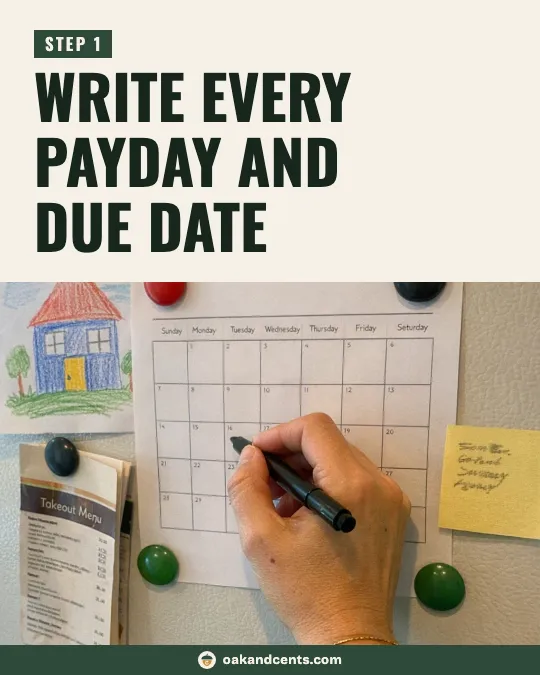
Before you plan any money, you need to see when it comes in and when it goes out.
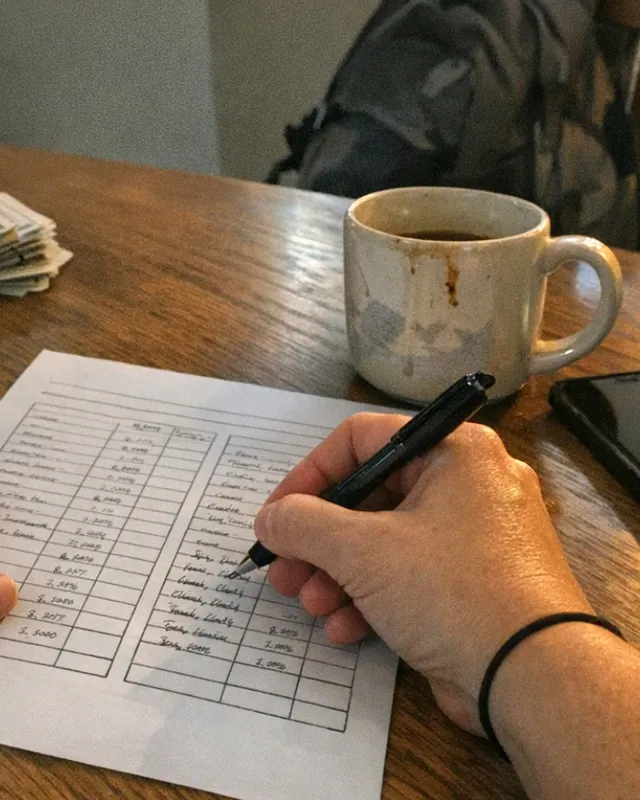
Grab a paper calendar, the notes app or one sheet of paper. Write down your paydays for the next two months.
Then list every bill with its due date and amount: rent, utilities, phone, car payment, insurance, card minimums, childcare and subscriptions. Include the ones that come out on their own, because those are the easiest to forget.
The CFPB’s free bill calendar suggests marking each payment a few days before it’s due: two or three days early for online payments, and at least seven days early if you pay by mail.
It also has you add your paydays, so you can compare the two.
That doesn’t mean tracking every coffee. This step is only about the big, regular things.
The free bill tracker on this page has room for every bill, its due date and a paid box for each month.
Once paydays and due dates sit side by side, the tight weeks stop being a mystery.
Step 2: Match Each Bill to the Paycheck Before It’s Due
Now pair them up. Each bill gets paid from the paycheck that lands before its due date, not the one after.
Here’s a made up example. You’re paid every other Friday, and rent is due on the 1st. So rent comes from the last paycheck of the month before.
The phone bill is due on the 18th, so it comes from the paycheck that lands just before it.
Write each bill under its paycheck. Then add up each group.
You’ll probably notice one paycheck carries a lot more than the other, usually the one that covers rent. That’s normal.
If a due date makes one paycheck too heavy, ask to move it. Some companies will, and it often only takes one short call.
Say this: “I’m paid every other Friday. Could you move my due date to the 20th so it lines up with my paycheck?”
Keep paying on the old date until the new one shows up on your statement.
A bill with a paycheck assigned to it is a bill you’ve already planned for.
Step 3: Set Aside Everyday Spending From Each Paycheck

Bills aren’t the only thing each paycheck has to cover. There’s also the grocery run, the gas tank and the small things that keep the house going.
Spending that changes each month is easy to forget in a budget, because it doesn’t send a bill. It just happens.
So give it a set amount from every paycheck, the same way you’d treat a bill.
Here’s the example from our free paycheck budget template, with made up numbers: $430 from each paycheck for groceries ($225), gas ($80), household and personal things ($40), fun money ($25) and a little savings ($60).
That doesn’t mean every week has to look the same. It means each paycheck starts with the basics already set aside.
If you like cash, this is where cash stuffing fits: one envelope per category, filled on payday. If groceries are the hardest part to keep steady, these grocery habits can help.
A set amount for everyday spending keeps the bills from losing a tug of war with the grocery store.
Step 4: Give What’s Left a Job Before the Week Starts
After bills and everyday spending, some paychecks have money left over. That money needs a job before it quietly becomes takeout.
Leftover money with no plan tends to disappear, even in careful households. It’s not a character thing. It’s just how open money behaves.
Before you spend anything else, decide where the rest goes:
- A cushion for the rent paycheck, if the next one will come up short.
- Extra on one debt, usually the one you’re paying off first.
- Savings for costs you know are coming, like car repairs or Christmas, also called sinking funds.
- A little breathing room in checking, so one surprise doesn’t become an overdraft.
If you like the idea of giving every dollar a job, a zero based budget takes this one step further.
The debt payoff calculator can show what even $50 of extra each payday does to your payoff date.
Money with a job is money you decided about. That’s the whole point.
When the Rent Paycheck Comes Up Short
Here’s the part that can feel confusing at first. Sometimes the paycheck that covers rent can’t cover it alone, even when the month adds up.
That isn’t a sign the budget is broken. It means the paycheck before it needs to help.
Here are the first four paydays from the example in our free paycheck budget template.
It uses made up numbers: $1,850 every two weeks, $430 set aside from each check for everyday spending and savings, and rent of $1,200 due on the 1st.
| Payday | Bills from this check | Left from this check | Running total |
|---|---|---|---|
| Oct 9 | $597 | $823 | $823 |
| Oct 23 (covers rent) | $1,538 | $118 short | $705 |
| Nov 6 | $292 | $1,128 | $1,833 |
| Nov 20 (covers rent) | $1,745 | $325 short | $1,508 |
The rent paychecks come up short on their own. But the paychecks before them leave more than enough, so the running total never drops below $705.
So when a light paycheck has money left, hold back enough to cover the next rent gap first. Then Step 4 can give the rest a job.
If you’d like the math done for you, the free paycheck budget template puts each bill under the paycheck before its due date. It shows what’s left from each check and a running total for your next six paychecks.
Note: It’s an Excel file with the formulas built in. It also opens in Google Sheets if you upload it to Google Drive. Type in the cream boxes, and the rest fills in. No sign up, no macros.
A short paycheck isn’t a problem when the one before it already planned for it.
Make It Work on Weekly, Twice a Month or Uneven Pay
The four steps stay the same on any kind of paycheck. Only the rhythm changes.
- Paid every two weeks: you get 26 paychecks a year, so usually two months bring a third one. Since the other two cover the regular bills, decide ahead of time where the third one goes.
- Paid weekly: plan four paychecks most months, and a fifth a few times a year. Smaller checks mean each one carries fewer bills.
- Paid twice a month, like the 1st and 15th: your paydays land on the same dates each month, so matching bills is simpler.
- Tips, gig work or changing hours: build the plan around your lowest normal paycheck. On bigger weeks, the extra goes to the cushion first.
- A bonus or tax refund: give it a job before it lands, like half to debt and half to savings.
If the 50/30/20 rule helps you think about the big picture, you can still fill it in one paycheck at a time.
The best paycheck plan is the one that matches how your money actually arrives.
Skip the Habits That Make Paydays Feel Tight
Paycheck stress often comes from a few small habits, not one big mistake. Here are five, each with a swap:
- Planning only after the money lands. Instead, plan the night before payday.
- Paying bills in the order they show up. Instead, follow the calendar from Step 1.
- Spending the leftovers from a light paycheck. Instead, hold back what the rent paycheck will need.
- Letting everyday spending come from whatever’s left. Instead, set it aside right after the bills.
- Treating a third paycheck like a bonus to spend. Instead, send most of it to debt or savings.
Your plan in one line: every bill gets a paycheck, every paycheck gets a plan, and what’s left gets a job.
Small swaps like these turn payday from a scramble into a routine.
Use the Free Template or One Sheet of Paper
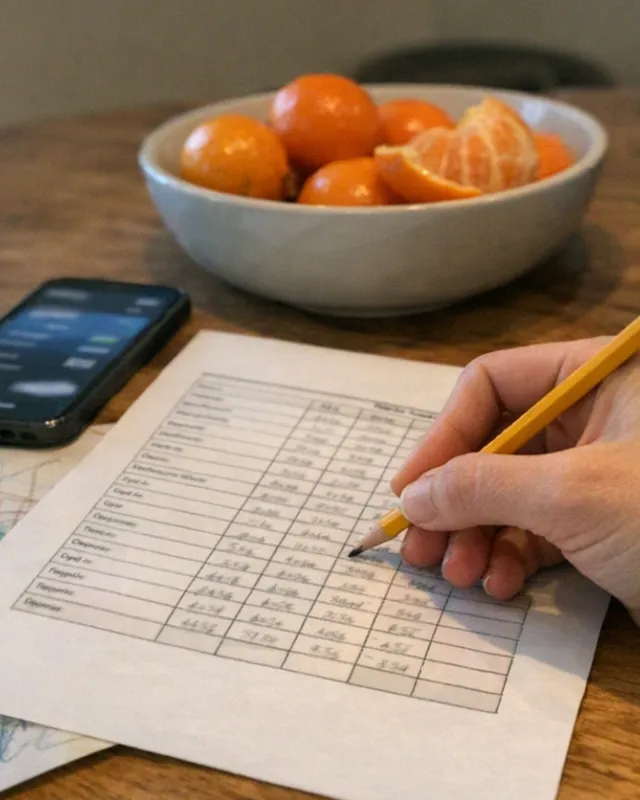
You don’t need special software to budget by paycheck. One sheet of paper with two columns, one for each paycheck this month, is enough to start tonight.
If you’d like something ready to fill in, there are two free options on this page.
The printable budget sheets come as a 6 page set: a monthly budget, a bill tracker, an expense tracker, a debt list, a savings tracker and a sinking funds tracker. Each page also comes as its own one page PDF.
The paycheck budget template is for anyone who’d rather let a spreadsheet do the matching. It works for weekly or every two weeks pay, with up to 20 bills.
If you’re paying down debt, keep your free debt tracker next to the plan and mark each extra payment.
Whatever you use, the habit matters more than the tool.
If Every Bill Is Matched and the Money Still Falls Short
Sometimes the plan shows something hard: even with every bill matched, the money doesn’t stretch to cover them all. If you’re seeing that, you haven’t done anything wrong. The plan did its job by showing you.
When that happens, the essentials come first: housing, utilities, food and getting to work.
Call the companies you owe about payment plans before more payments are missed. Lowering a few monthly bills can also help over time.
If past due bills or collections are part of the picture, a nonprofit credit counselor can help you rank what to pay first. The National Foundation for Credit Counseling website is a simple place to start looking.
Seeing the problem clearly is the first step to fixing it.
Plan Your Next Payday Tonight
Next Thursday night before payday can feel different. This time, the check already has a plan.
Tonight, write down your next four paydays and every bill due in that time. Put each bill under the paycheck before it’s due.
Then set aside your everyday spending, and give whatever’s left one job.
Tomorrow, when the money lands, you’ll already know where it’s going.