An emergency fund sounds like something you build from leftovers, whatever’s still in checking the night before payday. On a regular paycheck, leftovers are the least reliable money you have.
You want the cushion. You also need this paycheck to cover rent, the car payment and a card minimum. When saving feels like one more bill that won’t fit, that’s a timing squeeze, not a flaw in you.
The steadier answer is a payday habit: one small amount that leaves on the same day every time, before the week gets a say. Here’s how to set it up and keep it going for a whole year.
Leftover Money Rarely Shows Up, So Save on Payday Instead
Payday lands on Friday. By the following Thursday, the money has gone to gas, a grocery run, the electric bill and a birthday present for a classmate.
There was never a moment when it felt like extra.
That’s the problem with saving whatever is left. Spending fills the space it’s given, so there’s rarely anything left to save.
A regular paycheck gives you something better than leftovers: a date you can count on. The same amount lands on the same kind of day, again and again.
That makes it a good fit for a savings habit. The CFPB calls a regular savings habit especially helpful for people with consistent income (CFPB).
An emergency fund is money kept only for surprises: a car repair, a medical bill, a gap in pay. Our guide to sizing your emergency fund helps you pick the finish line.
This guide is about the engine that gets you there.
Saving first doesn’t mean saving a lot. It means the savings line goes out on payday, right after rent and before everything else.
The money you move on payday is the money that actually gets saved.
Pick a Payday Amount That Survives Your Tightest Week
It’s tempting to pick a big, motivating number. Then the paycheck that covers rent comes around, and the transfer gets canceled.
So start from your tightest paycheck, not your average one.
Look at the payday that has to cover the most: rent, the car payment, the biggest bills. What could leave that paycheck without leaving you short before the next one? That’s your amount.
It will probably feel small. That’s fine, because small amounts that repeat add up quietly.
Here’s how a few payday amounts grow if you’re paid every two weeks. The numbers are made up, and each row starts at $0.
| Saved each payday | After 13 paydays (about 6 months) | After 26 paydays (1 year) |
|---|---|---|
| $25 | $325 | $650 |
| $50 | $650 | $1,300 |
| $75 | $975 | $1,950 |
| $100 | $1,300 | $2,600 |
Paid weekly? $25 a week is the same as $50 every two weeks. Paid twice a month, $50 on each of 24 paydays is $1,200 a year.
If you’re paying down debt, every minimum payment still goes out first. The savings amount comes from what’s left after the must-pays.
At $50 a payday, a $1,000 starter fund takes 20 paydays, a little over nine months. The starter emergency fund guide covers that first stop in detail.
An amount you can keep on your worst paycheck will carry you further than a big one you cancel in March.
Let the Money Leave Before You See It
Once you have your amount, the next job is making sure you never have to remember it.
There are two easy ways to do that.
The first is splitting your paycheck. If you’re paid by direct deposit, your employer may be able to send part of each paycheck straight to a savings account (CFPB). The money never touches checking at all.
Say this: “Hi, I’d like to send part of each paycheck to a second account. Can I split my direct deposit, and is there a form for that?”
The second is a recurring transfer. Set it in your banking app for payday morning, or the day after if your deposit tends to land late.
One caution with transfers: if checking runs low on the day it goes out, you could face an overdraft fee. The CFPB suggests balance alerts or a calendar reminder to keep an eye on it.
Either way, send the money somewhere you won’t see every time you buy groceries. A separate savings account with a plain nickname works well.
Try this: Name the account after what it protects, not what it is. “Car and doctor money” is easier to leave alone than “Savings 2.”
Out of sight on payday means out of reach on a Tuesday.
Give Third Paychecks and Small Raises a Job Ahead of Time
Your steady transfer does the everyday work. A few times a year, though, extra money shows up, and that’s when the fund can take a bigger step.
Every two weeks works out to 26 paychecks across 12 months. So in most years, two of those months get a third payday.
When your bills are planned around two paychecks, that third one has more room in it. The free Biweekly Paycheck Budget on this page has a box to mark those months, so they don’t sneak past.
Other money with room in it:
- A raise. When your paycheck goes up, move part of the difference to savings before you get used to it.
- A bill that ends. When a subscription is canceled or a loan is paid off, keep sending that amount, just to savings now.
- A tax refund. The CFPB lists saving part of a refund as one of the easiest ways to get started (CFPB).
Here’s a made up year on a regular paycheck. $50 every payday adds up to $1,300. Add $150 from each of the two third paychecks, and that’s $300 more. Then $400 of a tax refund goes in.
That’s $2,000 in one year, without a single dramatic month.
Your plan in one line: one payday amount + an automatic transfer + a job for every third paycheck and refund.
Extra money that has a plan before it arrives doesn’t get absorbed by the week.
Check In Once a Month, Not Every Day
When you’re saving on autopilot, it’s easy to either forget the fund exists or check the balance ten times a week.
Neither one helps much. A short check once a month works better.
Pick a day, like the first Sunday of the month. Look at three things: did every transfer go out, what’s the balance, and is the amount still right for your tightest paycheck?
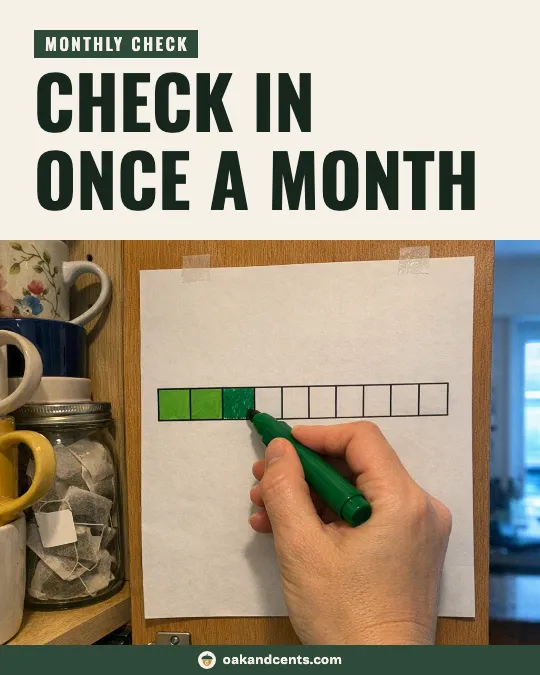
Then mark your progress somewhere you’ll see it. The free Savings Tracker on this page has a 10 part bar to color, so each section is 10% of your goal.
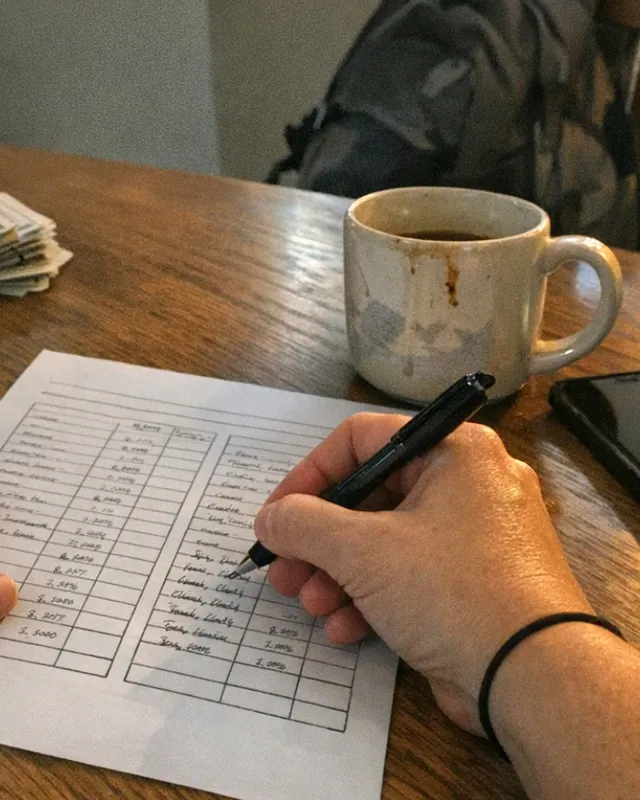
If you like a chart with a box for every payday, the Biweekly Payday Challenge on this page has 26 of them. At $20 a payday it adds up to $520, and at $40 it’s $1,040.
Notice the stops along the way: the first $100, the first $500, your starter goal. Each one means a surprise bill that no longer has to go on a card.
For a bigger picture, the emergency fund calculator uses your must-pay bills and monthly savings to show a starter goal, a full range and about how long each may take.
A fund you glance at monthly is a fund you keep feeding.
After You Use It, Lower the Transfer Instead of Stopping It
One day the fund does its job. The water heater gives out, or a paycheck comes up short, and the balance drops by a few hundred dollars.
It can feel like losing ground. It isn’t. The fund just did exactly what it was built to do.
The risky moment comes right after. Money feels tight that month, so the transfer gets paused, and somehow it never restarts.
Instead of pausing, keep the date and shrink the amount for a month or two. $50 can become $20. The habit keeps its place on payday, and the full amount comes back when things settle.
It also helps to decide in advance what counts as an emergency. The CFPB suggests setting a few guidelines for yourself and staying consistent. A rule like “needed, surprising and can’t wait” covers most cases.
Costs you can see coming, like holidays or school shoes, belong in sinking funds instead.
A smaller transfer that keeps going rebuilds the fund. A paused one rarely does.
If Payday Money Is Gone Before the Next Payday
Sometimes the problem isn’t the habit. The paycheck simply doesn’t reach the next one, even before any savings.
If that’s your situation, saving can start smaller, at $5 or $10 a payday, or wait a little while you steady things.
It may help to see where each paycheck goes. Our guide to budgeting by paycheck pairs every bill with the paycheck that should cover it, which often frees up a little room.
If rent, utilities or a minimum payment is overdue, getting current matters more than saving right now. A nonprofit credit counselor, like those at NFCC member agencies, can talk through what to pay first.
Starting with $5 is still starting.
Set the Transfer Before Your Next Paycheck Lands
The night before payday doesn’t have to be the night you look for leftovers anymore. The saving will already be done.
Tonight, pick your payday amount using your tightest paycheck. Then set one recurring transfer, or ask payroll about splitting your deposit.
Write your two 3 paycheck months on the calendar while you’re at it.
If you’re also paying down debt, keep the free debt tracker next to your savings chart. Seeing one number go up while the other goes down is a quiet kind of proof.
Same day, same amount, every payday. That’s how a regular paycheck builds a real cushion.