Say takeout, coffee runs and little online orders add up to about $75 a week. Pause them for four weeks of November, and you start December with $300 you didn’t have before (made up numbers, real math).
November is when the gift list grows and the sale emails pile up, while the card you’re paying down still wants every spare dollar. Wanting a cozy season and a smaller balance makes sense. Only the timing is tricky.
A no spend November turns the quiet weeks before the rush into a head start. You set your holiday rules once, color in a calendar each night and send every dollar you keep toward December.
What a No Spend November Actually Pauses
Halloween is barely over, the candy bowl is still on the counter, and the stores have already moved on to Christmas. A no spend November gives the 30 days in between a simple shape.
The basics keep going: rent, bills, groceries, gas and your debt payments. What pauses is everything extra, and in November that includes the holiday extras that sneak in early.
That doesn’t mean skipping Thanksgiving or telling the kids Christmas is canceled. It means deciding now which holiday costs are planned, so the rest can wait a few weeks.
Why this month? December asks for a lot at once: gifts, the big meal, gas for the drive, the class party. Paychecks keep their usual pace. Money kept in November lands right before that squeeze.
For the general method that works in any month, see the no spend month guide. This one is about using November on purpose.
Try this: If you can, pull up last December’s card statement. Circle the charges that came from a rush: the extra gift, the late shipping fee, the grocery run on the 23rd.
Those circles are what this November is getting ahead of.
A quieter November usually makes for a calmer December.
Decide What Waits Until December Before the 1st
A rule you write on a calm Sunday does the deciding for you on a hectic Tuesday. In November, your rules have one extra job: sorting the holiday costs you planned from the ones that can wait.
The everyday extras, like takeout and coffee runs, pause as usual. The table below adds the November ones. Change any line to fit your home.
| Still OK in November | Waits until December |
|---|---|
| Rent, bills, card payments, groceries and medicine | Holiday decor from the front of the store |
| A Thanksgiving menu with a set grocery amount | Black Friday deals that aren’t on your gift list |
| Gifts already priced in your Christmas budget | “One for me” buys while you’re gift shopping |
| The dish or class party treat you signed up for | Seasonal drinks and treats from the coffee shop |
| Gas for work and the drive to family | A new outfit for the holiday photos |
Gifts need one clear decision. Either they all wait until December 1, or the planned ones move to the left column with a price beside each name.
Keep real needs on the left side. If the Thanksgiving grocery amount is so tight that a card comes out at the store, raise it a little. A few grocery habits that add up can stretch it instead.
Copy both columns into the tracker’s rules box. When a sale tempts you on the 14th, the list answers, not the email.
Rules made early are kinder than choices made in a checkout line.
Plan for Thanksgiving, Black Friday and Birthdays Now
November has a few days that test any plan. The good news is that you can see most of them coming.
Open the calendar and circle three kinds of days:
- Food days: Thanksgiving, a school potluck, a work lunch.
- Sale days: Black Friday, Cyber Monday and the “early deals” emails that start weeks before.
- People days: birthdays, a friend’s dinner out, the class party.
Thanksgiving: write the menu first, then the grocery amount, then the list. Check the pantry before the store. If you’re a guest, offer a dish you can make mostly from what you already have.
Black Friday: unsubscribe from store emails before November 1, so the weekend stays quiet. If you’ll shop a sale for gifts, write each gift and its price in your Christmas budget first. Then pay only with money that’s already saved.
Be careful with buy now, pay later at checkout. It splits a price into smaller payments, but it’s still a loan with its own due dates (the CFPB explains how these loans work).
Birthdays and gatherings: set one amount for each gift now. When friends pick a restaurant, suggest a cozy night at home instead.
If you’re hosting, or heading to family, a short message can keep the big meal simple:
Say this: “We’re keeping November simple this year. Could we do Thanksgiving potluck style? I’ll bring the sweet potatoes and a pie.”
A plan for the big days keeps one dinner from turning into a lost week.
Color In One Day at a Time
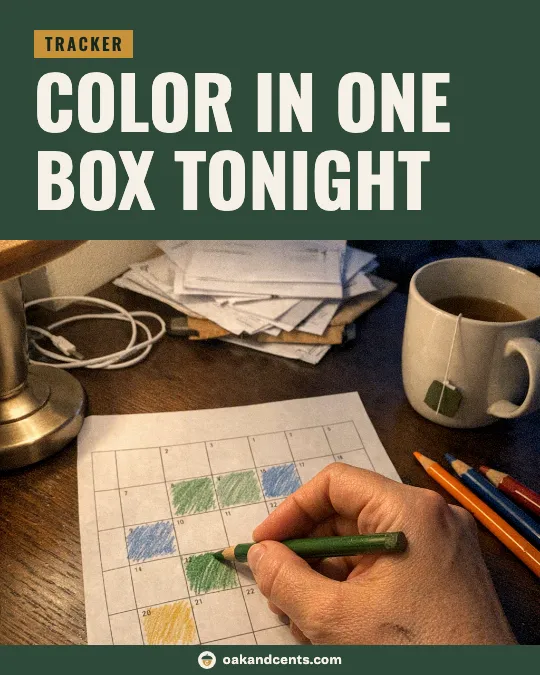
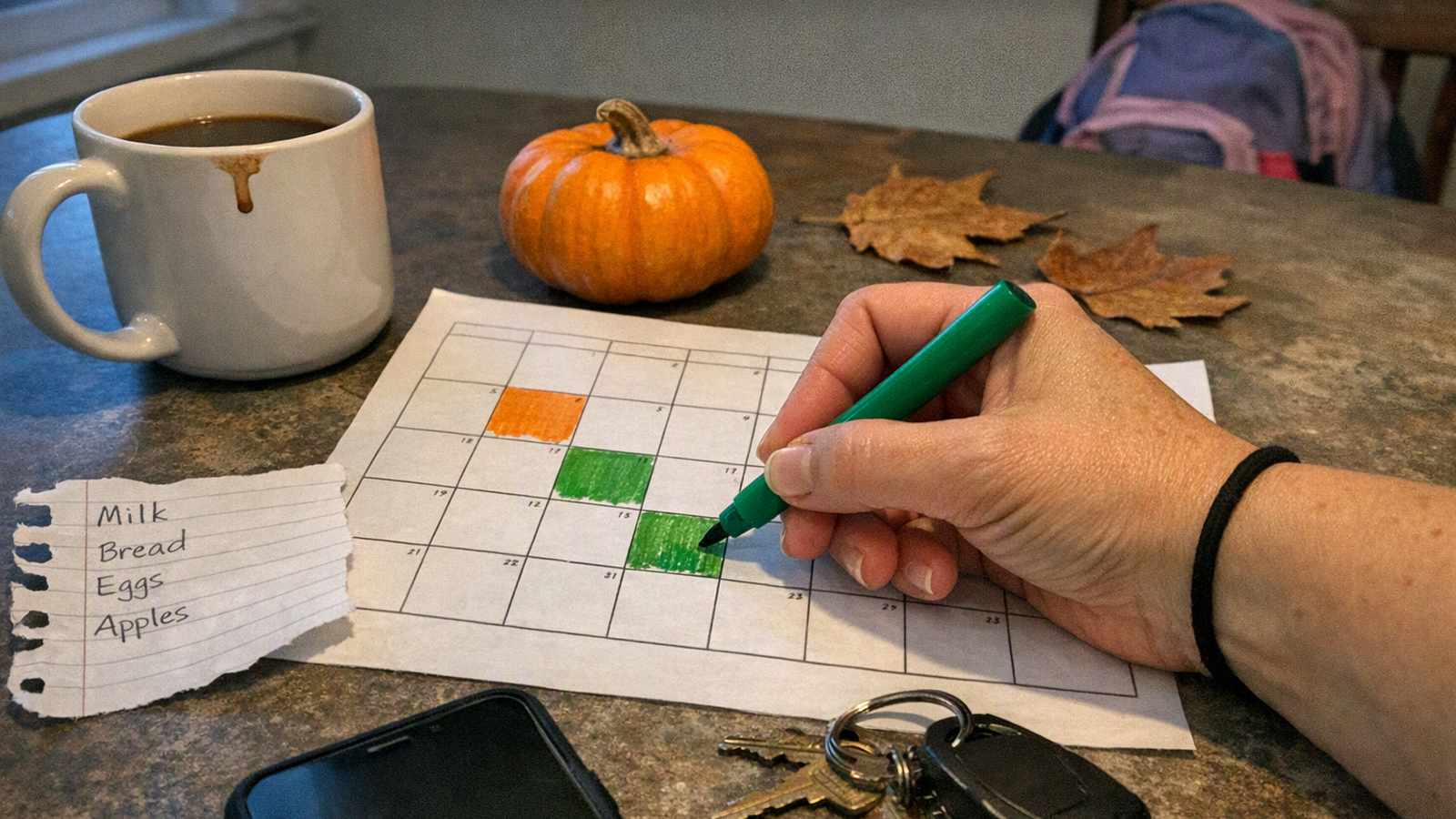
There’s something steadying about a page that fills up as the month goes. Each night you color one box, and November takes shape where you can see it.
The free No Spend Month Tracker on this page has a box for every day. November uses 30 of the 31, so the last box stays blank. Write November at the top and choose your goal before the 1st.
A goal of 22 or 24 days leaves room for Thanksgiving week and a birthday or two. A goal you can reach keeps the marker moving.
The nightly check is short. Did today stay inside your two lists? Then color the box. Paying the electric bill or picking up the Thanksgiving groceries you planned still counts.
On the big days, add a small star as you color: Thanksgiving, Black Friday, the birthday dinner. Those stars mark the days that used to cost the most.
When a day slips, leave it blank and pick the marker back up tomorrow. If it was a gift you’d have bought anyway, write it in your Christmas budget and cross that name off. It came out early, not extra.
On November 30, count the colored boxes and write the number at the bottom. That number comes with you into December.
Try this: Put the tracker on the fridge, right where the holiday catalogs and sale flyers tend to land. Recycle the flyer, color the box.
Thirty small boxes are easier to finish than one big promise.
Five Swaps for the Busiest Weeks Before the Holidays
By mid November, the season is everywhere. The coffee shop has its holiday cups, the front aisle is full of plaid, and the delivery app seems to know you’re tired.
These pulls are seasonal, so your swaps can be, too. You don’t have to resist each one. You only need something ready to do in its place.
- Instead of takeout the week before Thanksgiving, keep one easy pantry dinner ready, like pasta and a jar of sauce. The fridge may be full, but most of it is for Thursday.
- Instead of the holiday drink at the coffee shop, stir a little cinnamon into coffee at home and pour it into a travel mug you love.
- Instead of grabbing an “early deal,” add it to a note called “December maybe,” with the price, and close the app.
- Instead of a Saturday at the mall, pick a free outing, like a town tree lighting, a leaf walk or a drive to see the first lights go up.
- Instead of a treat for making it through the week, color your tracker, light a candle you already own and take ten quiet minutes.
The “December maybe” note does two jobs. Plenty of things on it lose their pull by December, and the ones that last can join your gift list with a price.
It helps with kids, too. “Let’s put it on the December maybe list” says yes to the idea without a yes at the register.
For more ways to pause at the register, try the guide on how to stop impulse buying.
Your plan in one line: holiday rules before the 1st, the big days circled, one box colored each night and a December job for every dollar you keep.
A swap planned in October beats a no you have to find in a busy store.
Give the Money You Keep a Job Right Away

Here’s the part that makes November count. Money you don’t spend has a way of drifting into next week’s groceries, unless it leaves your everyday account.
So move it on purpose, every Sunday night in November. Add up roughly what you skipped that week and send it somewhere with a name: a Christmas savings account, a labeled envelope or a payment on your card.
Back to the example from the start: $75 a week for four weeks is $300 by the end of the month. Still with made up numbers, here’s where it could go:
- All to Christmas: in the Christmas on a budget example, $300 is half of a $600 season, paid for before December begins.
- All to your card: one extra $300 payment toward the amount you owe, made before the holiday spending starts.
- Half and half: $150 to the gift fund and $150 to the card.
That doesn’t mean you need the smartest answer. Any job beats no job.
If you’re paying down a card, the debt payoff calculator shows what an extra payment does to your payoff date. No cushion yet? A starter emergency fund can catch a December surprise before it reaches a card.
Money with a name on it tends to still be there on December 1.
If Bills Need Every Dollar, Try a No Spend Black Friday Weekend
A full no spend November works well when the bills are covered and the holiday extras are what usually throw December off. It can also be a calm reset before the busiest stretch of the year.
It’s a harder fit if groceries, medicine or gas are already being trimmed, or a card is covering basics. A stricter month can squeeze a budget that has little left to squeeze.
A late bill or a debt that’s gone to collections changes the order, too. Those get handled before any challenge.
If that’s where you are, keep the season smaller. Try four no spend days from Black Friday through Cyber Monday, and pick a Christmas number that fits this year.
The NFCC can connect you with a nonprofit credit counselor, who can help you decide which bills come first before the holidays.
A small November still counts. Next year’s can be bigger.
Start Your November List Tonight
That $75 a week from the start doesn’t have to be exact. Even half of it, kept on purpose, means December opens with money already set aside.
Tonight, print the tracker, write down what waits until December and circle Thanksgiving and Black Friday on the calendar.
If you’d like rules and ideas for any month of the year, the no spend month guide picks up where this one leaves off.
The first box waits for November 1. The list can start tonight.