
A made up paycheck of $1,850 every two weeks works out to about $4,008 a month. Split 50/30/20, that’s roughly $2,004 for needs, $1,203 for wants and $802 for savings and debt.
Finding those three numbers is the easy part. Seeing where last month’s money really went is harder, with receipts in your purse and the rest in the bank app. That gap is normal, and no reason to drop the plan.
This free 50/30/20 budget template closes it. You type your pay, list what you spent and tag each line, and the sheet shows where you’re over or under. There’s a printable version too, for pen and paper.
Start With Your Paycheck, Not a Monthly Guess

You probably know your paycheck amount by heart, but maybe not your monthly total. So the template starts with the number you already know.
At the top, two cream boxes ask for your pay:
- Take home pay per paycheck: the amount that lands in your account after taxes.
- How often you’re paid: pick every week, every 2 weeks, twice a month, once a month or once a year from a short list.
A third box takes any other money coming in each month, like child support or a side job.
The template turns all of that into one monthly number. In the example, $1,850 every 2 weeks becomes $4,008.33 a month.
Why not just double the paycheck? Being paid every two weeks means 26 paychecks a year, so a couple of months each year bring a third one. The spreadsheet spreads all 26 across the year.
The printable planner does it differently on purpose. It counts two paychecks a month, $3,700 in this example, and treats the extra ones as a bonus.
Note: Neither way is wrong. The printable’s number is the more careful one to plan with, and the spreadsheet’s number shows your true yearly average.
Start with the number you know, and let the page do the rest.
Your Three Targets Fill In by Themselves
Once your pay is in, three targets appear without you lifting a finger. With the example pay of $4,008.33 a month:
- Needs (50%): $2,004.17
- Wants (30%): $1,202.50
- Savings and debt (20%): $801.67
Next to each one, a short line explains what belongs there. Needs are the bills you have to pay, like rent, utilities, groceries, insurance, gas and minimum debt payments.
Wants are the nice extras. Savings and debt covers your emergency fund, savings goals and anything extra you pay on a debt.
If you’d like the full story on each bucket, with gray areas and paycheck examples, our guide to the 50/30/20 rule covers it. This page is about putting the rule to work.
Only want the three numbers? The free 50/30/20 calculator gives you those in a minute.
The template goes one step further. It compares those targets with what you really spent, which is where the useful part begins.
Targets tell you where you’re headed. Your spending tells you where you are.
Tag Every Line as a Need, a Want or Savings and Debt

Below the targets is a list for the month’s spending. Each line gets three things: what it’s for, how much you spent and a bucket.
You pick the bucket from a short list: Need, Want or Savings and debt. No typing labels, no spelling to get right.
The example has 20 lines already filled in. Rent, electric and water, phone, internet, groceries, gas, car insurance and minimum debt payments are tagged as needs.
Eating out, streaming, clothes, fun money, the gym, hobbies, gifts, hair and kids’ activities are wants. The emergency fund, an extra debt payment and retirement sit in savings and debt.
That doesn’t mean your tags have to match the example. If kids’ activities feel like a need in your house, tag them that way. The sheet just adds up whatever you choose.
A few lines trip people up:
- The minimum on a card is a need, because missing it can bring late fees.
- Anything above the minimum goes in savings and debt. It’s progress, not spending.
- A line with no bucket isn’t counted in any total, so the sheet reminds you to pick one for every line.
An easy way to fill it in: sit down with last month’s bank statement and a highlighter, and work through it once.
Each tag is a small decision. Together they show you the shape of your month.
Read the Over and Under Numbers Without Panic

Here’s the moment of truth. Each bucket shows its target, what you spent and the difference.
These are the results in the template’s example, with made up numbers:
| Bucket | Target | Spent | Result |
|---|---|---|---|
| Needs | $2,004.17 | $2,025.00 | $20.83 over |
| Wants | $1,202.50 | $720.00 | $482.50 under |
| Savings and debt | $801.67 | $800.00 | $1.67 under |
Needs ran $20.83 over. That’s close enough to call a near match, not a problem.
Wants came in $482.50 under, and savings and debt landed almost exactly on target.
Then there’s the line at the bottom: money left over this month. In the example, it’s $463.33. That’s the take home pay of $4,008.33 minus the $3,545 that was spent or saved.
That leftover deserves a plan before it fades into ordinary spending. It could go to an extra card payment, a starter emergency fund or a cost you know is coming.
If needs run over by more than a little, start with the bills that might bend. A phone or internet plan is often worth one call.
Say this: “I’m going through my budget this month. Is there a lower plan or a current offer I could switch to?”
For more ideas like that, see how to lower your monthly bills.
Over and under aren’t grades. They’re directions for next month.
Change the Split When 50/30/20 Doesn’t Fit Your Rent
The 50, 30 and 20 sit in their own cream boxes, so you can change them.
Say rent and childcare take a big bite of your pay. You could try 60% for needs, 20% for wants and 20% for savings and debt.
With the example pay of $4,008.33, the needs target becomes $2,405 and the other two become $801.67 each.
If your new shares don’t add up to 100%, the sheet tells you right away. A quick fix, and the targets update.
That doesn’t mean giving up on saving. A smaller savings share you keep every month still adds up.
Our 50/30/20 rule guide has a few gentler splits and when each one tends to help. Try one for a month or two, then look again when your rent, pay or childcare changes.
A split that fits your real life is the one you’ll keep using.
The Printable Planner Follows the Same Three Steps
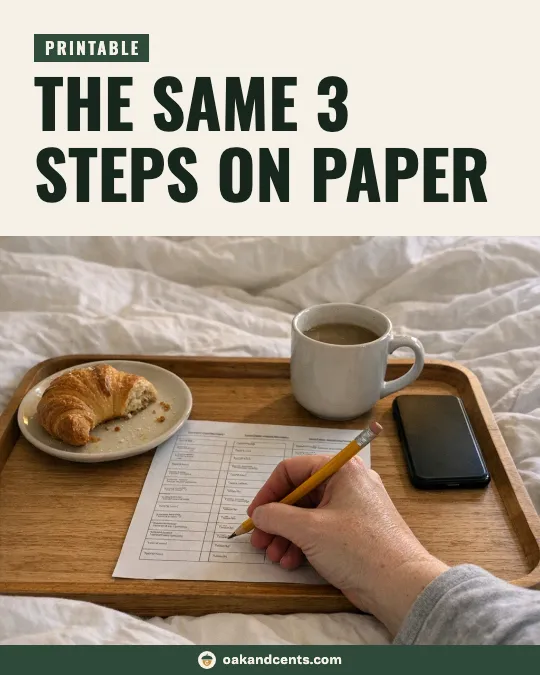
A pen and a printed page can feel calmer than a screen. The free 50/30/20 Budget Planner on this page is one printed page in three steps.
Step 1 is your take home pay. You tick how often you’re paid, write one paycheck and work out your monthly take home.
A small hint on the sheet shows how: one paycheck times 4 if you’re paid weekly, or times 2 if you’re paid every two weeks or twice a month.
Step 2 has three boxes for your targets: 50% for needs, 30% for wants and 20% for savings and extra debt.
Step 3 is three short lists with Planned and Actual columns. Needs get 13 lines, wants get 6 and savings and extra debt get 4, each with a total at the bottom.
A note on the page repeats the debt rule: minimum debt payments count as needs, and anything extra goes in the 20%.
You can use the printable on its own, or fill in the Planned column at the start of the month and type the totals into the spreadsheet later.
Paper or screen, the three steps stay the same.
Check In Once a Month, Then Start Fresh
The template holds one month at a time. A simple habit keeps it useful.
At the end of each month, open last month’s bank statement and fill in the spending list. Look at the over and under numbers, give any leftover a job, and you’re done.
For the next month, save a copy of the file with the month in its name and type over the amounts. Your buckets and pay stay in place, so it’s quicker each time.
After two or three months, you’ll start to see a pattern. Maybe wants creep up in months with birthdays, or needs jump when the electric bill does.
If one cost surprises you every year, like car registration or holiday gifts, a sinking fund can smooth it out.
Ten quiet minutes a month can tell you more than a year of guessing.
Needs Taking Nearly Everything? Start Here Instead
Three buckets suit you well if your pay is fairly steady and you want a simple view of your month. It’s a good match, too, if you like seeing over and under at a glance.
Think twice if your needs take nearly everything, even with a gentler split. In that case, a plan that gives every dollar a job, like our zero based budget template, may give you more control.
If you’re paid every week or two and bills bunch up before rent, planning one paycheck at a time can help too. The steps for that are in our guide to budgeting by paycheck.
When bills are already past due, no split will fix that alone. A nonprofit credit counselor can look at your numbers with you and help put the most important bills first. The NFCC can help you find one.
A tight month on the page is still a month you understand.
Start With One Paycheck and Last Month’s Statement
That $1,850 paycheck at the top of this page was made up. Yours is real, and it’s all you need to start.
Tonight, download the template, type your take home pay per paycheck and pick how often you’re paid. Your three targets will appear straight away.
This weekend, add last month’s spending from your bank statement and tag each line.
If part of your 20% goes to debt, the debt payoff calculator can show what that extra payment does over time.
Three targets and one honest month are a solid place to begin.