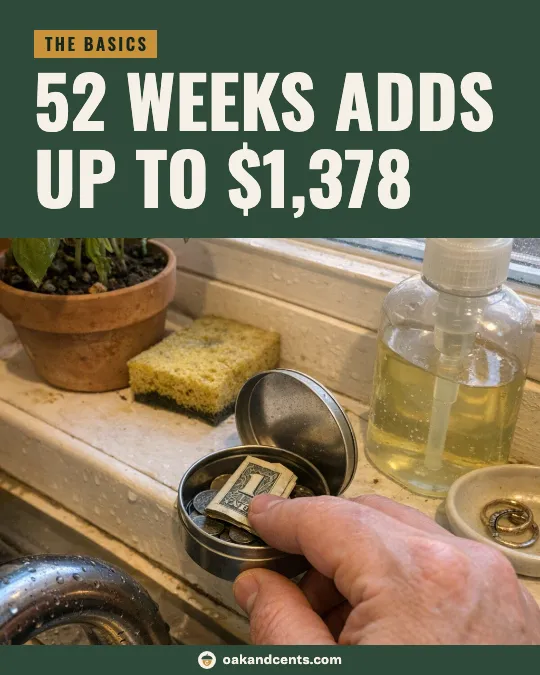
One dollar this week, $2 next week, and $52 in the very last week. Add it all up and you’ll have $1,378 a year from now.
The first weeks feel almost too easy. Then the boxes grow, and a January start puts $202 into the last four weeks, right in December. If that worries you, it’s the math, not you.
The answer isn’t willpower. It’s picking the right size and direction before week 1. Settle those two things now, plus a start date and a home for the money, and the big weeks stop being a surprise.
What the 52 Week Savings Challenge Actually Asks of You
It’s a year of saving where each week asks for one dollar more than the week before.
You save $1 in week 1, $2 in week 2, $3 in week 3, and so on. Week 52 asks for $52. Add every week together and you get $1,378.
That works out to $26.50 a week on average. But you never save the average. You save that week’s number.
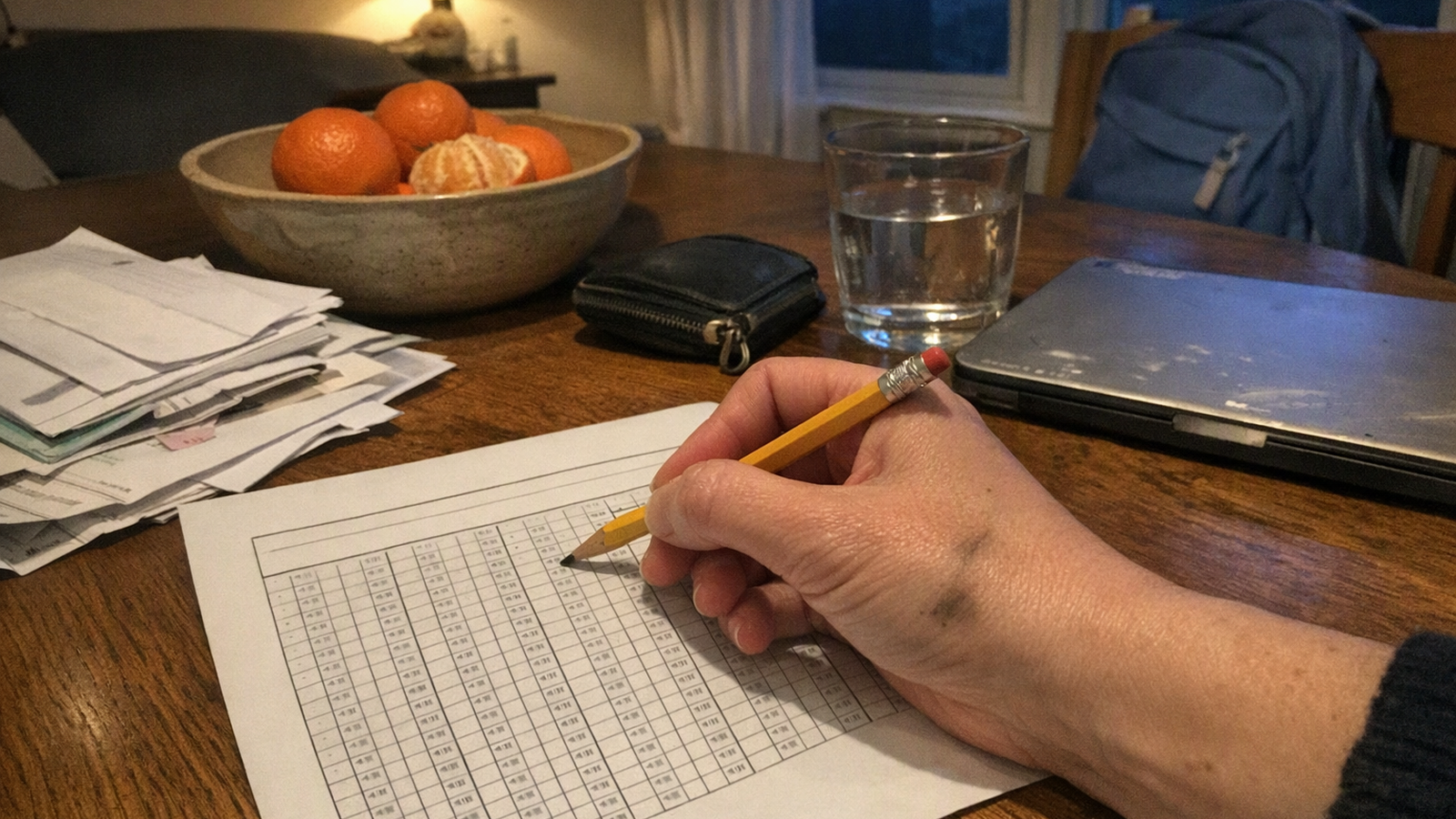
The free chart on this page lays it out for you. It has 52 boxes in 4 columns of 13, and each box shows the week, that week’s amount and your running total.
That doesn’t mean you need a special jar, a binder or an app. A pencil and a savings account are plenty.
The first month looks like this: $1, $2, $3 and $4, for $10 in total. It’s a gentle way to start.
The one thing to know before week 1 is where the bigger weeks land.
Small steps, one dollar bigger each time. That’s the whole idea.
Most of the Money Comes in the Last Few Months
Here’s the part that’s easy to miss on a pretty chart: the challenge is lopsided.
After 26 weeks, halfway through the year, you’ll have $351 saved. That’s only about a quarter of the total. The other $1,027 comes in the second half.
That’s not you falling behind. It’s how a chart that grows by $1 a week works. The late weeks are the big ones.
Each column on the chart covers 13 weeks, about three months. Here’s what each column adds up to:
| Weeks (one column) | Full chart | Half size chart |
|---|---|---|
| 1 to 13 | $91 | $45.50 |
| 14 to 26 | $260 | $130 |
| 27 to 39 | $429 | $214.50 |
| 40 to 52 | $598 | $299 |
| Total | $1,378 | $689 |
The last column asks for more than six times what the first one does. On the full chart, every week in it is somewhere between $40 and $52.
Seeing that now is a gift. You can plan for it, instead of meeting it by surprise in month ten.
A slow start is a feature. A surprise ending is the part to plan around.
Pick the Full Chart or the Half Size One Before Week 1
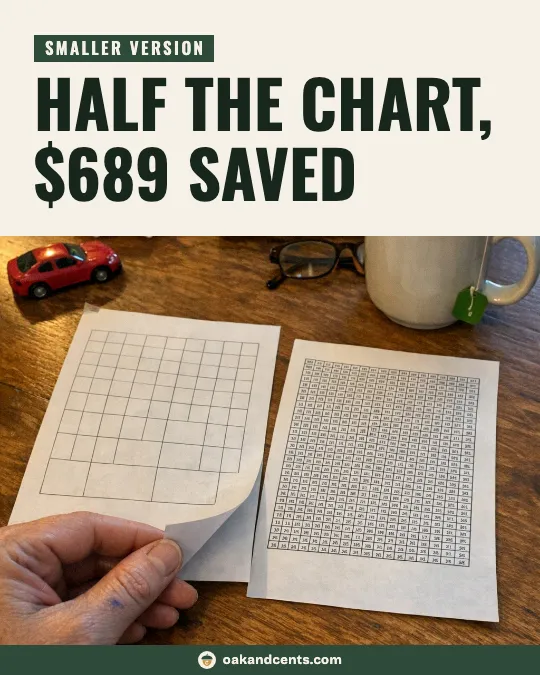
The smaller version keeps the same shape at half the cost. It’s a real challenge, not a consolation prize.
On the half size chart, you save 50 cents in week 1, $1 in week 2 and $1.50 in week 3. Each week goes up by 50 cents until week 52, when you save $26.
It adds up to $689, exactly half of $1,378. That’s about $13.25 a week on average.
Here’s a simple way to choose. Look at the biggest box on each chart: $52 on the full one, $26 on the half size one.
Could you set that amount aside this week, after rent, bills, groceries and minimum payments? If yes, either chart can work. If $52 feels like a stretch, start with the half size chart.
You can always size up later. Finish the half size chart this year, and the full one may feel easier next year.
Try this: Stick both charts on the fridge side by side for a day. The one that makes you feel calm is the one to start.
The right chart is the one you’re still coloring in at week 40.
Run It in Reverse If the Big Weeks Land at a Bad Time
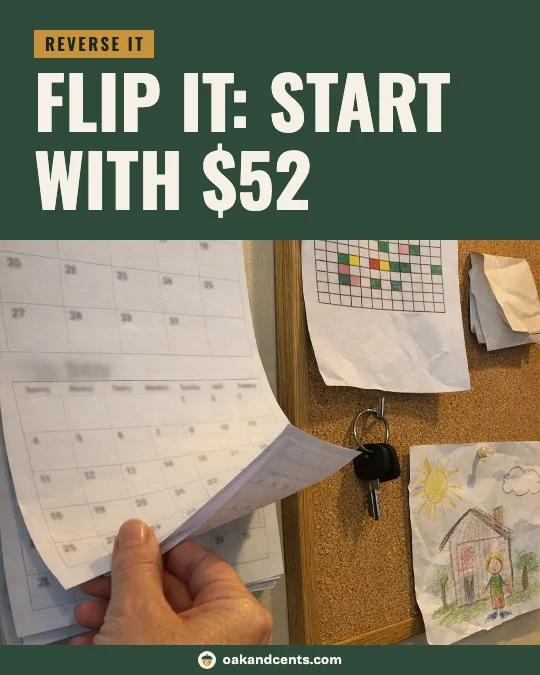
The order of the weeks is up to you, and flipping it can make your hardest months easier.
The tip printed on the chart says you can do it in reverse. You start with $52 in week 1 and count down to $1 in week 52. The total is still $1,378.
This matters because the biggest weeks land wherever week 40 lands, and that depends on when you start.
Here’s how the timing plays out:
- Start this week, in early October: the small weeks cover the holidays, and the biggest ones land next July through September, around back to school.
- Start in January: the biggest weeks land in October, November and December, right along with the holidays.
- Start in reverse: the biggest weeks come first, while the challenge still feels new.
Starting forward this week leaves the holidays light, which gives a Christmas budget more room.
That doesn’t mean reverse is always better. Starting with $52 means the first four weeks ask for $202, so it fits best when you have some room right now.
Before week 1, open your calendar and find your three toughest months. Then pick the direction that keeps the biggest boxes away from them.
The total doesn’t care about the order. Your budget does.
Keep Every Week to One Small Move
The challenge is easier to keep when saving takes about a minute, not a decision.
The amount changes every week, so it’s harder to put on autopilot than a fixed transfer. A little routine fills that gap.
Pick one day each week, like payday or Sunday night. Move that week’s amount from checking to savings, then color in the box.
If you’re paid every two weeks, save two weeks at once. Your first payday covers weeks 1 and 2, which is $3. Your last payday covers weeks 51 and 52, which is $103.
If you already budget by paycheck, that’s just one more line after the bills.
A separate savings account makes all of this easier, because the money stays out of sight. If you’d like one just for this challenge, a short call to your bank can sort it out.
Say this: “Hi, I’d like to open a second savings account just for a savings goal. Is there a monthly fee or a minimum balance I should know about?”
Money at a bank insured by the FDIC is covered up to $250,000 per depositor, per bank, for each ownership category (the FDIC explains the details). A jar on the counter isn’t.
One minute a week is a habit you can keep for a year.
Swap These Common Stumbles for Easier Fixes
When a 52 week challenge stalls, it’s usually over a small snag, not a big problem.
You don’t need more willpower. You need a swap ready before the snag shows up.
Here are five common ones, each with a swap:
- Missing a week and quitting. Instead, pick up where you left off. Double up the next week, or let your finish date move back a week.
- Keeping the cash in a jar at home. Instead, move it to savings each week, so it isn’t sitting there on pizza night.
- Starting the full chart when $52 wouldn’t fit. Instead, start the half size chart and size up next year.
- Dipping in for a sale. Instead, give the money a name, like car repairs or a starter emergency fund, and leave it for that.
- Waiting for January to start. Instead, start this week. Week 1 is whatever week you choose.
Your plan in one line: the right size chart, the right direction, one savings account and one minute a week.
A missed week is a pause, not the end of the challenge.
Start With What You Already Have
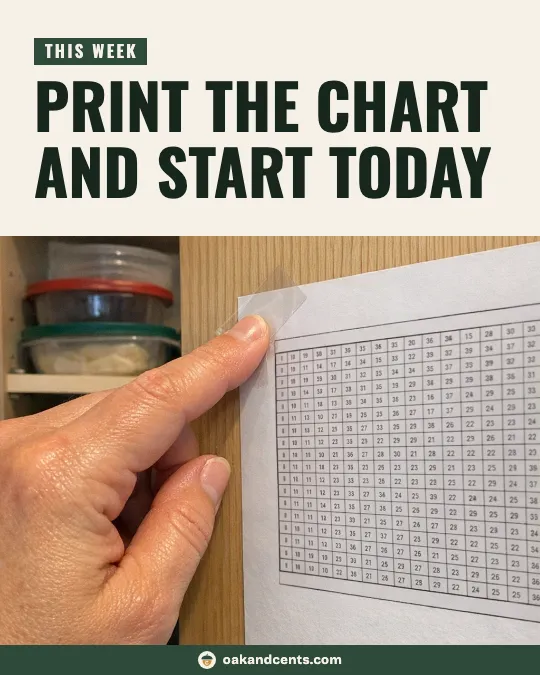
You don’t need a planner, a cash binder or a new app to begin. One sheet of paper and an account you already have will do.
Print the chart, write your start date and what you’re saving for at the top, and tape it somewhere you’ll see it every day. The fridge or the inside of a cabinet door both work.
Then color in week 1 tonight. One dollar is enough to make it real.
If you’d like to see your progress another way, the free savings tracker sheet has a progress bar with 10 sections to color and a log for each deposit.
If you’d rather try something shorter or with a different rhythm, our list of savings challenge ideas has 10 free charts, from $150 to $5,050. The 100 envelope challenge lets you save the amounts in any order.
A sheet of paper and a pencil is a full starter kit.
Past Due Bills Come Before Week 1
This challenge fits well when you have a steady paycheck, even a small one, with a little room after the bills. It also suits people who like watching progress on paper.
Think twice if rent, utilities or a card payment is past due, or if a debt has gone to collections. Those come first, and a savings challenge can wait.
If you’re paying off a card, keep paying every minimum first. A small cushion from the challenge can keep the next surprise off the card.
If you’d rather send extra money to a debt instead, the debt payoff calculator shows what that does to your payoff date.
When money feels too tight to sort out alone, a nonprofit credit counselor can help you see it more clearly. The National Foundation for Credit Counseling is a good place to look for one.
Waiting a few months to start is still a plan.
Color In Box One Tonight
Everything starts with week 1 and a single dollar. It’s small on purpose.
Tonight, pick the full chart or the half size one, decide on forward or reverse, and color in box one.
When you’re ready to think past this year, the emergency fund calculator can help you pick a goal to grow toward next.
A year of small weeks adds up to something you can see.