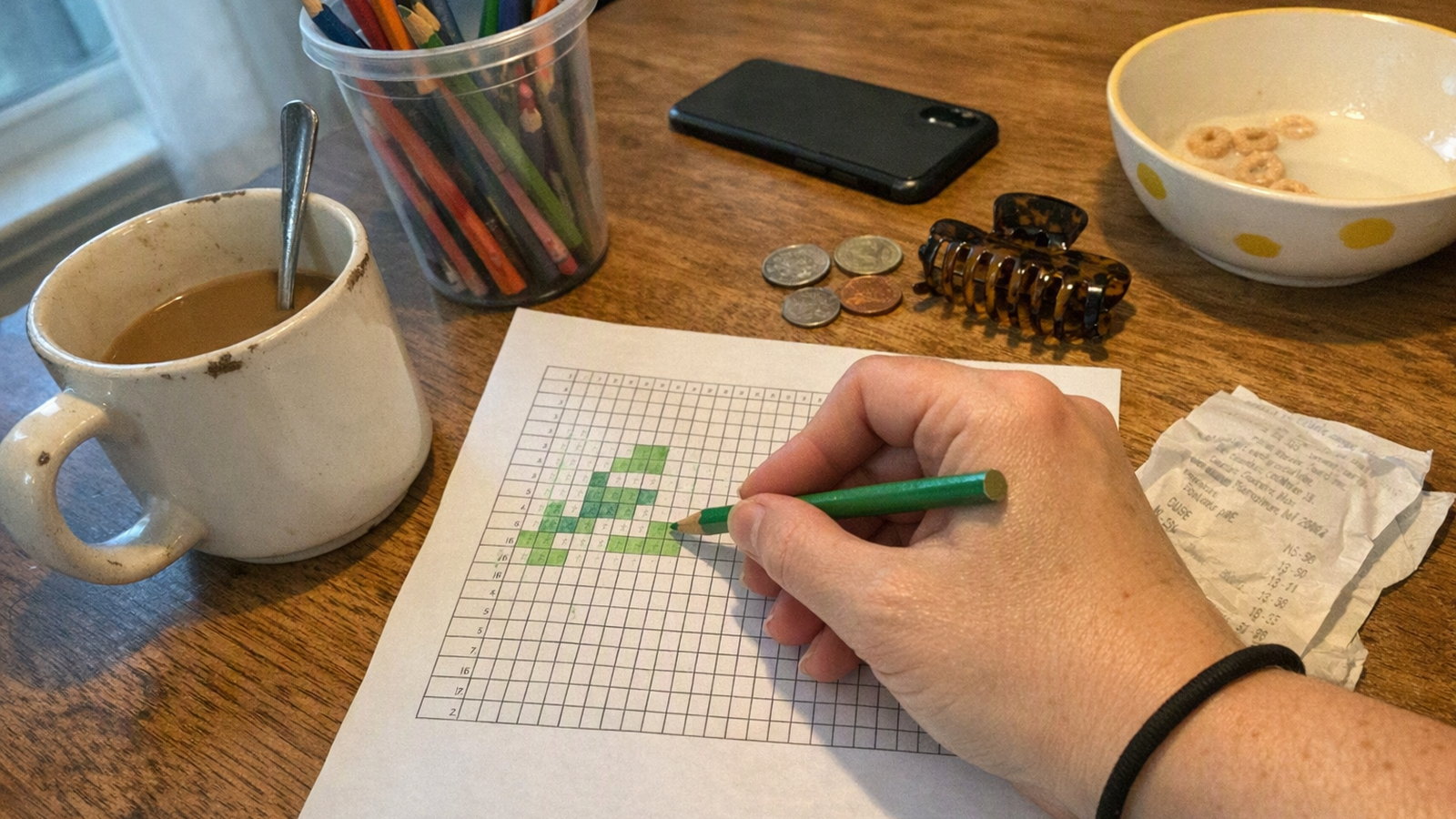
A $5,050 challenge chart pops up in your feed, and starting with the biggest one feels like the serious choice. That total looks exciting, and it can be the hardest chart to keep going once the big boxes show up.
You want a little cushion, so the next car repair doesn’t land on a card. You also have rent, groceries and a minimum payment due Friday. Feeling pulled both ways is part of caring about both.
The answer isn’t the biggest chart. It’s the one that fits this month’s paycheck. Here are 10 savings challenge ideas, from a $150 chart up to $5,050, each with a free printable, so you can pick one tonight.
1. Save $150 in 30 Days With the $5 a Day Challenge
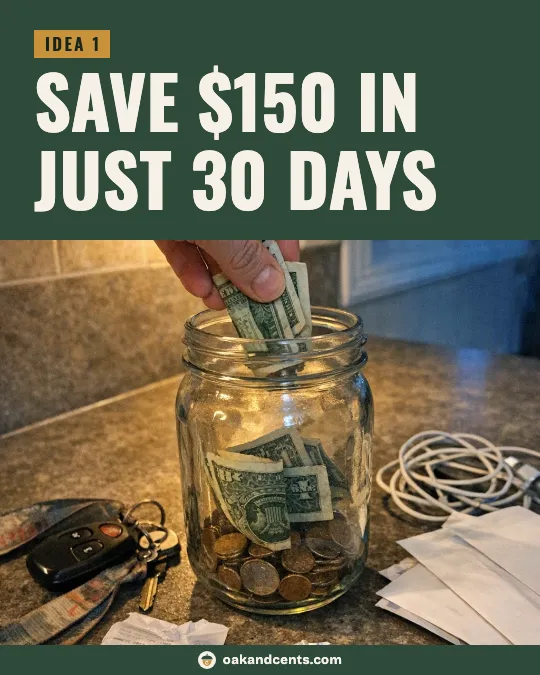
A drink on the way to work, a snack at the gas station, a few dollars at the school book fair. Five dollars leaves most days without much notice.
The worry is that saving only counts if it hurts. It doesn’t.
This challenge points that same $5 the other way. You move $5 into savings every day for 30 days and finish with $150.
The chart has 30 boxes, each with its running total, so box 10 reads $50 and box 20 reads $100. Watching that number climb is half the fun.
If you miss a day, the tip on the sheet is to save $10 the next day and keep going.
Try this: Print the $5 a day chart tonight, move $5 to savings and color in box one before bed.
Small and daily is easier to keep than big and someday.
2. Fill 25 Envelopes for $325 When Every Week Looks Different
Once $5 a day feels normal, you might want a challenge that bends a little when the week gets tight.
Some weeks the electric bill runs high, or a field trip form comes home with a fee. A fixed amount can start to feel like one more bill.
The 25 envelope challenge lets you choose. The chart has 25 envelopes marked $1 to $25. You pick any one that fits, save that amount and color it in.
Add $1 plus $2 plus $3, all the way up to $25, and you get $325.
A slow week gets the $1 envelope. A payday week can take the $25.
One envelope a day finishes in 25 days. One a week takes 25 weeks, a little under six months.
You don’t need 25 real envelopes. The 25 envelope chart has big envelope drawings to color, and the money itself can sit in your savings account.
A $1 week is still a week you saved.
3. Save $20 Every Payday for $520 With the Biweekly Challenge
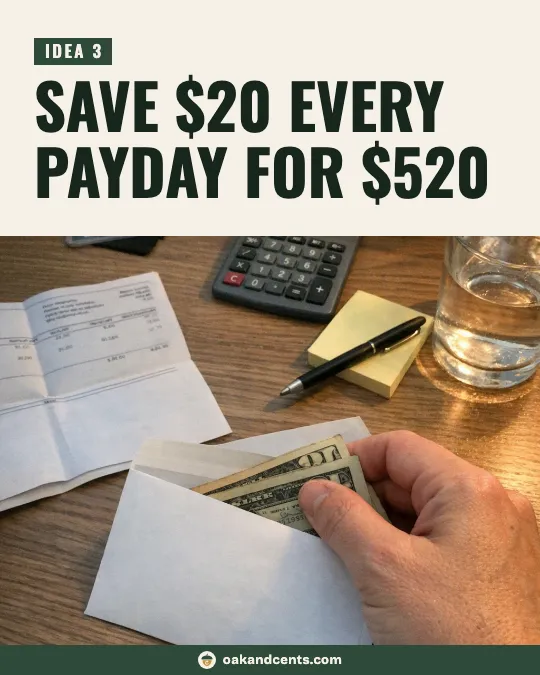
Some people would rather not decide anything each week. That’s where a payday challenge fits.
If you’re paid every two weeks, that’s 26 paydays a year. Save $20 from each one, and you’ll have $520 by the end of the year.
The hard part is usually timing, not the amount. By Thursday, payday money has a way of turning into gas, groceries and a lunch account refill.
So move the $20 the same day the paycheck lands, before anything else gets paid. If your bank offers automatic transfers, set one for payday and let it run.
The biweekly payday chart has 26 boxes, each with a spot to write the date. If $20 feels easy, the tip on the sheet is to double it: $40 a payday makes $1,040.
If you already budget by paycheck, this is just one more line under the bills.
Money you move first doesn’t have to survive the week.
4. Try the Half Size 52 Week Challenge to Save $689 in a Year
After a few paydays in a row, a whole year of saving starts to feel possible. The half size 52 week chart is a gentle way to try it.
You save 50 cents in week 1, $1 in week 2 and $1.50 in week 3. Each week goes up by 50 cents until week 52, when you save $26.
That adds up to $689 over the year, about $13.25 a week on average.
The fear with yearlong charts is the end of the year. The amounts keep growing, and the biggest weeks can land right around the holidays.
Here, the last four weeks add up to $101. On the full size chart, those same four weeks add up to $202.
That doesn’t make the half chart the lesser one. It’s the same habit at half the price.
Try this: Print the half size chart and tape it inside a kitchen cabinet, where you’ll see it every time you reach for a mug.
Half the size is still a whole year of showing up.
5. Save $1,000 in 100 Days With $10 a Day
After a yearlong chart, a shorter goal with a round number can feel like a nice change of pace.
This one is simple: $10 a day for 100 days makes $1,000. Each box shows the day and your running total, so day 50 reads $500.
Ten dollars a day sounds like a lot until you see it as about $70 a week.
Here’s an example with made up numbers. If packing lunch saves you about $10 each workday, that alone covers five boxes a week.
A thousand dollars makes a good first cushion for smaller surprises, like a new tire or a vet visit. Our guide to a starter emergency fund walks through that first $1,000.
Grab the $1,000 in 100 days chart if you like a clear finish line.
A round number with an end date is easier to say yes to.
6. Color In 50 Envelopes for $1,275 at Your Own Pace
If the 25 envelope chart felt good, the 50 envelope chart is its bigger sibling, with the same freedom to pick any envelope.
The envelopes are marked $1 to $50, and together they add up to $1,275. One a day takes 50 days. One a week takes 50 weeks, almost a full year.
A common worry is grabbing all the easy envelopes first and getting stuck with the big ones at the end.
One way around that is to pair them. Take a big envelope on payday weeks and a small one in the slow weeks, so the chart stays balanced.
You don’t have to go in order or on a schedule. The chart only asks that each envelope gets colored once.
Print the 50 envelope chart and pick your first envelope tonight.
Your pace is allowed to change with your paycheck.
7. Save $1,378 in a Year With the Classic 52 Week Challenge
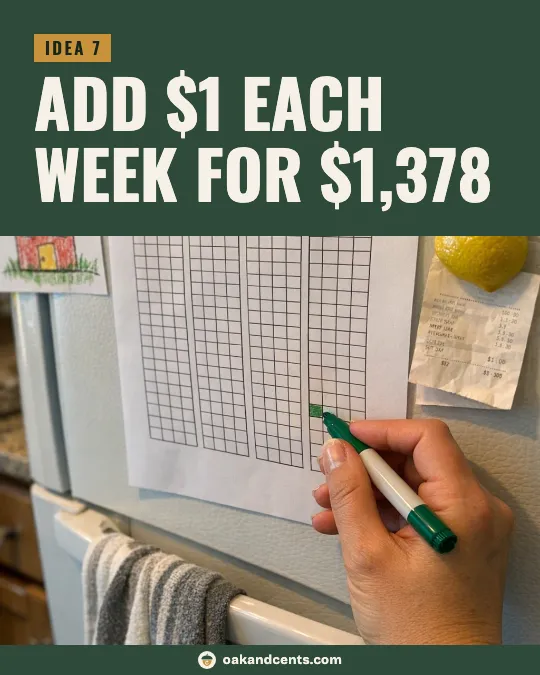
The classic 52 week challenge is a close cousin of the 50 envelope chart, except it sets the order for you.
You save $1 in week 1, $2 in week 2, and so on, up to $52 in week 52. The total is $1,378.
Week 1 feels almost silly, and that’s on purpose. By the time the amounts grow, the habit is already in place.
The catch is the back half of the year. Start in January, and the last four weeks ask for $202 right in December.
The tip on the sheet helps here: you can run it in reverse, starting with $52 and ending with $1. The total stays the same, and December gets the small weeks.
You also don’t have to wait for January. Any week works, including this one.
Our full guide to the 52 week savings challenge has the free chart and a look at how the amounts grow over the year.
The total is big. Each week is small.
8. Save $2,525 With the Half Size 100 Envelope Challenge
Past the $1,000 mark, envelope challenges start to ask for more. The half size 100 envelope chart is the middle step.
It has 100 envelopes, from 50 cents up to $50, going up in 50 cent steps. Together they add up to $2,525, exactly half of the full chart.
One envelope a day takes 100 days. Two a week takes 50 weeks, which works out to about $50.50 a week on average.
That’s real money, so it helps to know where it will come from before you start. A raise, a second income or a debt you just paid off can free up room.
Print the half size 100 envelope chart if the full one feels like too much right now.
The middle step is still a big step.
9. Save $5,050 With the Full 100 Envelope Challenge
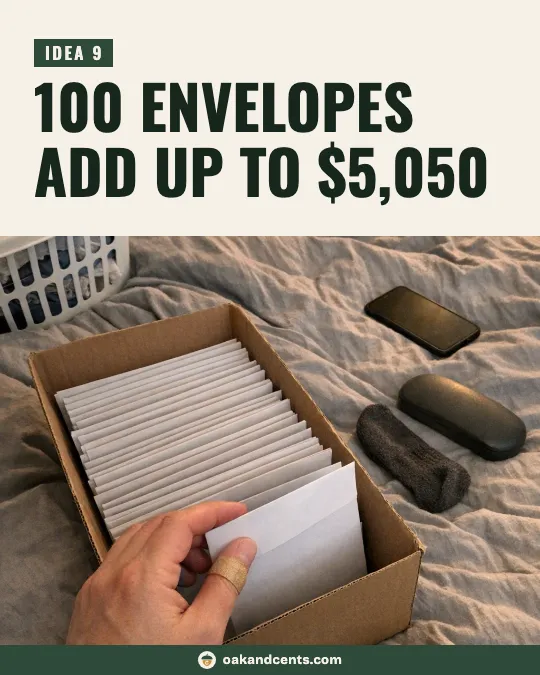
This is the big one, the chart you’ve probably seen all over Pinterest.
There are 100 envelopes marked $1 to $100. You pick one, save that amount and color it in. Add $1 plus $2, all the way up to $100, and you get $5,050.
One a day takes 100 days, which is about $50 a day on average. Two a week takes 50 weeks, about $101 a week.
That’s a lot for one paycheck, and it’s okay to say so. For many households, this chart fits better with two incomes or after a raise.
If you love the idea, start with a smaller version and come back to this one later. Our guide to the 100 envelope challenge explains how it works and shows three smaller versions.
Here’s the 100 envelope chart for when you’re ready.
Picking the chart you can finish is a win, not a step down.
10. Use a No Spend Month to Find the Money for Any Chart
Every chart above has the same quiet catch. The money has to come from somewhere.
Often it’s hiding in small, everyday spending that’s hard to see in a busy week.
A no spend month makes it visible. You pick a month, write your own rules and color a box for every day you spend nothing outside them.
The worry is that it will feel like a whole month of saying no. It doesn’t have to.
The no spend month tracker has a box for your rules, with two lists: Still OK and Not this month. Bills, debt payments, groceries from your list and gas for work can all stay on the Still OK side.
So this isn’t about going without food or skipping a bill. It’s about pausing the small extras for a few weeks and noticing what happens.
Here’s an example with made up numbers. Say coffee on the way to work costs about $8, four times a week.
Four weeks without it keeps $128 in your account. That’s most of the way to the $150 on the $5 a day chart.
There’s no money total on this tracker. It counts the days with no spending, so it works for 28, 30 or 31 day months.
A day you break your rules is just a box you don’t color. Tomorrow is a new box.
If you like a deadline, no spend November lands right before the holidays. Our no spend month guide has more on writing rules that feel fair.
Try this: Before your month starts, write three things on the Not this month line. Only three.
The charts help you save. The no spend month shows you where the saving can start.
How to Pick the Challenge That Fits Your Paycheck
Ten charts is a lot. The easiest way to choose is to look at the biggest box, not the total.
Find the largest single amount on the chart. If you couldn’t cover it this week without touching bill money, pick the next size down.
Here’s a quick guide to match a chart to your month:
| If your month looks like this | Try | Total |
|---|---|---|
| Every dollar already has a job | $5 a day or 25 envelopes | $150 or $325 |
| Paid every two weeks | Biweekly payday | $520 |
| Steady weekly pay | Half size or classic 52 week | $689 or $1,378 |
| You want a cushion soon | $1,000 in 100 days | $1,000 |
| Two incomes or a recent raise | Half size or full 100 envelope | $2,525 or $5,050 |
| Not sure where the money goes | No spend month | Counts days, not dollars |
Your plan in one line: one chart you could pay this week, one savings account and one evening a week to color in your boxes.
Starting small isn’t settling. Finishing a small chart makes the next one feel possible.
Keep the Money Somewhere It Won’t Get Spent
Real envelopes are fun to fill. They’re also easy to borrow from on pizza night.
A separate savings account keeps challenge money out of sight and away from your debit card.
Money at a bank insured by the FDIC is covered up to $250,000 per depositor, per bank, for each ownership category (the FDIC explains how that works). Cash in a drawer isn’t.
If you love cash, keep it in envelopes for a week or two, then deposit it. Our cash stuffing guide has more ideas for that.
It also helps to give the money a name. Call it an emergency fund for surprises, or a sinking fund for a cost you can see coming, like back to school or car registration.
If you’re paying down a card, a small cushion matters even more. The next flat tire is less likely to end up on that card.
Money with a name is easier to leave alone.
When a Savings Challenge Should Wait
Some months there isn’t room for any chart, even the $5 a day one. That’s not a failure. It’s a month where something else comes first.
If rent, utilities or a card payment is past due, or a debt has gone to collections, those come before a savings challenge. Keep paying at least the minimum on every debt.
For help sorting out what to pay first, the National Foundation for Credit Counseling can connect you with a nonprofit credit counselor.
The charts will still be here next month.
Print One Chart Tonight
That big chart with the exciting total will still be there when you’re ready. It doesn’t have to be your first one.
Pick the one whose biggest box you could pay this week. Print it, move the first amount to savings and color in box one tonight.
For a bigger target later, the emergency fund calculator can help you find a number to grow toward.
Every chart, big or small, starts with one colored box.