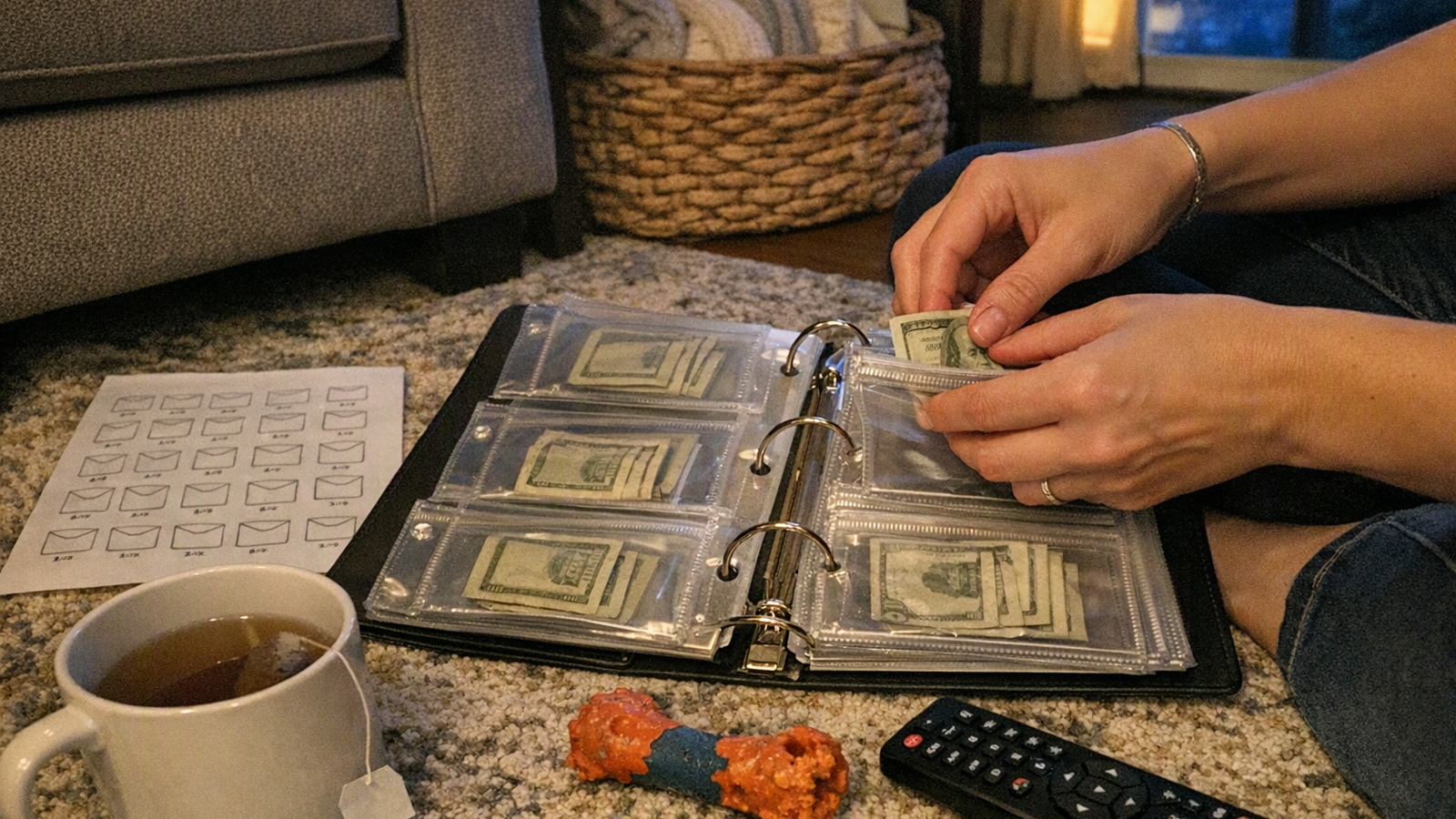
You scroll past it again: a binder of 100 little envelopes, half of them stuffed with cash and crossed off in neat handwriting. It looks so satisfying. Then you add it up.
All 100 envelopes come to $5,050. You’d love that kind of cushion, and you also don’t want to start something that stalls at envelope 30. Wanting it and doubting it can sit side by side.
The answer isn’t forcing the biggest version. It’s knowing how the challenge works, then picking the size that fits. Below are 4 free charts, a quick test for choosing yours and a pace you can actually keep.
How the 100 Envelope Challenge Works in 3 Steps
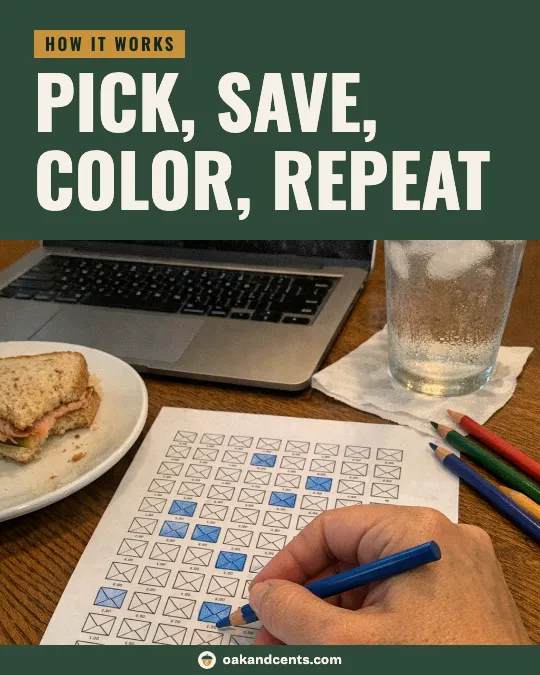
The idea is simple: 100 envelopes, each marked with an amount from $1 to $100, filled in any order you like.
Here’s how it works:
- Pick any envelope. Whatever fits this week, big or small.
- Save that amount. Move it to savings, or set the cash aside.
- Color it in. Then pick the next one.
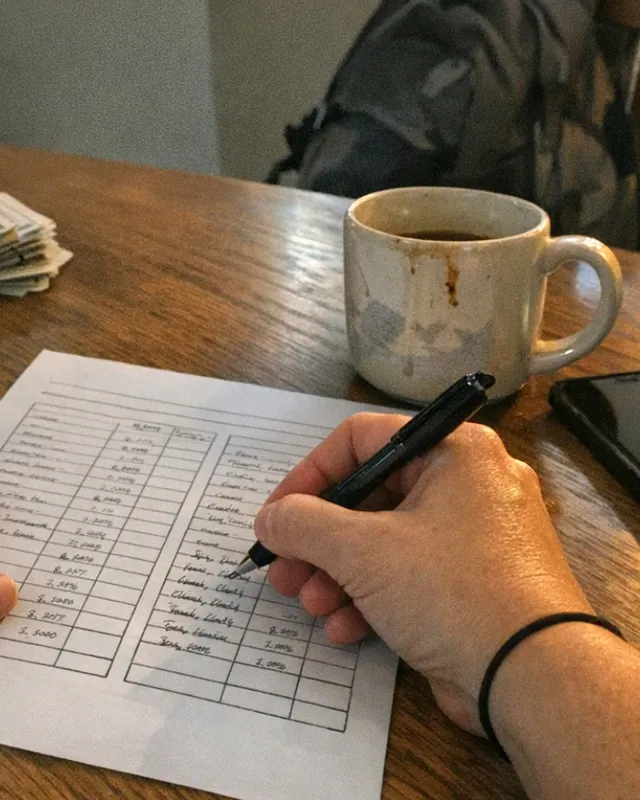
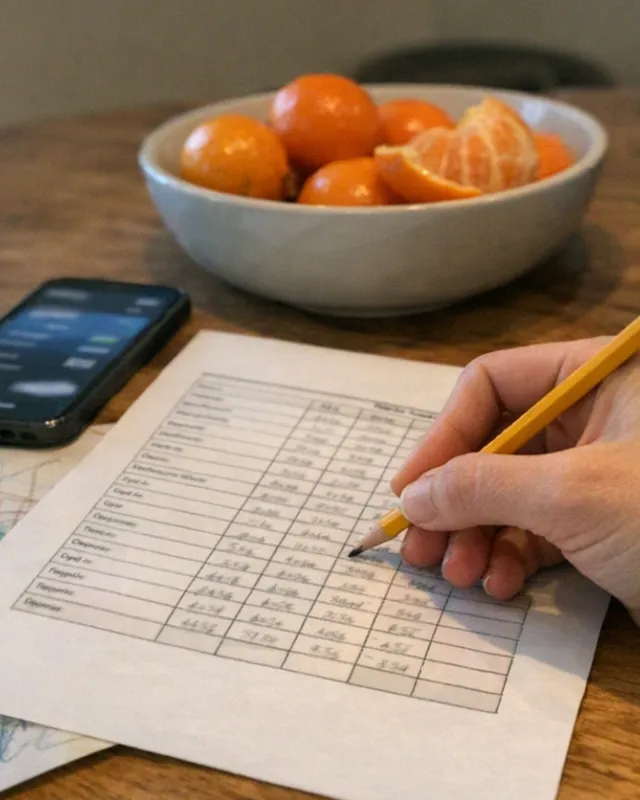
The free chart on this page has all 100 envelopes drawn in a 10 by 10 grid. You don’t need 100 real envelopes, a binder or a trip to the craft store.
Add $1 plus $2 plus $3, all the way up to $100, and the total is $5,050. That’s an average of $50.50 an envelope.
The freedom to choose is what makes this challenge different. A tight week can take the $3 envelope. A payday week can take one in the $90s.
That doesn’t mean the order never matters. If you save every small envelope first, the last few months can get heavy. There’s an easy fix for that below.
Pick, save, color. That’s the whole method.
The Pace Decides How Hard It Feels
The total is fixed. How fast you go is up to you, and the pace changes everything.
The note on the chart gives two speeds: one envelope a day takes 100 days, and two a week takes 50 weeks. You can also go slower.
Here’s what each pace asks for on average:
- One envelope a day: done in 100 days, about $50 a day, or roughly $350 a week.
- Two envelopes a week: done in 50 weeks, about $101 a week.
- One envelope a week: done in 100 weeks, almost two years, about $50 a week.
The daily pace is a lot of money in a short time. For many budgets, two a week or one a week is far easier to keep.
There’s no prize for finishing first. A slower pace you can keep beats a fast one you drop in month two.
Try this: Before you color anything, write your pace at the top of the chart: one a day, two a week or one a week.
Fast is optional. Steady is the part that works.
Try a Smaller Version If $5,050 Feels Like Too Much
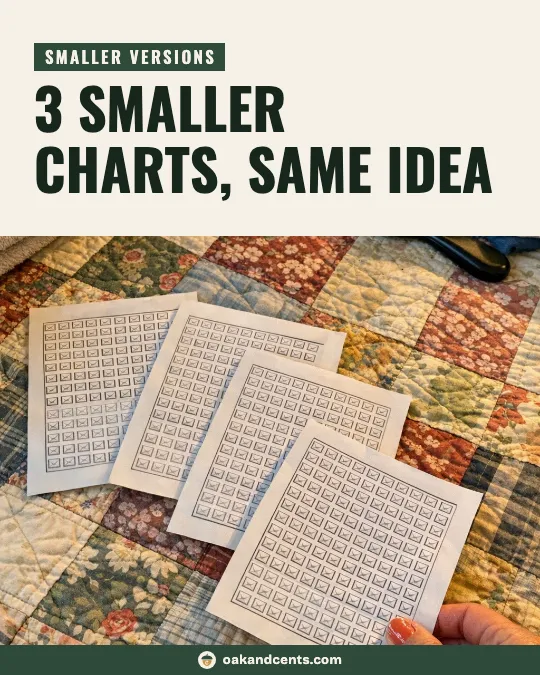
If $5,050 feels out of reach right now, the same idea works at a smaller size. Each one has its own free chart on this page.
The half size 100 envelope chart keeps all 100 envelopes but starts at 50 cents and goes up in 50 cent steps to $50. It adds up to $2,525, exactly half.
The 50 envelope chart runs from $1 to $50, for $1,275. One a day takes 50 days, and one a week takes 50 weeks.
The 25 envelope chart has 25 big envelopes from $1 to $25, for $325. One a day takes 25 days, and one a week takes 25 weeks.
Here’s how all 4 compare:
| Chart | Envelopes marked | Total | Biggest envelope | One a week takes |
|---|---|---|---|---|
| 100 envelope | $1 to $100 | $5,050 | $100 | 100 weeks |
| Half size 100 envelope | 50 cents to $50 | $2,525 | $50 | 100 weeks |
| 50 envelope | $1 to $50 | $1,275 | $50 | 50 weeks |
| 25 envelope | $1 to $25 | $325 | $25 | 25 weeks |
The half size chart and the 50 envelope chart both top out at $50. The difference is the number of steps: 100 small ones or 50 whole dollar ones.
A smaller chart isn’t second best. A finished 25 envelope chart is $325 you didn’t have before.
Choose Your Size With the Biggest Envelope Test
The easiest way to pick a chart is to look at its biggest envelope, not its total.
Ask one question: could you set that amount aside this week, after rent, bills, groceries and minimum payments, without feeling squeezed?
Here’s an example with made up numbers. Say you could spare about $40 this week. The $100 and $50 envelopes would be a stretch, so the 25 envelope chart is a comfortable place to start.
Once you finish it, try the 50 envelope chart next. Stepping up feels very different from scaling back.
The same test works when life changes. A raise, a paid off card or a second income can make a bigger chart fit later.
Your plan in one line: the chart whose biggest envelope fits this week, a pace you can keep and one savings account for all of it.
Pick for this month. You can always size up later.
Pair Your Envelopes So Every Week Costs the Same
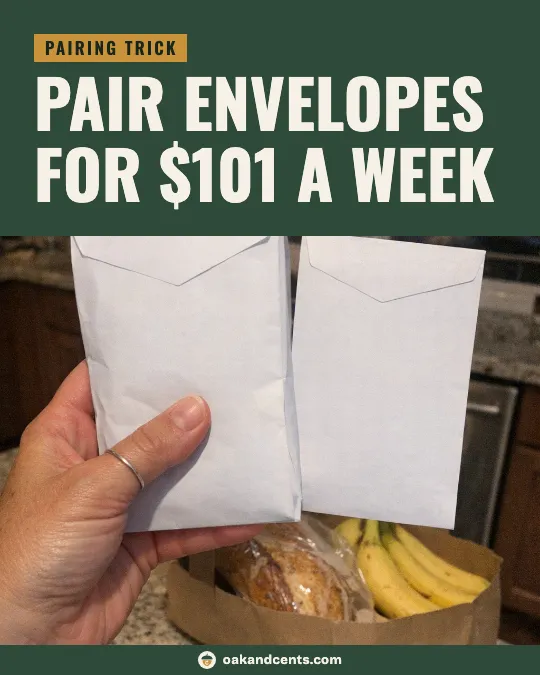
Choosing freely is fun, but it can leave a pile of big envelopes for the end. Pairing fixes that.
Match each small envelope with a big one so the two add up to $101. The $1 goes with the $100, the $2 with the $99, the $3 with the $98, and so on.
That makes 50 pairs. Fill one pair a week, and every week asks for the same $101. Fifty weeks later, you’ve saved $5,050.
A steady amount is easier to plan around than two random envelopes, which could add up to anything from $3 to $199.
The same trick works on the smaller charts:
- Half size 100 envelope: pairs add up to $50.50, so it’s 50 weeks at $50.50.
- 50 envelope: pairs add up to $51, so it’s 25 weeks at $51.
- 25 envelope: 12 pairs add up to $26 each, and the $13 envelope is left on its own. That’s 12 weeks at $26, plus one week at $13.
If a week is tight, skip the pair and come back to it. Nothing is lost. The finish date just moves.
A steady amount also makes an automatic transfer easy. A short call or message to your bank can set one up.
Say this: “Hi, I’d like to set up an automatic transfer of $101 every Friday from my checking account to my savings account. Can you help me with that?”
Same amount, every week. That’s the calm version of this challenge.
Keep the Money in the Bank, Not in a Shoebox
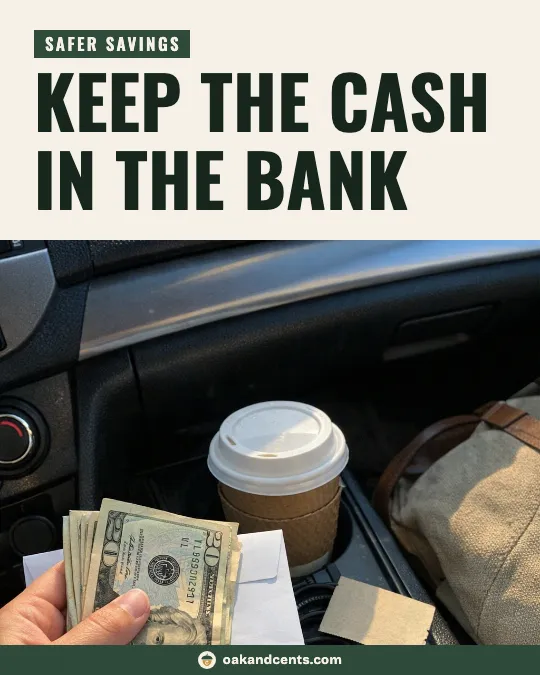
The envelope binders all over Pinterest are fun, and there’s nothing wrong with loving them. The cash inside is the part to rethink.
Cash at home can get borrowed for pizza night, lost in a move or stolen.
Money at a bank insured by the FDIC is covered up to $250,000 per depositor, per bank, for each ownership category (the FDIC’s guide to deposit insurance has the details). A shoebox isn’t.
That doesn’t mean giving up the binder. Keep it as your tracker: move the money to savings first, then color the envelope or tick it off in the binder.
If you love handling real cash, fill the envelopes for a week, then deposit them all at once. Our guide to cash stuffing for beginners has more on making cash and a bank account work together.
Give the money a job, too. An emergency fund for surprises, or a sinking fund for a cost you can see coming, is easier to leave alone.
The fun is in the envelopes. The money is safer in the bank.
Swap the Habits That Stall an Envelope Challenge
When an envelope challenge stalls, it’s usually a small habit, not one big problem.
You don’t need more willpower. You need a swap ready before the snag shows up.
Here are five common ones, each with a swap:
- Saving all the small envelopes first. Instead, pair a small one with a big one.
- Picking the $5,050 chart because it’s the one you saw online. Instead, pick the chart whose biggest envelope fits this week.
- Borrowing from the cash. Instead, deposit it each week and color the envelope after.
- Quitting after a missed week. Instead, pick up where you left off. The total stays the same, and only the end date moves.
- Starting without a goal. Instead, write one at the top of the chart, like a car repair cushion or your first $1,000.
Every envelope you color is real money saved, even when the chart takes longer than you planned.
If Rent or a Card Payment Is Behind, Let the Envelopes Wait
This challenge fits well when you have a regular paycheck with a little room after the bills, and you like seeing progress on paper.
Think twice if rent, utilities or a card payment is past due, or if a debt has gone to collections. Those come first. The same goes if a card is covering groceries right now.
If you’re paying down debt, keep paying every minimum. A small cushion can keep the next surprise off your card. The debt payoff calculator shows what sending extra money to a debt would do instead.
Not sure what comes first? A nonprofit credit counselor, like the ones in the National Foundation for Credit Counseling network, can help you decide.
Waiting until there’s room makes a stall at envelope 30 less likely.
Color Your First Envelope This Week
That binder of 100 stuffed envelopes will probably scroll past again. It’s a lovely picture, and it’s only one version of this challenge.
This week, pick your chart with the biggest envelope test, write your pace at the top and color in your first envelope.
For more ways to save with a printable, our list of savings challenge ideas has 10 free charts. The 52 week savings challenge sets the amount for you each week.
If you’re saving toward a cushion, the emergency fund calculator can help you pick your next goal.
One envelope is a real start.