It’s 10:40 at night, the kids are finally asleep, and a pair of boots you didn’t know you needed is sitting in your cart. Your thumb hovers over the button.
Part of you wants the small lift after a long day. Part of you knows the card statement will remember it longer than you will. Wanting something nice doesn’t make you careless.
The answer isn’t a strict rule against ever buying anything. It’s a few small pauses between wanting and paying. Pick from the ten below, and start with whichever one feels easiest tonight.
1. Sleep on Anything Over a Set Amount
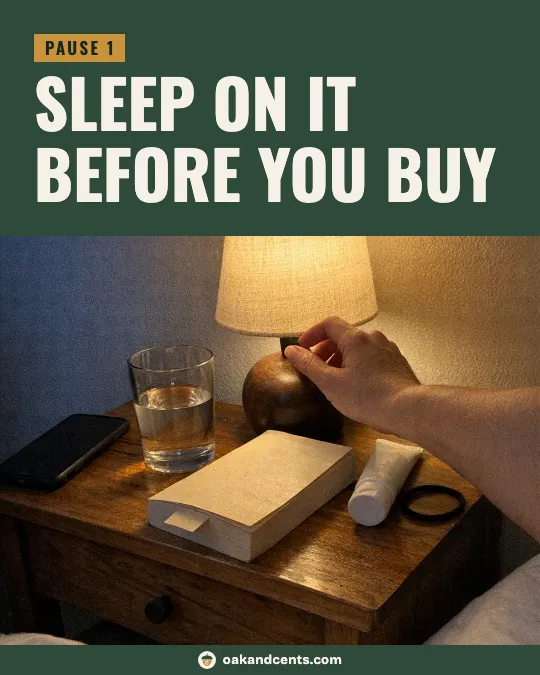
Most impulse buys happen fast. A few taps, and the order confirmation is already in your inbox.
The simplest pause is time. Pick one dollar amount, like $30, and let anything above it wait until tomorrow.
That doesn’t mean you can never buy it. It means you’ll decide when you’re rested, not at the end of a long day.
In the morning, ask one question: do I still want it as much as I did last night? Sometimes the answer is yes, and that’s fine. Often, the pull has faded.
Tonight, choose your number and write it somewhere you’ll see it, like a sticky note on your laptop.
A purchase that’s still a good idea tomorrow will still be there tomorrow.
2. Leave the Cart Full and Walk Away
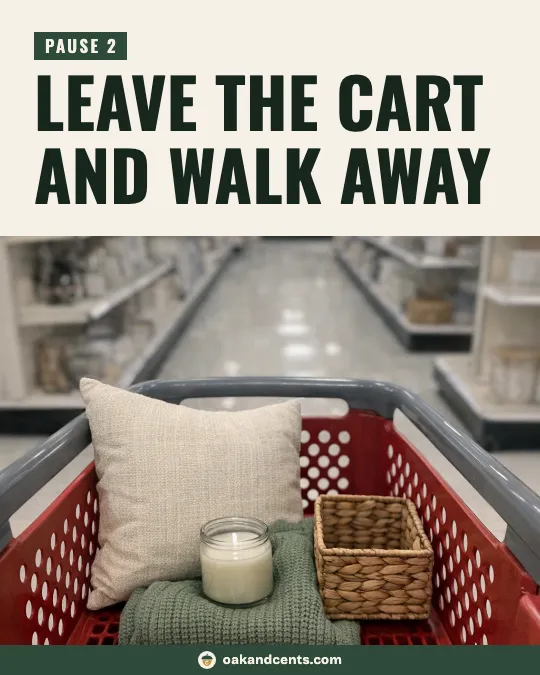
Once you’ve got a waiting rule, the cart itself becomes a helpful tool.
Instead of buying or deleting, just leave it. Close the app or walk away from the cart in the store, and come back later if you still want it.
This works because it doesn’t ask you to say no. It only asks you to say “not right now.”
The fear is missing out. What if the sale ends? Even then, a deal on something you didn’t plan to buy still costs money.
Give online carts a day or two. In a store, put the item back and finish your loop. If you’re still thinking about it at the checkout, you can go get it.
Many full carts stay full, and that’s the point.
A cart you walk away from costs nothing.
3. Remove Saved Cards From Your Browser and Apps
Online shopping is built to be quick. Your card number, address and a single button are all saved and ready.
That ease is helpful for paying bills. For impulse buys, it removes the moment where you’d normally stop and think.
So add the moment back. Remove your saved card from your browser, your favorite shopping apps and any one click settings.
You don’t have to delete your accounts. You just make yourself type the card number when you really want something.
Thirty seconds of typing is often enough time for a second thought.
If you’re paying down a card, this matters even more. When last month’s bill wasn’t paid in full, new purchases usually start costing interest from the day you buy (CFPB).
A little friction protects a lot of progress.
4. Unsubscribe From the Emails That Send You Shopping
The removed card slows the checkout. The next pause goes further back, to the moment the idea arrives.
Sale emails, app notifications and “just for you” texts are designed to bring you back to the store. And they land on the same phone you scroll when you’re tired.
You didn’t go looking for that sweater. It came looking for you.
Tonight, unsubscribe from three store emails. Turn off sale notifications on the shopping apps you use most.
That doesn’t mean you’ll never hear about a good deal. When you need something, you can always go check.
Try this: Before unsubscribing, search your inbox for “sale” and see which stores show up most. Start with those three.
Fewer invitations mean fewer decisions to make.
5. Ask Which Line of the Budget Will Pay for It
You’re in the store and something catches your eye. Before you reach for it, ask one plain question: which line of my budget is this from?
If there’s an answer, like “clothing” or “fun money,” and there’s room left in it, you can buy it calmly.
If there’s no answer, that’s useful information too. It means the money would come from somewhere else: groceries, a bill or this month’s extra debt payment.
That doesn’t mean you need a detailed budget. Even a few simple lines work, and the 50/30/20 calculator can help you set them up.
If you already budget by paycheck, it’s the same idea: every purchase has to fit into a paycheck that’s already planned.
A purchase with a home in the budget is a choice. One without a home is a leak.
6. Turn the Price Into Hours of Work
Prices are just numbers on a tag. Hours of your life feel different.
Here’s an example with made up numbers. Say you take home about $16 an hour after taxes.
| Price | Hours of work at $16 an hour |
|---|---|
| $12 lunch out | About 45 minutes |
| $48 sweater | 3 hours |
| $120 boots | 7 and a half hours |
That doesn’t mean nothing is worth it. Some things are absolutely worth three hours of work.
It means you’re comparing the item with something real: your time and energy.
The same math works for small extras. $40 a week of little purchases adds up to about $173 a month.
That’s more than the $150 extra a month in our debt snowball method example, which clears a whole store card by month 4.
Ask yourself: would I work three hours for this today?
7. Shop With a List and One Set Amount
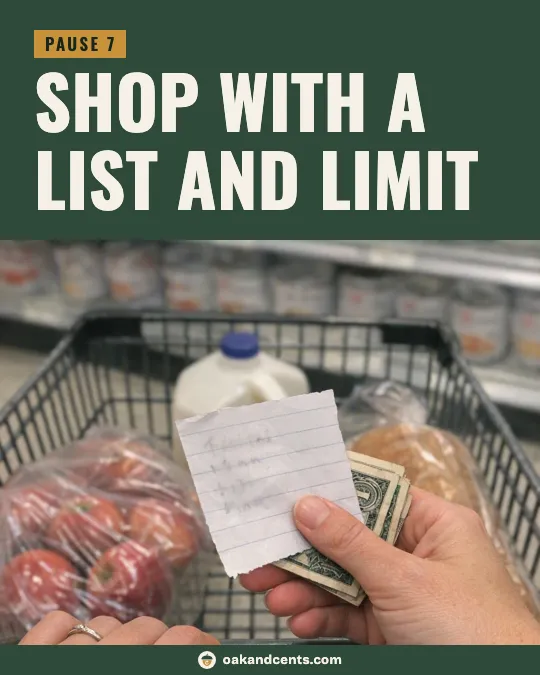
The grocery store is where many small impulse buys hide. A snack for the drive home, a magazine at the register, a “two for” deal on something you didn’t plan.
A list and a set amount do most of the work for you.
Before you go, write what you need. Then decide the most you’ll spend on this trip.
Some people bring that amount in cash, so the limit is in their hand. If you like that idea, cash stuffing for beginners explains how to start with your next paycheck.
That doesn’t mean you can’t buy something off the list. If it’s on sale and you’d buy it anyway, swap it for something else on the list.
For more ways to keep the total down, these habits that save money on groceries add up week after week.
A list decides at home what the store would love to decide for you.
8. Pause Twice at Buy Now, Pay Later
At checkout, a button offers to split the price into four small payments. The total suddenly looks much smaller.
That’s exactly why it deserves a second pause.
Buy now, pay later is a loan, usually paid back in four or fewer payments. Many plans don’t charge interest, but most charge late fees if you miss a payment (CFPB).
Each plan also adds new due dates to your month. A few of them at once can crowd the same paycheck as your rent and your debt payments.
That doesn’t mean it’s never useful. It means it shouldn’t be the reason you can afford something.
Ask: would I buy this today if I had to pay the full price now? If the answer is no, the four payments don’t change it.
Four small payments are still the whole price.
9. Notice the Feeling Before the Purchase
By now, you’ve added pauses to the store, the app and the checkout. The last pause is inside you.
Often, an impulse buy isn’t really about the item. It shows up when you’re tired, bored, stressed or a little lonely, late in the day.
That’s very human. A small purchase feels like a quick reward, and shopping apps are always open.
The pause here is simply noticing. Before you buy, name what you’re feeling. “I’m worn out.” “I’m bored.” “Today was hard.”
Then try one small free swap: a walk around the block, a shower, a cup of tea, a text to a friend. Check again in ten minutes.
That doesn’t mean every purchase is about feelings. Sometimes you just need new socks.
It means you get to choose, instead of the moment choosing for you.
10. Give Yourself a Little Planned Fun Money
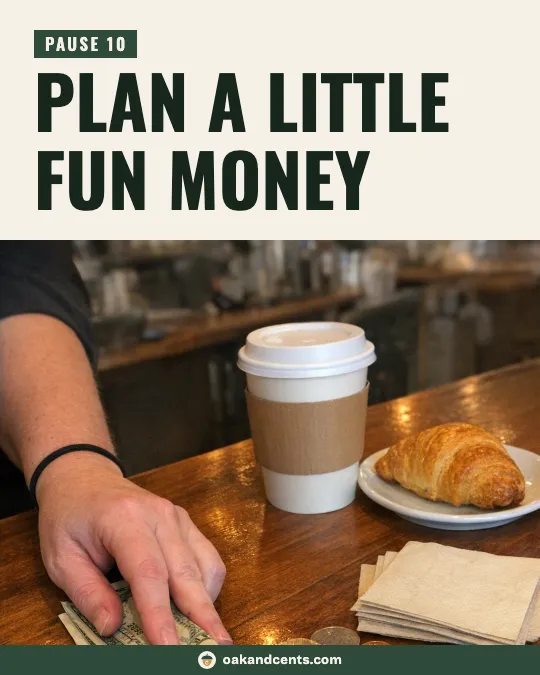
Here’s the pause that makes all the others easier: a small amount of money that’s yours to spend freely.
It can feel backwards. If you’re trying to spend less, why plan to spend?
But a budget with no fun in it is hard to live with. When every want is a no, it’s easy for them to pile up and spill out all at once, often on a card.
Planned fun money changes that. You decide ahead of time, on a calm day, how much is for small joys. Then you spend it without a second thought.
Here’s an example with made up numbers: $20 a week, which is about $87 a month.
It can go to a coffee out, a new lipstick, a paperback or a cheap takeout night. When it’s gone, the rest waits until next week.
That doesn’t mean a big number. It means a steady one you can keep, after your bills, your minimum payments and any extra you send to debt.
If you’re working through a no spend month, you can even decide which small treats are still OK. The free No Spend Month Tracker on this page has a box for exactly those rules.
Some weeks, you’ll use all of it. Some weeks, you’ll forget. Either way, you’re practicing something important: spending on purpose.
Try this: Put your fun money in a separate envelope or a separate account, and give it a name you like. “Saturday money” works.
The pauses keep the impulses small. The fun money keeps you from feeling like you’re always saying no.
Spending on purpose feels very different from spending to feel better.
When You’ve Already Bought It
Sometimes the pause doesn’t happen, and the package arrives anyway. That’s okay.
Check the return window first. Many stores give you a set number of days, so a quick decision helps.
If you can return it, do. If you can’t, let it go without beating yourself up. Being hard on yourself won’t make the next pause any easier.
Then pick one pause from this list to try next time. Write down what happened, in one line, on the free Expense Tracker on this page.
If shopping ever feels hard to stop even when you really want to, it’s worth talking to a doctor or a counselor.
And if spending has led to bills you can’t keep up with, a nonprofit credit counselor can help you get those bills back in order. Agencies in the National Foundation for Credit Counseling network offer that kind of help.
One purchase is one purchase. It isn’t the whole story.
Try One Pause Tonight
Those boots in the 10:40 cart can sit there a little longer. You don’t need ten new rules to handle them. You need one pause.
Tonight, choose one: set your overnight number, remove a saved card or unsubscribe from three emails.
This week, notice what happens to the little extras. Write them down, or color a box on the No Spend Month Tracker for every day without one.
If you’d like to see what freed up money could do, the debt payoff calculator shows how an extra payment each month changes your debt free date.
The boots can wait until morning. You might find you don’t miss them at all.