Getting out of credit card debt sounds like it needs a big start: a new card, a loan, a weekend of cutting everything. Usually the first month is much quieter. A list, a few settings, two phone calls.
Part of you wants it fixed by Sunday. Another part would rather not open the card app at all. Both are common when a balance has sat there a while, and neither means you’ve done this wrong.
So here’s a calm first 30 days, one week at a time, with one focus and a few small jobs each week. Day 30 ends with a real extra payment sent and a payoff month circled.
Week 1: Stop New Charges and Put Every Card on One Page
The first job is the smallest one. For the next 30 days, the card you’re paying down gets a rest.
There’s a reason that matters more than it seems. While a card carries a balance from one month to the next, anything new you buy on it typically builds interest right away (CFPB).
Resting the card doesn’t mean cutting it up. It means adding a little friction between you and the tap.
On days 1 and 2, try three quick settings:
- Switch the default card in your phone’s wallet to your debit card.
- Turn on purchase alerts in the card’s app, so every charge pings you.
- If the app has a lock switch, flip it on for the month.
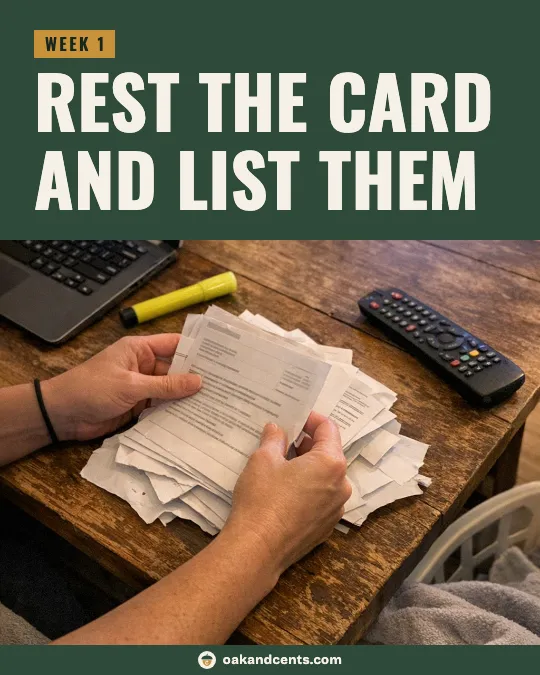
Then, on days 3 to 7, gather every statement or open every card app. For each card, write down five things: its name, its due date, what you owe on it, the interest rate and the minimum payment.
The interest rate may be listed as APR, which means the card’s yearly interest rate. There’s a row for every card on the free Debt Payoff Worksheet you can print from this page.
Worried you’ve forgotten one? The three big credit bureaus let you see your credit report free every week through AnnualCreditReport.com (FTC), and open cards in your name are listed on it.
Last, set every minimum payment on autopay. Nothing goes late while you’re still planning.
Try this: If opening the statements makes your chest tight, do one card a night. A few nights, a few rows, and week 1 is done.
A list on paper is far less scary than a pile of envelopes you haven’t opened.
Week 2: Find Your Steady Payment and One Card to Aim At
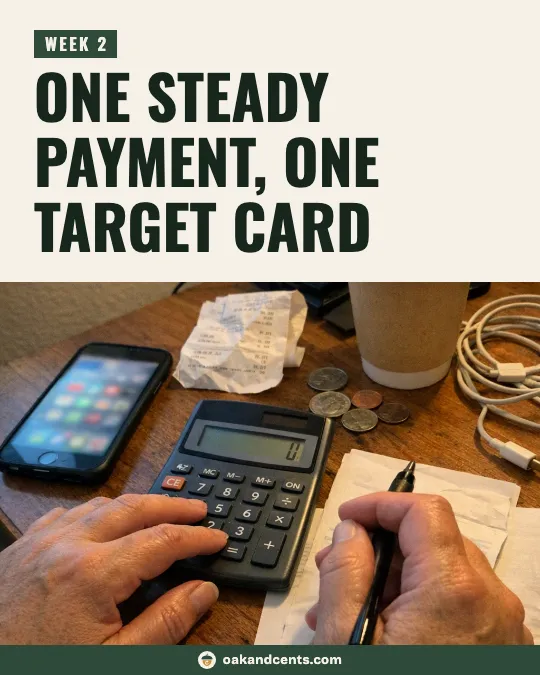
With the list done, week 2 is about money: how much can go to the cards each month, and which card gets the extra.
Start with last month. Pull up your card and bank statements and read them slowly, with a pen in hand.
You’re not grading yourself. You’re looking for two or three small leaks you’d happily close.
Here’s a made up example of what that can look like:
- A $15 streaming service nobody has opened since summer
- About $45 in delivery fees and tips across three takeout orders
- About $40 trimmed from groceries by skipping two quick stops
That’s $100 a month, found without a raise or a second job.
Now add that found money to the minimum on the card you’re aiming at. That’s your steady payment. It stays the same every month, even when the minimum on the statement shrinks.
Say that card has $3,000 on it at 25% interest. The credit card interest calculator estimates its first minimum at about $93. Add the $100 and round up, and the steady payment is $200.
At $200 a month, the credit card payoff calculator shows that card paid off in 19 months, with about $635 in interest.
On minimums alone, it takes more than 15 years and about $5,022 in interest. The minimum payment trap guide explains why the gap is so wide.
With more than one card, every card keeps getting its minimum, and only one gets the extra. The usual picks are the smallest balance or the highest interest rate.
Our snowball vs avalanche guide can help you choose between them.
You don’t have to choose forever. Pick one for now. The rest of this month works the same either way.
One number and one target. That’s all week 2 asks of you.
Week 3: Make the Two Calls That Cost Nothing
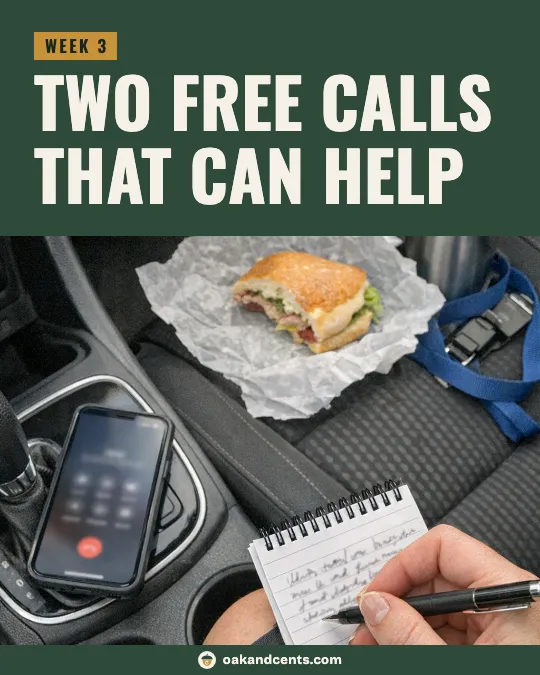
By week 3 you know your numbers, and that makes this the right week to pick up the phone.
Calls can feel awkward, especially about money. It helps to remember that the person on the other end takes these calls all day.
The first call is to ask for a lower interest rate on the card. They may say no, and the call is still free.
If they say yes, it adds up. On our $3,000 example with $200 a month, a drop from 25% to 20% saves about $153 in interest and one month.
The step by step script for asking has the exact words, plus what to say if the answer is no.
The second call, or the same one, is about timing. If your due date lands a few days before payday, ask to move it.
The CFPB notes that you may be able to work with creditors, card companies included, to adjust when bills are due (CFPB).
Say this: “Hi, my paycheck lands on the 15th, and I’d like my card payment to go out right after it. Is there a way to move my due date to the 18th or later?”
Keep a sticky note by the phone. Jot down the date, the name of the person and their answer.
If they can’t change anything today, that’s still useful information. You’ll know where things stand before week 4.
Two short calls this week can take a little weight off every month after it.
Week 4: Send the First Steady Payment and Start Counting
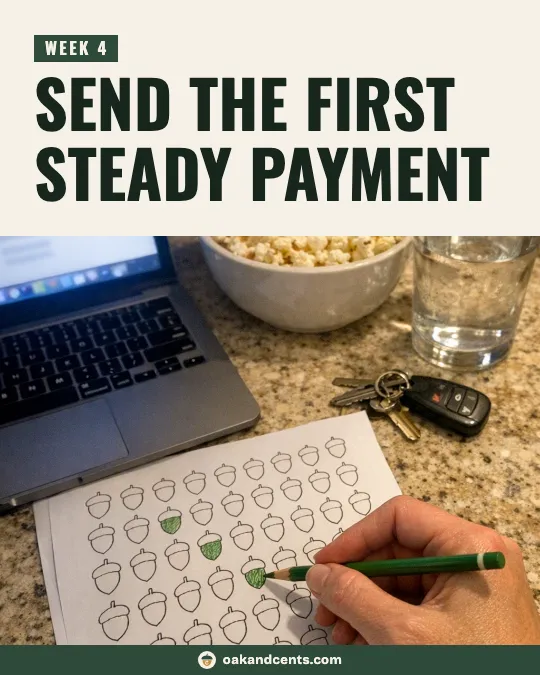
This is the week your plan becomes a payment.
Schedule the steady payment for the day after payday, when the money is already in your account. On your target card, it can simply replace the minimum autopay from week 1.
If you budget by paycheck, it gets its own line right after rent.
It can feel small next to the total. $200 against $3,000 doesn’t look like much on the first day.
What matters is that it goes out again next month, and the month after that.
So give yourself a way to see it. The free coloring chart you can print from this page is a grid of 100 acorns, one for each 1% of what you owe. On a $3,000 card, every acorn is $30.
If you prefer numbers in boxes, the free debt payoff tracker spreadsheet logs each month and shows how much you’ve paid off.
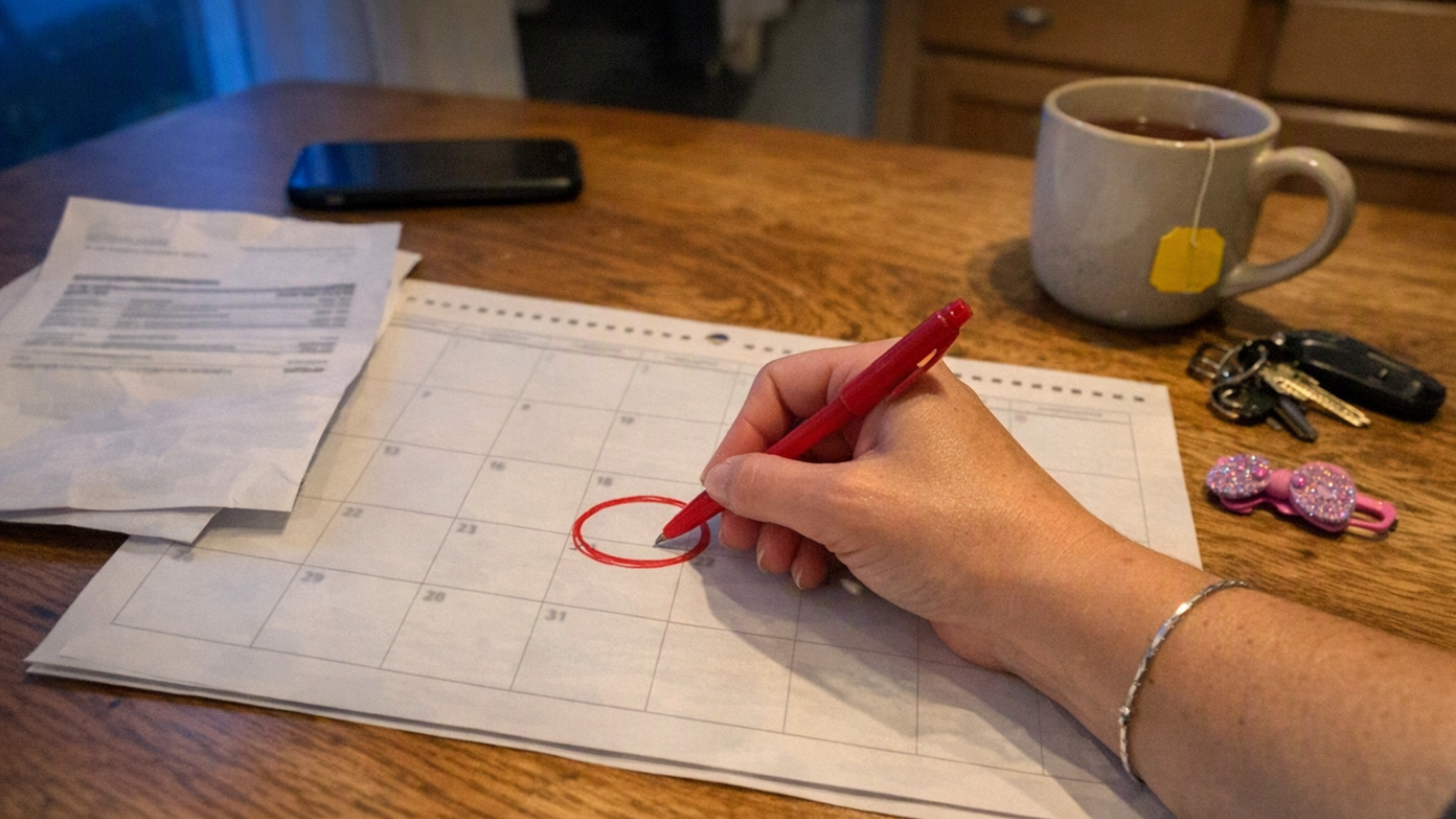
Then find your payoff month. Put your own numbers in the payoff calculator and write that month on the calendar, somewhere you’ll walk past.
Try this: On day 30, ask yourself three quick questions. Did anything new go on the card? Did the steady payment go out? Is the payoff month on the calendar?
Three yeses is a very good first month. Two is still real progress.
Celebrate it in a way that costs nothing: a walk, a favorite dinner at home, an early night.
The first payment at your new number is the one the rest of them follow.
Your First Month at a Glance
Here’s the whole month on one screen, so you can save it or print it:
| Days | Focus | Small jobs |
|---|---|---|
| 1 to 2 | Rest the card | Switch your phone wallet to debit, turn on alerts |
| 3 to 7 | See every card | List each card, check your free credit report, put every minimum on autopay |
| 8 to 14 | Find your number | Read last month’s statements, set a steady payment, pick one target card |
| 15 to 21 | Make two calls | Ask for a lower rate, ask to move a due date |
| 22 to 30 | Pay and track | Send the steady payment, color your first acorns, circle your payoff month |
Your plan in one line: a resting card + every minimum on autopay + one steady payment aimed at one card.
None of these steps needs a new loan, a transfer card or a month without slipups. They’re the base that the bigger moves sit on later.
If you want to compare those bigger moves, our guide to how to pay off credit card debt lays out nine of them side by side.
If a Week Goes Sideways, Do the Next Unfinished Task
The car needs a tire in week 2, and it goes on the card. Or week 3 arrives in the middle of a family birthday and the calls don’t happen.
It’s easy to read that as proof the plan already failed. It isn’t.
These 30 days are an order, not a deadline. If a week slips, you don’t start over at day 1. You simply pick up the next unfinished task.
If a real emergency landed on the card, add the new amount to your list and keep going. The steady payment still works. It may just take a month or two longer.
To keep the next surprise off the card, even a small starter emergency fund helps. Some people send part of their found money there for a few months, while every minimum still goes out.
A plan that bends is a plan you’ll still be following in March.
When the Minimums Already Don’t Fit
Sometimes week 1 shows something harder. You add up the minimums, and they’re more than the paycheck can cover.
If that’s where you are, it’s a sign the plan needs outside help, not more effort from you.
Call your card company before you miss a due date. The CFPB’s advice is to reach out right away, because many card companies are open to changing a payment for someone in a money emergency (CFPB).
Tell them what you can pay, and for how long.
A nonprofit credit counselor can also sit down with your whole budget. The NFCC can connect you with one. Ask about any fees before you agree to anything.
Reaching out in week 1 is still doing week 1.
Day 31 Looks a Lot Like Day 30
No new card, no loan, no weekend of cutting everything. Just a list, a few settings, two calls and one steady payment.
That’s what getting out of credit card debt looks like for most of the way: the same small moves, repeated.
Tonight, do only days 1 and 2. Switch your phone wallet to debit and turn on purchase alerts. It takes about five minutes.
When you’re ready for week 2, type your own numbers into the credit card payoff calculator and see your month.
The calm version works. It just needs you to keep showing up for it.