A $4,000 card at 24% interest adds about $80 in its first month. Pay $200 a month and, in this made up example, it’s gone in 26 months. Pay only the minimum and it can take more than 17 years.
It’s easy to feel pulled between two kinds of advice: cut everything and throw every dollar at the card, or move the balance somewhere new. Neither one tells you which fits your paycheck.
Paying off a credit card isn’t one secret move. It’s one or two strategies that fit your life, kept up month after month. Here are 9, compared side by side, so you can pick yours tonight.
1. Stop the Balance From Growing While You Pay It Down
You send $200 to the card on Friday. On Tuesday, the grocery total goes on the same card because it’s the one saved in the app.
It feels like running up a down escalator.
The worry is real: what if the car needs a tire and the card is tucked away? That fear makes sense. But payments can’t catch up while new charges keep landing.
There’s a second reason. When you carry a balance, you usually lose the grace period on new purchases, so they start costing interest from the day you buy (the CFPB explains how that works).
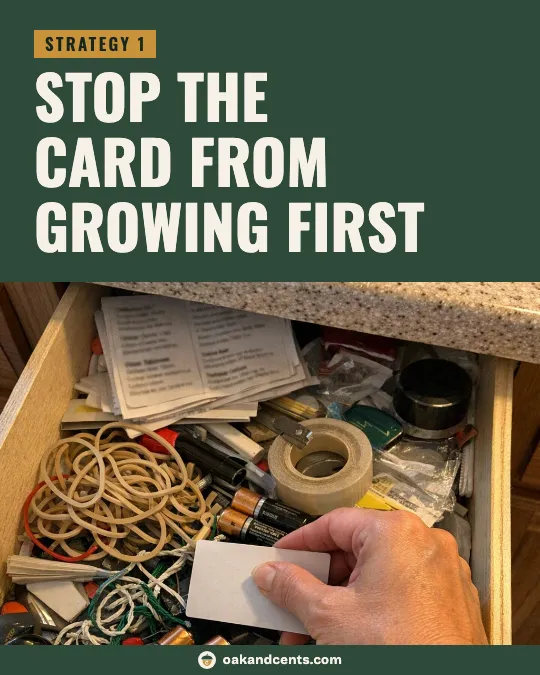
That doesn’t mean cutting the card in half. It means making it a little harder to reach.
Try this: Tonight, delete the saved card from one shopping app and move the card itself into a drawer.
For real emergencies, even a small starter emergency fund means the card isn’t your only backup.
A card that isn’t growing is a card you can finish.
2. Pay One Steady Amount Instead of the Minimum
Once the balance stops growing, the next question is how much to send each month.
The minimum payment is the smallest amount the card company accepts. It’s built to keep your account current, not to finish the balance. As the balance drops, the minimum drops too, so it stretches out for years.
Here’s our $4,000 example at 24% again, with made up numbers. The credit card interest calculator compares minimums with a steady payment, so you can check them:
- Only the minimum (the calculator’s estimate, starting near $121): more than 17 years and about $6,763 in interest.
- $150 every month: 39 months and about $1,773 in interest.
- $200 every month: 26 months and about $1,160 in interest.
You don’t need a huge number. You need one that stays the same, even when the minimum shrinks.
If the minimum due box on your statement has been making you uneasy, the minimum payment trap guide walks through it slowly.
The minimum keeps the account open. A steady payment closes it out.
3. Use the Debt Snowball if You Need a Quick Win
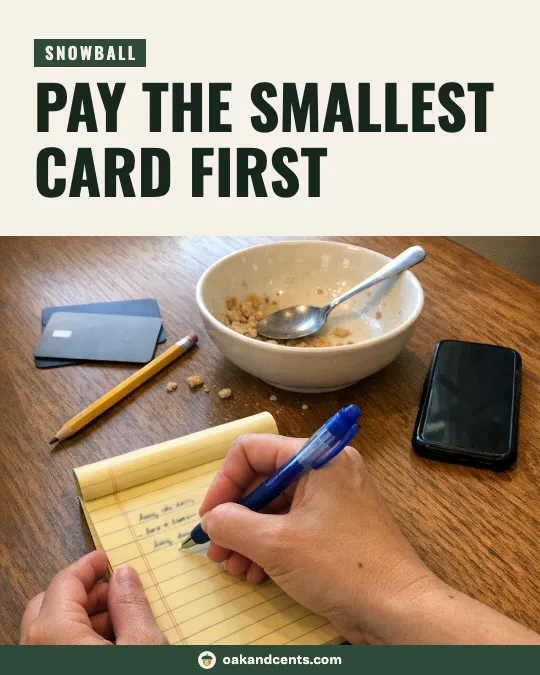
A steady payment works beautifully on one card. With two or three, the extra money needs a target.
The debt snowball picks the smallest balance first. You pay the minimum on every card and send everything extra to the smallest one. When it’s gone, its whole payment rolls onto the next card.
Many people worry this is the “wrong” choice because it ignores the interest rate. It’s not wrong. It’s a choice that trades a little interest for quick proof that the plan works.
Here’s a made up example. A $600 store card at 24% gets its $25 minimum plus $150 extra, so $175 a month. It’s paid off in month 4.
Then that $175 joins the next card’s minimum, and the next card starts to fall faster.
The debt snowball method guide has the full steps. If you like numbers in boxes, the free snowball spreadsheet does the math for you.
A first card crossed off in month 4 can carry you through month 14.
4. Use the Debt Avalanche if the Interest Bothers You Most
Some people feel better with the quick win. Others feel better knowing they’re paying the least interest. The avalanche is for the second group.
It uses the same steps as the snowball, in a different order. The card with the highest interest rate gets all the extra money first.
The catch is patience. If that card also has a big balance, your first payoff can take a while.
In the example inside our free spreadsheets (five made up debts and $150 extra a month), the avalanche saves about $301 in interest and finishes one month sooner.
The snowball gets its first payoff in month 4, while the avalanche waits until month 15.
Neither is a mistake. The snowball vs avalanche comparison can help you pick, and the debt payoff calculator runs both with your own cards. There’s also a free avalanche spreadsheet.
The best order is the one you’ll still follow in month 10.
5. Ask Your Card Company for a Lower Interest Rate
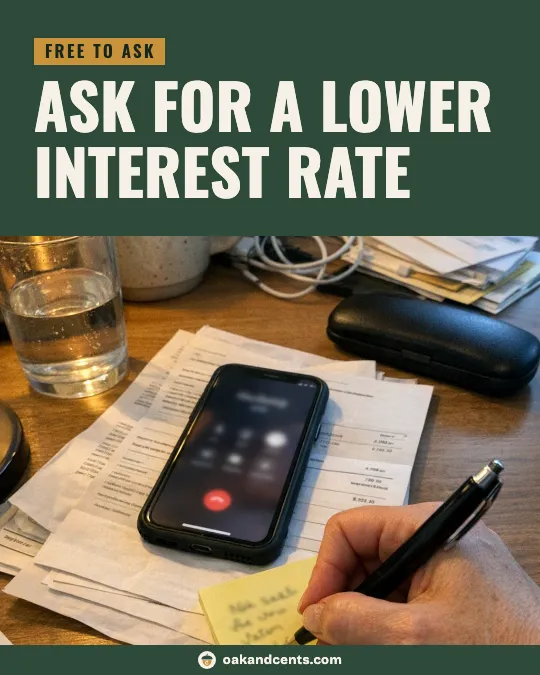
Most people never call to ask. The rate on the statement feels fixed, like the price on a shelf.
Some card companies are willing to lower your interest rate if you ask (the CFPB lists it as one option to try). There’s no promise they’ll say yes. But the call is free.
Here’s why it’s worth ten minutes. On our $4,000 example at $200 a month, dropping the rate from 24% to 19% saves about $311 in interest and one month.
Say this: “I’ve been a customer for a while and I’m working on paying this card down. Is there any way you can lower my interest rate?”
If they say no, thank them and ask what might change their answer in a few months.
The full script, with what to say if they say no, is in how to ask for a lower credit card interest rate.
The worst answer is no, and that one costs nothing.
6. Move the Balance to a 0% Transfer Card, Carefully
If asking didn’t work, a balance transfer is the next lever on the interest rate.
You move what you owe to a new card with a 0% offer for a set number of months. There’s usually a balance transfer fee, often a percentage of what you move (CFPB).
Here’s a made up comparison. Our $4,000 card at 24% with $275 a month takes 18 months and about $775 in interest.
Now say a transfer charges a 3% fee ($120) and gives 0% for 15 months. With the same $275 a month, the $4,120 is gone in month 15. The only cost is the $120 fee.
That’s a real difference. But there are limits. You have to be approved, the rate goes up when the offer ends, and new purchases on that card can start costing interest right away.
Paying more than 60 days late can also raise the rate on everything (CFPB).
You don’t need a transfer to make progress. If you try one, divide the total by the 0% months first.
A 0% offer helps when there’s a plan to finish before it ends.
7. Look at a Consolidation Loan Only if the Rate Is Lower
A consolidation loan is a personal loan that pays off your cards, so you have one fixed payment instead of several.
It can make life simpler. One due date, one number, and a clear end month.
But simpler isn’t always cheaper. The CFPB points out that some low loan rates are short teaser rates, and a lower monthly payment can mean paying for longer and more overall (CFPB).
There’s a quieter risk too. Once the cards show $0, it’s easy for them to fill up again.
Before you sign anything, check three things: the interest rate, the total you’d repay, and what you’ll do with the empty cards.
If the loan’s rate isn’t lower than your cards, it doesn’t help. If it is, the steady payment still does the work.
A new loan is a tool, not a fresh start.
8. Send Found Money Straight to the Card
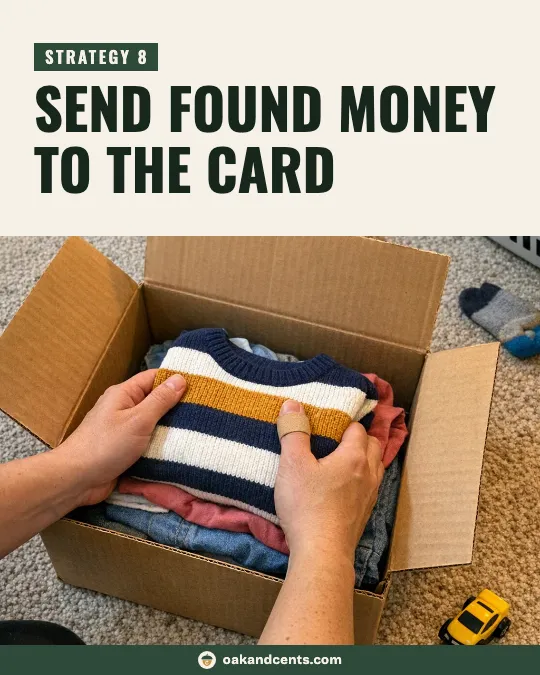
The tax refund lands. A few outgrown clothes sell online. A bill you called about drops by $20.
Small, uneven money like that tends to vanish into the week.
Giving it a job before it arrives makes it count.
Here’s a made up example on our $4,000 card at 24%: $500 sent in month 1, plus the usual $200 a month, clears it in 22 months instead of 26. That saves about $293 in interest.
That doesn’t mean every extra dollar has to go to the card. Keeping a small cushion is part of the plan, not a step back.
Steady extras help too. A lower monthly bill or a few hours from one of these side hustles can become a monthly boost. Here’s what an extra $100 a month can do on three example timelines.
Money with a job waiting is much harder to lose.
9. Get Help From a Nonprofit Credit Counselor
Sometimes the problem isn’t which strategy to pick. It’s that the minimums already don’t fit, and the statement on the counter feels too heavy to open.
If that’s where you are, nothing is wrong with you. Card interest and stacked minimums can outgrow a normal paycheck, especially after a job change, a medical bill or a new baby.
This is when outside help makes sense.
A nonprofit credit counselor can look at your whole budget with you. They may suggest a debt management plan.
With one, you make a single monthly payment to the counseling agency, and it pays your card companies. These plans typically lower your monthly payments, interest and fees (CFPB).
There can be fees, so ask for the price in writing first.
Be careful with companies that promise to make your debt go away or tell you to stop paying your cards. The CFPB lists those as warning signs (CFPB).
To find a counselor, start your search with the National Foundation for Credit Counseling.
Say this: “I have credit card debt and my minimum payments are hard to keep up with. Can you help me look at my options and tell me about any fees first?”
If you’re already behind, call your card company before the next due date too. Many card companies are willing to work with you on your payment during a money emergency (CFPB).
Asking for help is a strategy too. Often it’s the bravest one on this list.
Compare the 9 Strategies Side by Side
Here’s everything in one place, so you can see which two or three fit your situation:
| Strategy | Good for | Watch out for |
|---|---|---|
| 1. Stop new charges | Everyone, first | Keep a small emergency cushion |
| 2. One steady payment | Anyone above the minimum | Pick a number you can keep |
| 3. Debt snowball | Needing a quick win | A little more interest |
| 4. Debt avalanche | Paying the least interest | A slower first payoff |
| 5. Ask for a lower rate | Any card you pay on time | They may say no |
| 6. 0% balance transfer | Good credit and a clear end date | Fee, approval, rate after the offer |
| 7. Consolidation loan | A rate lower than your cards | Longer terms and empty cards |
| 8. Found money | Refunds, sales, bill savings | Keep a small cushion |
| 9. Credit counselor | Minimums that don’t fit | Fees and settlement promises |
Your plan in one line: no new charges + one steady payment + one card that gets all the extra.
A simple plan uses strategies 1 and 2, plus one order (3 or 4). The rest are levers you pull when they fit.
Start With One Card Tonight
That $4,000 card from the top of the page adds about $80 in interest in its first month alone. That number only shrinks once the balance starts falling, and that can start this week.
Tonight, write down every card, what you owe and its interest rate. The free worksheet on this page has room for all of it.
Then pick your steady payment and your order. Put your own numbers in the credit card payoff calculator to see your month.
One card, one number, one order. The rest follows.