The electric bill lands in your inbox, and you pay it, the way you usually do. In the back of your mind, a quiet tally starts: who covered groceries, who paid daycare, who bought the birthday gift.
Bringing it up can feel petty. Keeping quiet lets a small resentment grow in the corner. Feeling awkward about money is normal, even for couples who share everything else.
What helps isn’t a long talk or one person taking over. It’s one shared page with both paychecks, every household bill and a line that says who sends who what. Here’s how the free template works.
A Household Budget Puts Both Paychecks on One Page

A household budget is a plan for the money two people share. It shows what each of you brings home, what the household costs and what’s left for each of you.
The free template on this page is built for exactly that. It has room for:
- Each person’s take home pay each month, meaning what lands after taxes.
- Shared bills, with who pays each one, or the joint account.
- Each person’s own costs, like a personal card or a gym membership.
- Monthly totals for each of you and for the household.
- Who owes who, worked out for you.
Your part is the cream boxes. Everything else, including the totals in gold, works itself out.
It opens on a short “How to use” tab, with example numbers already in place. There’s no sign up.
It works in Excel, and in Google Sheets if you upload it to Google Drive and open it there.
That doesn’t mean every dollar either of you earns has to be pooled. The template only asks about the costs you share.
Two paychecks, one page, and no more math in your head.
Choose Your Split First: By Income or Down the Middle
Before you list a single bill, decide how you’ll share the household costs. The template offers two ways.
By income means the one who earns more pays a bigger share. 50/50 means each of you pays half.
Neither is more loving or more fair than the other. They just suit different couples. By income often feels kinder when paychecks are far apart. Down the middle can feel simpler when they’re close.
Here’s the template’s example with made up numbers. Alex takes home $3,400 a month and Sam takes home $2,600. Their shared bills come to $3,720. Split by income, Alex covers 56.7% and Sam covers 43.3%.
| With the example numbers | By income | 50/50 |
|---|---|---|
| Alex’s fair share of shared bills | $2,108 | $1,860 |
| Sam’s fair share of shared bills | $1,612 | $1,860 |
| Money that changes hands | Sam sends Alex $120.33 | Sam sends Alex $185.00 |
| Left over each month: Alex / Sam | $932 / $648 | $1,180 / $400 |
Look at the last row. With a 50/50 split, Sam ends up with $400 a month and Alex with $1,180. By income, the gap is much smaller.
You can switch between the two in one box and watch every number change. Try both before you decide.
Say this: “Can we look at our bills together this weekend and try splitting them two ways, just to see which feels fair to both of us?”
The split you both agree on is the right one for your house.
List Every Shared Bill and Who Pays It
Next comes the list of everything the household shares. Pull up last month’s statements and write down each cost, along with who usually pays it.
In the example, the shared list has 13 lines: rent, electric and gas, water, internet, groceries, car insurance, a phone plan, childcare, streaming, household supplies, a car loan, an emergency fund and date night.
Together they come to $3,720 a month.
For each bill, you pick who pays it from a short list: one of you, or the joint account.
In the example, the joint account covers the big four: rent ($1,500), groceries ($650), childcare ($400) and the emergency fund ($200). That’s $2,750. Each of the other bills is paid by Alex or by Sam.
There’s room for 20 shared bills, which is usually plenty. If you change a name at the top, pick it again in the “Who pays it” column so the totals stay right.
If a bill doesn’t have a payer yet, the sheet shows a short note asking you to pick one. Nothing slips through quietly.
Savings belongs on this list too. The $200 emergency fund line in the example is treated just like rent: a cost the household shares.
A bill with a name next to it is a bill nobody has to wonder about.
Keep a Little Money That’s Just Yours
Shared bills cover the house. But each of you also has costs that belong to one person: a card you had before you met, a haircut, a hobby, a coffee on the way to work.
The template gives each person their own list, with room for 10 costs each.
In the example, Alex’s own costs are a student loan ($180), a gym membership ($30), fun money ($100) and clothes ($50). That’s $360.
Sam’s are a store card ($35), a Mastercard ($120), hair ($45), fun money ($100) and a hobby ($40). That’s $340.
Personal money can feel like a selfish line in a family budget. It usually works the other way. When each of you has a little that’s truly yours, small purchases stop needing a discussion.
It also keeps personal debts visible without turning them into a household argument. If one of you is paying down a card, that payment sits in their own list.
The debt snowball method can help decide which card gets any extra first.
Why it matters: Fun money for both of you is part of the plan, not a leak in it. Plans with no personal money in them are often the first ones to be dropped.
Some money with no questions attached keeps everything else calmer.
Read the One Line That Evens Things Out

This may be the most helpful part of the page. Near the top, the template writes one plain sentence that settles the month.
In the example, it says: “Sam sends Alex $120.33 a month to even things out.”
Here’s where that comes from. Alex’s fair share of the shared bills is $2,108, but between the joint account and the bills Alex pays directly, Alex is paying $2,228.33 now.
Sam’s fair share is $1,612, and Sam is paying $1,491.67 now. The difference is $120.33.
One small transfer each month, and the split matches what you agreed on. No tally in the back of anyone’s mind.
If the two of you are already even, the line says so, and no money needs to change hands.
The “Left over” numbers use each person’s fair share, so they already count that transfer. In the example, Alex has $932 left each month and Sam has $648. That’s $1,580 together.
That leftover is worth a conversation of its own. It could go to extra debt payments, a bigger emergency fund or a goal you’re both excited about.
One line on the page can replace a lot of quiet keeping score.
Plan for the Family Costs That Sneak Up
Kids add costs that don’t arrive as neat monthly bills. School pictures, a field trip, new shoes in a size you didn’t expect, a birthday party every other weekend.
When those land on whoever happens to be at the store, the tally starts again.
One fix is to treat them as shared costs with a monthly amount. A “kids’ extras” line or a back to school fund can sit right in the shared list, with a payer like any other bill.
This is how a sinking fund works: a little set aside each month for a cost you can see coming. Birthdays, holidays and school costs are all good candidates.
The same goes for a family cushion. The example’s $200 a month to an emergency fund means the next car repair doesn’t land on one person’s card.
Not sure how big that cushion should be? The emergency fund calculator can help you pick a number.
Due dates matter too, especially when two people pay different bills. The free bill tracker on this page lists every bill with a paid box for each month, so you both know what’s done.
A cost you planned for together doesn’t turn into a who paid question later.
Make It a Monthly Money Date, Not a Meeting

A household budget only helps if you both look at it. Once a month is usually enough.
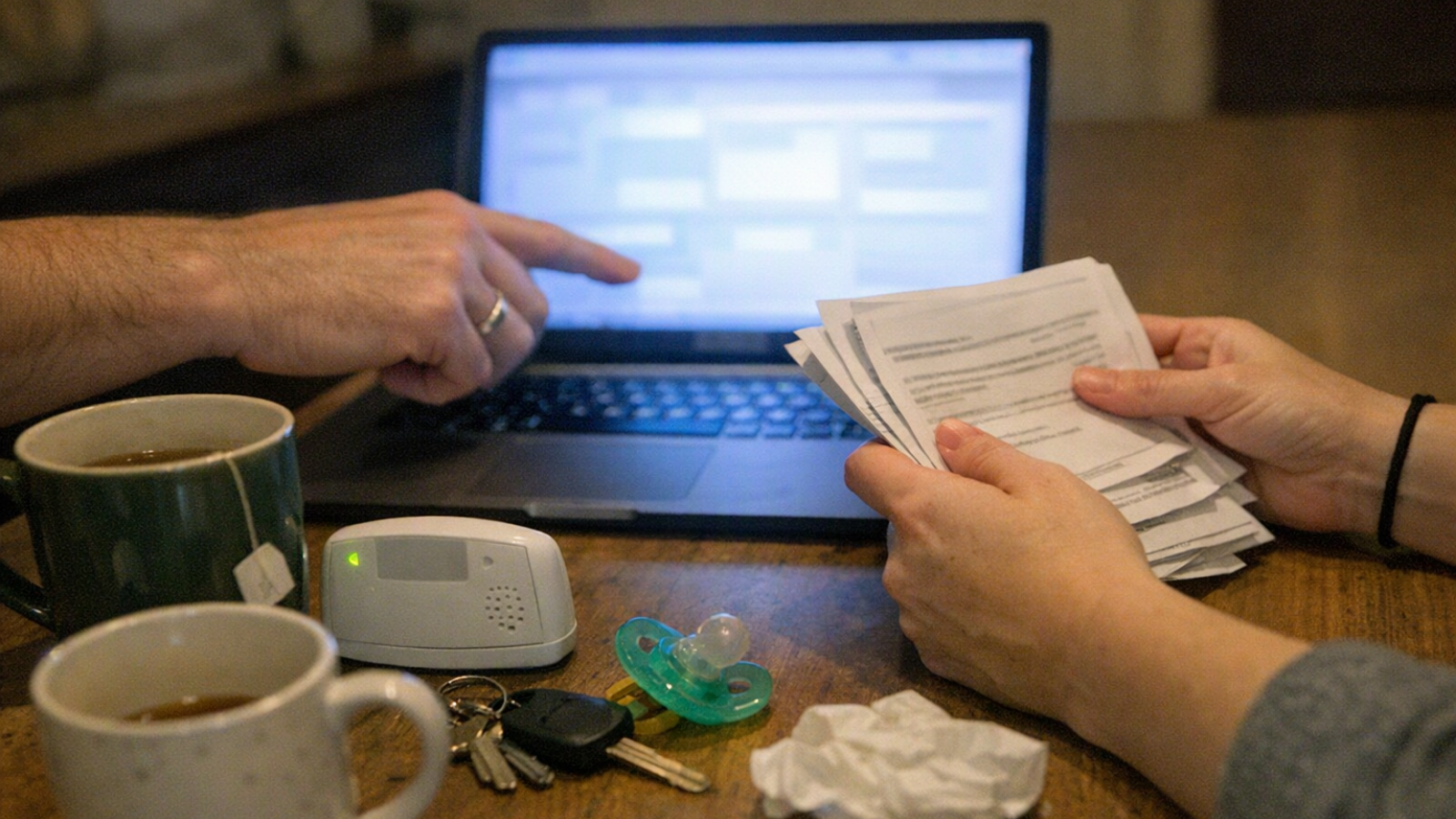
Pick an evening after payday, make tea, put the kids to bed and open the file together. Twenty minutes is plenty.
Here’s a short list for that check in:
- Update anyone’s take home pay if it changed.
- Add or remove any shared bill.
- Check that every shared bill still has a payer.
- Look at the “who owes who” line and set up that month’s transfer.
- Decide together what the leftover money is for.
That doesn’t mean every money date has to fix everything. Some months, the best outcome is that nothing surprised you.
If you’d rather plan on paper first, the free monthly budget sheet on this page works well at the kitchen table. You can also see our full set of printable budget sheets.
End on something good: a debt that dropped, a savings goal that grew, a month with no late fees.
A calm twenty minutes a month can save a lot of tense ones.
If One Paycheck Carries Most of the House
It’s built for two people who each bring home a paycheck and share a home’s costs. It’s especially helpful when you pay different bills from different accounts.
Think twice if only one of you has an income right now, or if you’re a single parent running the house alone. In that case, a simple monthly plan, like our free Excel budget template, may fit better.
The split also needs both of you on board. If one person sets the numbers alone, the plan is much harder to keep.
If bills are already past due, or no split covers the basics, outside help can take the heat out of it.
A nonprofit credit counselor can go over the numbers with both of you, and the NFCC is one place to start looking.
You can also start smaller: our guide on how to make a budget when you are in debt walks through the first steps.
A plan that covers the basics is a strong start, even if the extras wait.
Pour Two Cups of Coffee and Fill In the Top Box
That electric bill in your inbox doesn’t have to start a quiet tally anymore. It just needs a line on the shared page and a name next to it.
This week, download the template and fill in the top together: both names and what each of you takes home.
Then pick your split, by income or 50/50, and add the shared bills you can think of tonight. The rest can wait for your first money date.
If either of you is paying down debt, the debt payoff calculator shows what that leftover money could do.
One page you both trust is worth more than two private tallies.