Cancel every subscription, cook every meal, skip every treat: that’s the usual advice for saving money fast. It sounds bold, and it’s very hard to keep up past the first weekend.
You might need money soon for a car repair, a past due bill or some breathing room. But the budget is already tight, with little left to trim. A tight budget is a math problem, not a measure of your effort.
Saving fast isn’t about a joyless month or a second job. It’s a 30 day sprint: one target, one small focus a week and a separate place for the money. You can set it up tonight and start week 1 tomorrow.
Saving Fast Works Best as a 30 Day Sprint
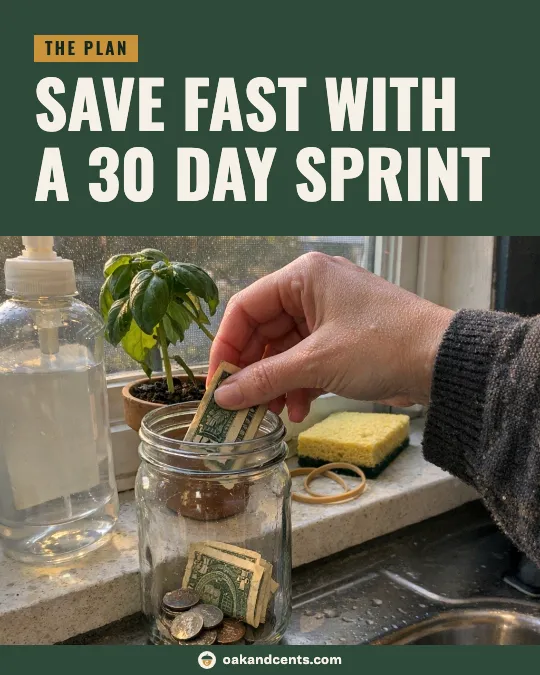
Saving money fast is easier when it has an end date.
Cutting back with no finish line can feel like a punishment. A sprint feels more like a project: it starts, it ends and then you get to rest.
Thirty days is long enough to see real progress and short enough to stay with it.
That doesn’t mean giving up every small comfort. It means four weeks, each with one simple focus, and money moved somewhere safe as you go.
Here’s what that could look like for a made up household aiming for $300. The amounts are examples, not promises.
| Week | Focus | Example saved |
|---|---|---|
| Week 1 | Find the leaks and cancel two unused subscriptions | $25 |
| Week 2 | Swap two takeout nights for backup dinners | $30 |
| Week 3 | Sell a few things you no longer use | $60 |
| Week 4 | A no spend weekend and one planned grocery trip | $35 |
| Every day | Set aside $5 a day | $150 |
| Total | $300 |
Your amounts will look different. A $150 month counts just as much as a $300 one.
A short plan you finish beats a big one you drop in week two.
Pick One Target Number and One Place to Keep It
Before you cut anything, decide what the money is for. “Save more” is hard to aim at. “$300 for the car repair” is not.
A clear target gives every small no a reason. Skipping takeout feels different when you know where the $15 is going.
Choose a number that fits your month. If you’re not sure, start with $150, the total of the $5 a day challenge.
If the money is a cushion for surprises, the emergency fund calculator can help you pick a number. Our guide to a starter emergency fund shows where to begin.
Then give the money a home that isn’t your everyday account: a separate savings account, or a labeled envelope at home.
Why it matters: Money left in checking tends to get spent without anyone deciding to spend it. A separate spot puts one small step between you and the money.
A number with a name is much easier to save for.
Week 1: Find Where the Money Already Goes
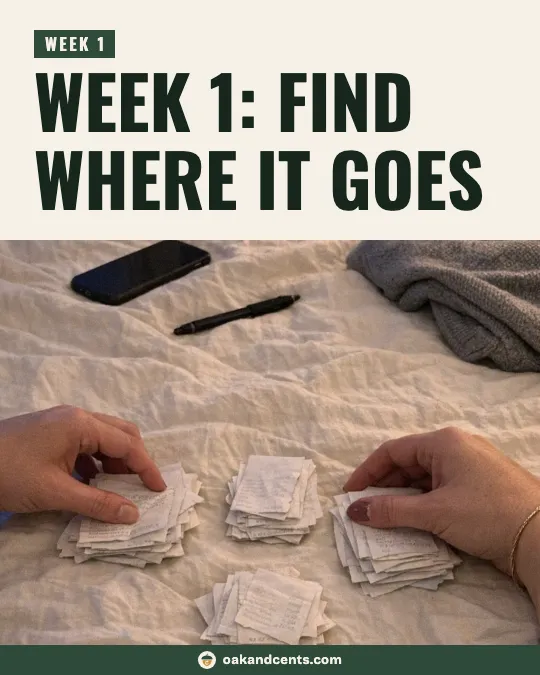
It’s Sunday night, and you open your banking app with a small knot in your stomach. That feeling is normal. Plenty of people put this part off.
Week 1 isn’t about judging what you spent. It’s only about seeing it.
Look through the last 30 days of your bank and card statements. Sort each charge into one of three groups: must pay, could trim and forgot about it.
You don’t need a spreadsheet. A sheet of paper with three columns works fine.
Try this: Spend three minutes circling every charge under $20. Small charges are where forgotten subscriptions and quick stops tend to hide.
In the made up example, this week turns up two subscriptions nobody uses. Cancelling them saves $25 this month.
Once you can see the leaks, they’re much easier to close.
Week 2: Cut the Easy Leaks First
With the leaks in view, week 2 is for closing the easy ones. Not the hard ones. The easy ones.
Starting with the hardest cut is how a lot of sprints stall. Easy wins build a little momentum.
Here are good places to look:
- Takeout and delivery: keep two or three backup dinners in the pantry for busy nights.
- Quick store stops: make one planned grocery trip a week instead.
- Monthly bills: call about a cheaper internet or phone plan.
- Little daily buys: the coffee run, the vending machine, the app store.
That doesn’t mean never buying a coffee again. Pick two or three leaks for these 30 days and leave the rest alone.
For more ideas, see our grocery habits that add up and our guide to lowering your monthly bills.
In the example, two takeout nights become backup dinners and save $30.
Small cuts you barely notice add up faster than big ones you resent.
Week 3: Bring In a Little Extra Money
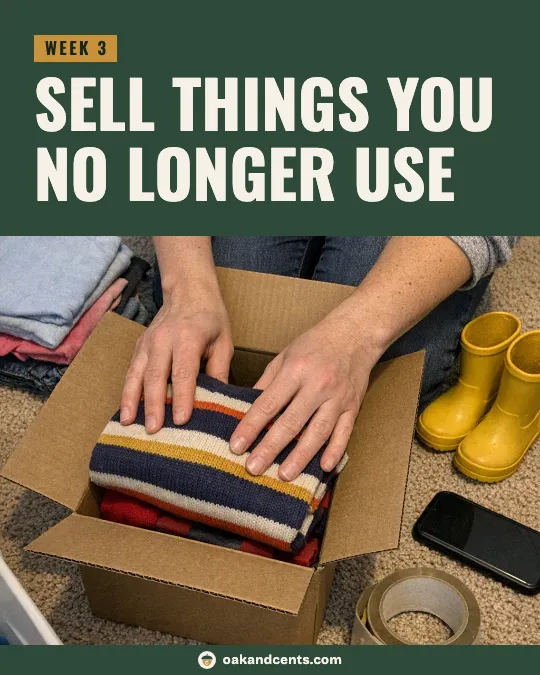
By week 3, the spending side is quieter. Now look at the other side: a little extra coming in.
This isn’t about taking on a second job. It’s about money that’s already close by.
Walk through one room and look for things you no longer use: outgrown kids’ clothes, a stroller, a lamp, a game console, spare tools. Selling a few of them locally or online can add up quickly.
Return anything that still has tags and is inside the return window.
Then check for money that’s already yours. State governments hold most unclaimed money, from sources like old bank accounts and insurance policies, and you can search your state’s list, USAGov explains.
If you have the time and energy, an extra shift or a small side hustle can help. It’s optional.
In the example, selling a few things brings in $60.
Extra money works hardest when it goes straight to the target.
Week 4: Lock the Savings In Before Payday Can Spend It
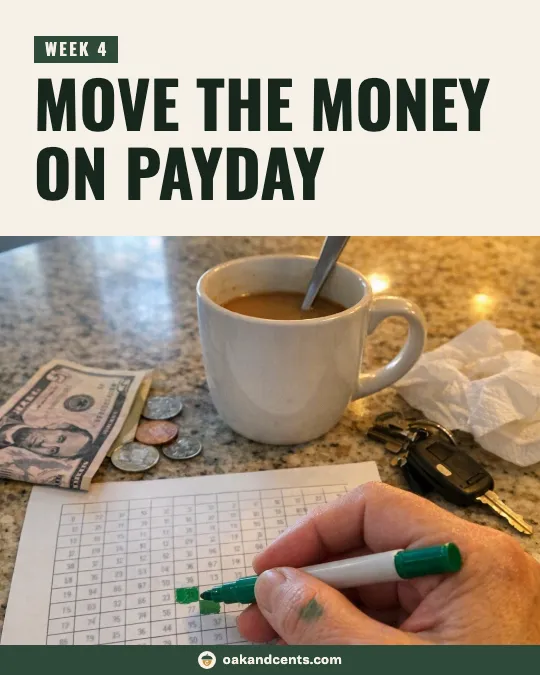
The last week is about keeping what you saved, and making the habit outlast the sprint.
The biggest risk now isn’t one big purchase. It’s the money slowly drifting back into everyday spending.
So move money first. On payday, transfer your savings amount before you spend on anything that isn’t a bill. If your bank offers automatic transfers, set one for payday.
This is a good week for a no spend weekend: nothing beyond groceries from your list and gas. The free no spend tracker on this page makes it easy to mark the days.
Keep the daily habit going, too. The $5 a day chart on this page has 30 boxes, one for each day, and they add up to $150. Color one in each time you set the money aside.
In the example, the no spend weekend and one planned grocery trip save $35.
If the weekend goes well, a full no spend month could be a good next step.
When day 30 arrives, don’t stop cold. Keep the $5 a day going, or turn it into one small transfer every payday. The second month is often easier, because the habits are already in place.
Give yourself credit for the days you kept, too. Every box you colored is money that’s still there.
Saving that happens on its own doesn’t depend on willpower.
Make the 30 Days Fit Your Kind of Month
Not every month starts on the 1st with a steady paycheck. The sprint can bend to fit yours.
- Paid every two weeks: split the target across the paydays in your 30 days. Two paydays and $300 means $150 from each.
- Paid once a month: move the full savings amount on payday, then let the weekly steps add to it.
- Tips or gig work: save a set share of every deposit, like $10 of every $100, so slow weeks don’t break the plan.
- A surprise bill mid sprint: pay it, then pick up where you left off. The sprint pauses. It doesn’t fail.
- A refund or a gift: send it straight to the target and finish early.
If you budget by paycheck, add savings as its own line right after the bills.
The plan that fits your pay is the one that works.
Skip the Fast Money That Costs More Later
When you need money quickly, some options look like shortcuts. A few of them cost far more than they save.
Being tempted doesn’t mean you’re doing anything wrong. These offers tend to show up right when money feels tightest.
Here are four swaps to keep in mind:
- A payday loan. Instead, sell something or ask the company you owe for a payment plan.
- Skipping a minimum payment. Instead, pause any extra payments for 30 days and keep every minimum on time.
- Buy now, pay later for everyday things. Instead, wait until the money is saved. It’s still a loan with its own due dates.
- Overdrafting to cover a gap. Instead, check your bank’s overdraft setting and ask to move a due date to after payday.
A payday loan is usually a short, high cost loan due on your next payday.
A typical two week loan with a $15 fee per $100 works out to an APR, the yearly interest rate, of almost 400%, the CFPB explains.
Your plan in one line: one target, one separate place, one focus a week and $5 a day.
Fast savings should leave you with more options next month, not fewer.
If Money Is Already Too Tight to Save
Some months, there’s nothing left after rent, food and the minimum payments. If that’s this month, you haven’t failed. The sprint can wait.
A 30 day sprint works best when there’s a paycheck coming in and a little room after the bills, even if it’s only $5 a day.
It’s not the right first step if rent, utilities or a card payment is already past due, or if a debt has gone to collections. Those come first.
Reaching out to a nonprofit credit counselor through the National Foundation for Credit Counseling can help you sort out what to pay first this month.
Taking care of this month’s essentials is a plan, too.
Start Your 30 Days Tonight
If the urge to cut everything at once creeps back in, you can let it pass. One target and one week at a time is easier to keep.
Tonight, write down one target number and decide where the money will live. Then print the $5 a day chart and color in day one.
Tomorrow, open your statements and start week 1.
If the money is headed for a debt, the debt payoff calculator can show how much an extra $300 moves your payoff date.
Thirty days, one week at a time. Day one can start tonight.