The deposit notification pings on Friday morning, and for a few hours the checking balance looks roomy. By Tuesday, it has been through the gas pump, the grocery store and a field trip form.
You’d like to keep a little of it this time. You also know next week’s bills won’t wait for good intentions. Wanting both is reasonable, and it’s the spot where one small, repeatable habit helps most.
The biweekly savings challenge asks for one move: $20 every payday, 26 times. Color a box each time, and the free chart on this page adds up to $520 in a year.
How the Biweekly Savings Challenge Works
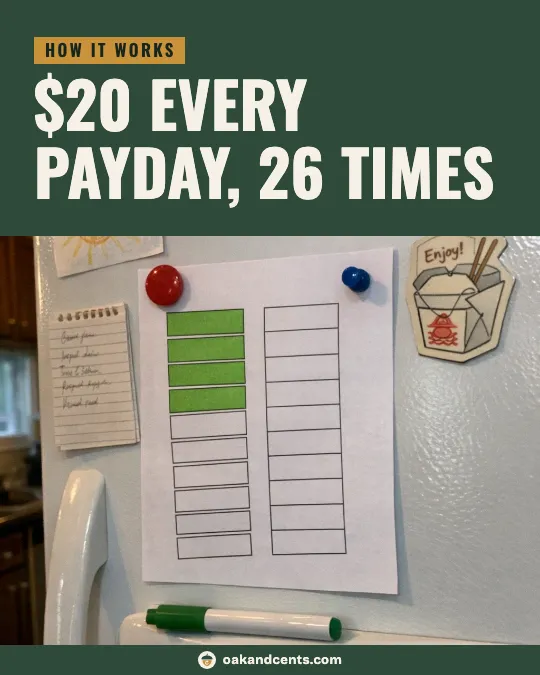
Pay that arrives every other week means 26 paydays a year. This challenge gives each one a single job.
On every payday, you move $20 into savings. Then you write the date on the chart and color that payday’s box.
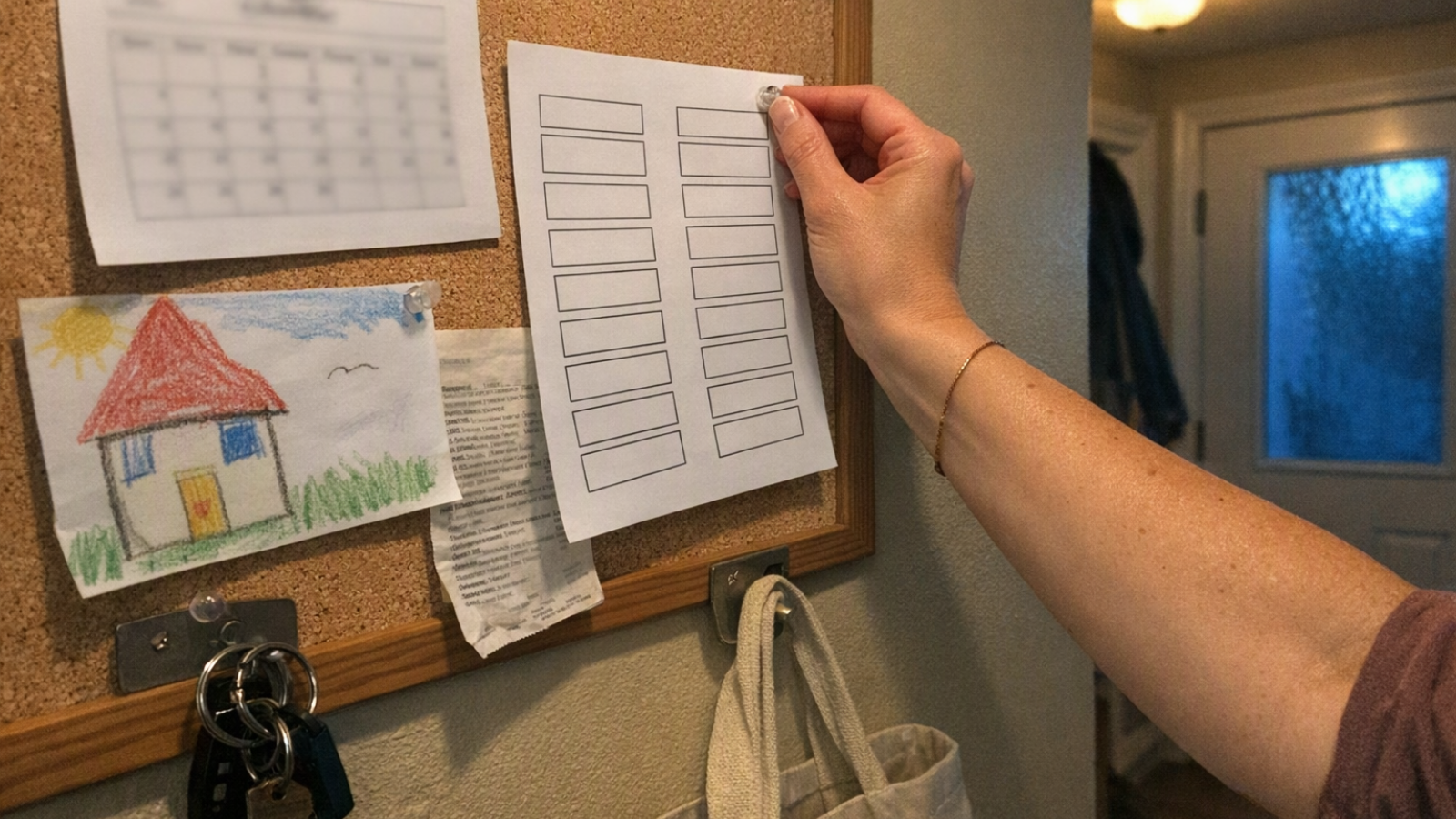
The free Biweekly Payday Challenge chart has 26 boxes in two columns, from Payday 1 to Payday 26.
Each box has a line for the date, the $20 and a small running total. So Payday 10 reads $200, and Payday 26 reads $520.
At the top there’s a line for what you’re saving for and your start date. At the bottom there’s a line for the day you finish.
That’s the whole challenge. No envelopes to buy, no amounts that grow every week, no math on the fly.
You can start on any payday, too. October works just as well as January.
Paid weekly instead? Color one box each week and it becomes a 26 week savings challenge, with $520 in about six months.
If you’d like to compare this chart with the others we offer, our list of savings challenge ideas puts ten of them side by side.
One payday, one box, one $20. That’s the rhythm.
Write All 26 Dates Before Your First Transfer
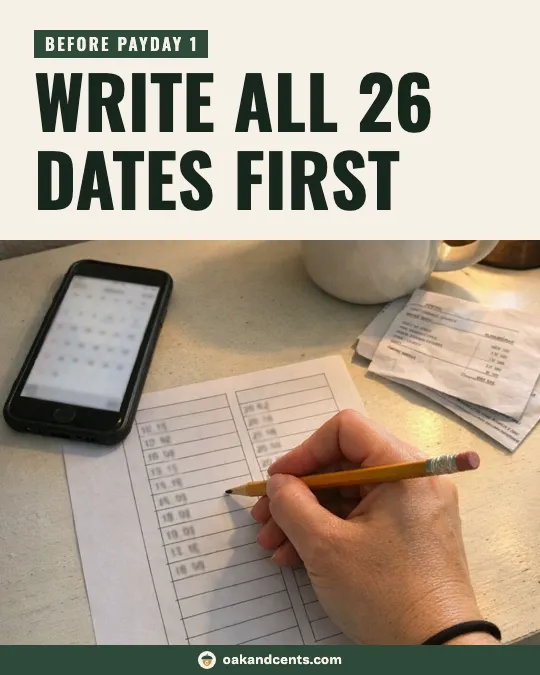
Before you move a single dollar, take ten minutes with the chart and your calendar.
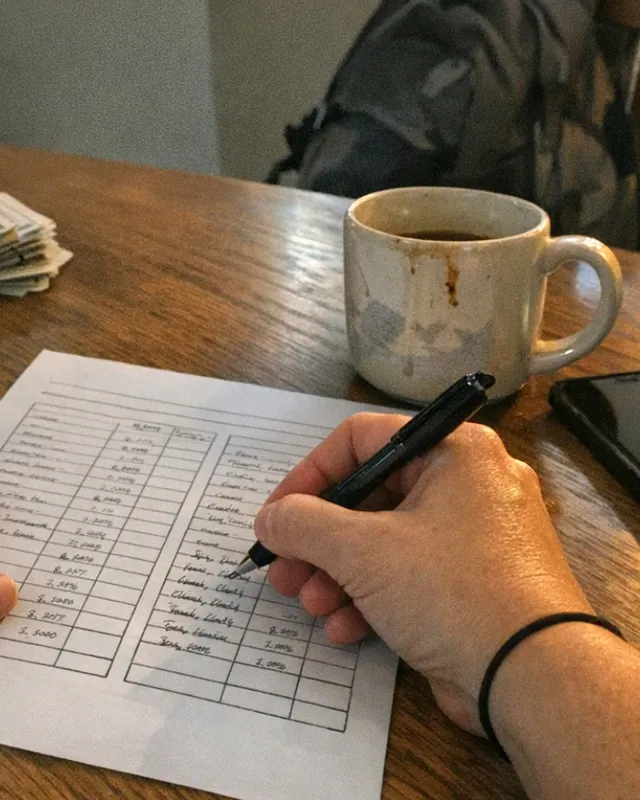
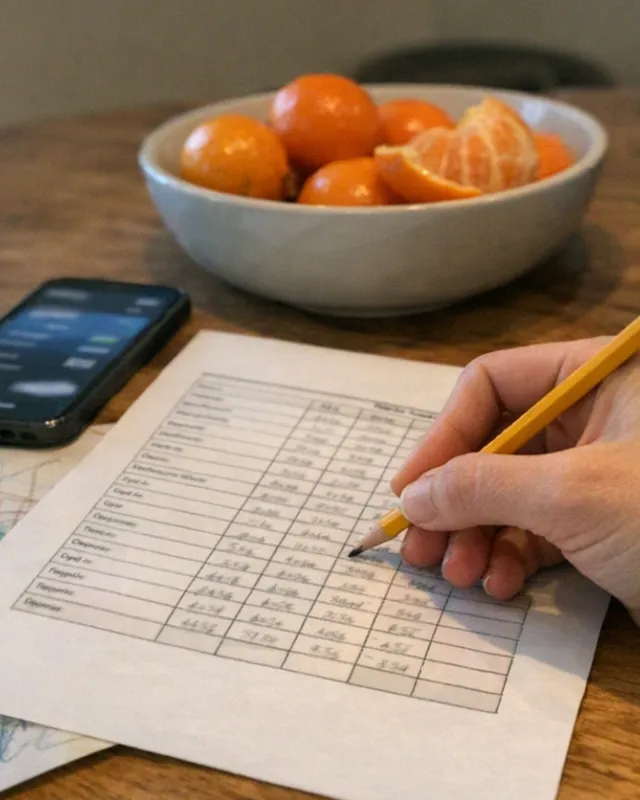
Write your next payday on the Payday 1 line. Then count forward two weeks at a time and fill in every line down to Payday 26.
It sounds like a small thing, but seeing the whole year on one page changes how the challenge feels. The finish line stops being vague.
Here’s a made up schedule. Say your first payday is Friday, October 23, 2026. Payday 13, the halfway mark at $260, falls on April 9, 2027. Payday 26 lands on October 8, 2027.
While you’re writing, watch for the months with three paydays. With pay every two weeks, most years have two of them. In this example, they’re January and July 2027.
Circle those. They’re your easy months, because bills are usually planned around two paychecks. There’s also a spot to list them on the Biweekly Paycheck Budget printable from this page.
Also put a small dot next to any payday that lands in a heavy week, like the one before rent or a birthday. You’ll know it’s coming instead of being surprised by it.
Try this: Write the finish date in the “Finished on” spot in pencil now. It’s a quiet promise to your future self, and you can trace over it in pen on the day.
A chart with every date filled in is a plan, not a hope.
Pick $20, $40 or an Amount That Fits
The chart prints $20 in every box, and $20 is a good place to start. It’s small enough for most paychecks and big enough to add up.
Still, your amount can be different. The math stays simple because there are always 26 paydays.
| Saved each payday | After 26 paydays |
|---|---|
| $10 | $260 |
| $20 | $520 |
| $30 | $780 |
| $40 | $1,040 |
| $50 | $1,300 |
At $40, just double each running total on the chart, which matches the tip printed on it. At $10, cut each total in half.
To choose, think about your heaviest payday of the year, the one that also covers rent and the car insurance. What could you still move that day without feeling squeezed? Start there.
If you and a partner both get paid, you could each fill a chart.
Say this: “What if we each moved $20 on payday and colored our own chart? By next fall we’d have $1,040 together, and it’s only $20 each time.”
You can always raise it later. A box colored at $20 still counts more than a box skipped at $40.
Pair Every Transfer With One Colored Box
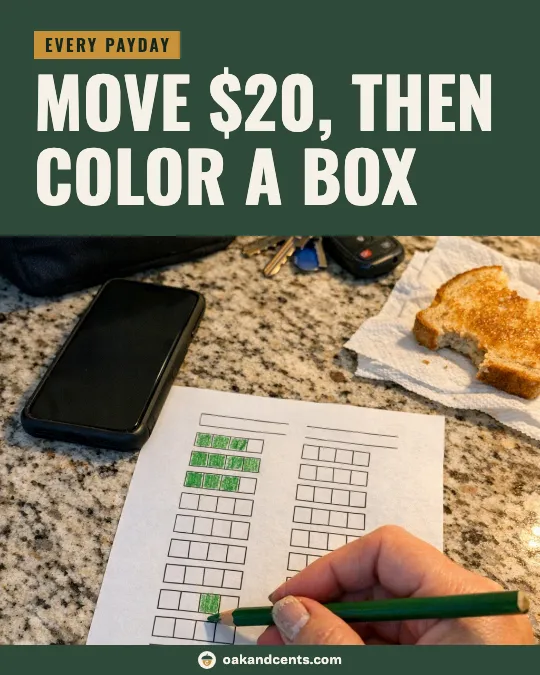
The transfer is what saves the money. The colored box is what keeps you coming back.
So tie them together. On payday morning, move the $20, then color the box right away, before you put the phone down.
Moving the money first matters. Money that sits in checking until Thursday tends to become gas, groceries and the lunch account.
If your bank lets you schedule a transfer every other Friday, set it once and let it run. Then the only job left on payday is picking up the marker.
Hang the chart where your eyes already go: the fridge, the inside of the pantry door, next to the coffee maker.
Some people like to make it a tiny ritual. Same marker, same spot, maybe the first sip of coffee while they color.
Somewhere in the middle of the chart, the novelty can wear off. That’s normal, and it’s where the chart earns its place. Look back at the column of colored boxes and notice how far it already reaches.
The money does the saving. The box does the remembering.
Give the $520 a Name Before Payday 1
There’s a line at the top of the chart that says “Saving for.” Filling it in might be the most useful thing you do all year.
Money without a name is easy to borrow back. Money with a name tends to stay put.
Here are a few names that fit $520 well:
- The first half of a starter emergency fund. A starter emergency fund is often $1,000, and two charts at $20, or one at $40, get you there.
- Next year’s holidays. Starting in October gives you a full year, and our Christmas on a budget guide shows how to split the money once it’s there.
- A bill you know is coming. Car registration, a yearly subscription or back to school. Our guide to sinking funds explains how to save for costs like these.
- A cushion while you pay off a card. A little set aside means a flat tire doesn’t automatically go on the card you’re paying down.
Pick one name per chart. If you have two goals, print two charts.
A name on the top line turns $20 into something you’re protecting.
When a Payday Can’t Spare $20
Sometimes payday arrives right after the car needed a new battery, and $20 just isn’t there. It happens, especially on a chart that runs a whole year.
What matters is what you do with the empty box. Quitting is the only move that actually breaks the challenge.
Here are three ways to handle it:
- Split it. Add $10 to each of the next two paydays. Two boxes at $30 cover the missed one.
- Move it to the end. Leave the box blank and add one more payday after Payday 26. You finish two weeks later, with the same $520.
- Catch up in a third paycheck month. Those months tend to have more breathing room, so they’re a good time to fill in a blank box or two.
Pencil a small arrow in the blank box so you remember which fix you chose.
Every so often, the calendar gives some people a 27th payday in a year. If that happens to you, it’s a free catch up box.
A blank box with a plan is still part of a finished chart.
What to Do After Payday 26
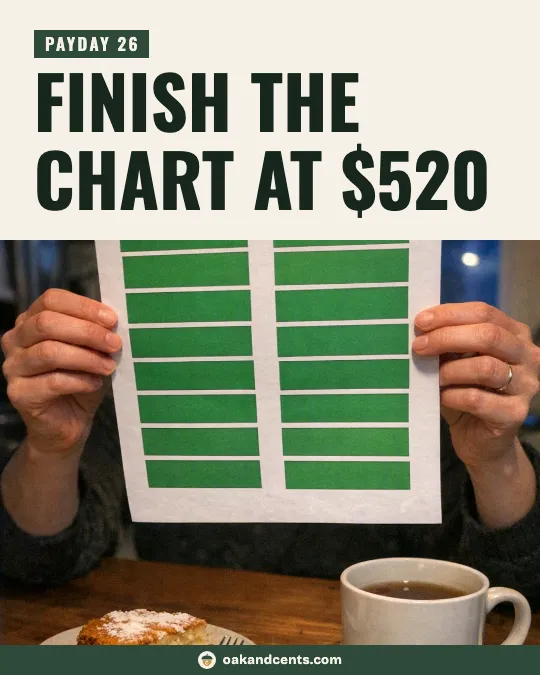
The last box gets colored, and you write the date on the “Finished on” line. Take a moment with that one.
Twenty six small moves, and now there’s $520 that wasn’t there a year ago.
Celebrate in a way that doesn’t undo it: a favorite dinner at home, a walk somewhere pretty, a photo of the full chart.
Then decide what’s next. A few easy paths:
- Go again at $40. Print a fresh chart and double the totals. That’s $1,040 by the next finish line.
- Try a bigger chart. The 52 week savings challenge is a natural follow up if you like coloring boxes.
- Keep the transfer and drop the chart. If the habit feels automatic now, let the same $20 keep flowing into an emergency fund. Our guide to building an emergency fund on a regular paycheck shows how to grow it from here.
Your plan in one line: one $20 transfer + one colored box + every payday, for 26 paydays.
The chart ends at 26. The habit doesn’t have to.
If Bills Have to Come First Right Now
Some seasons don’t have $20 to spare, or even $10. If that’s this season, the chart can wait.
Rent, the power bill, groceries and every minimum payment come before any savings challenge. If any of those are already past due, catching up is the more important job.
When it’s hard to tell which bill comes first, a nonprofit credit counselor can walk through them with you. You can look for one through the NFCC, which connects people with member agencies.
When things steady, the chart will be right where you left it.
Write Payday 1 on the Chart Tonight
That Friday notification will ping again soon. This time, $20 of it can have somewhere to go before the week gets to it.
Tonight, print the free chart and write your next payday on the Payday 1 line. Then fill in the other 25 dates and write your goal at the top.
On payday morning, move the $20 and color the first box.
If you’re working on a card balance too, the free debt tracker can sit right next to the chart. Two kinds of progress, side by side.
One box at a time, 26 times. That’s how $520 shows up.